Technology · NASDAQ: PANW
Palo Alto Networks: how the business works
Palo Alto Networks sells firewalls, security software subscriptions and support that protect organizations' networks, clouds and logins from hackers, with revenue of $11.5 billion in FY2026.
By Hardik Bhandare · Checked against filings: . Editorial policy. Corrections
Follow Palo Alto Networks
Email me when Palo Alto Networks's page is updated after earnings.
We'll send a confirmation email first. See our privacy policy.
Palo Alto Networks, Inc. · Santa Clara, California · Founded 2005
Updated for Q4 FY2026 · checked
- Revenue, FY2026
- $11.5B
- Net income, FY2026
- $307M
- Subscriptions and support, share of FY2026 revenue
- 80.1%
- Cash from operations, FY2026
- $4,553M
- Employees, Jul 31, 2026
- 21,921
The short version
Palo Alto Networks in 5 points
1 · What it sells
Palo Alto Networks sells firewalls, security software subscriptions and support that protect organizations' networks, clouds and logins from hackers, with revenue of $11.5 billion in FY2026.
2 · Who pays it
In FY2026 customers in the United States paid 61.9% of Palo Alto Networks' revenue, Europe, the Middle East and Africa 21.1%, Asia-Pacific and Japan 12.0% and the rest of the Americas 5.0%.
3 · What it keeps from $100
Of every $100 of FY2026 revenue Palo Alto Networks kept $2.7 as net income, after a $562 million net fair-value loss on convertible notes and capped calls, while its operating income was $695 million.
4 · Where the operating profit comes from
Palo Alto Networks reports one segment and no profit by product, but subscriptions and support made up 80.1% of FY2026 revenue and gross profit was $70.4 of every $100 of revenue.
5 · The one thing to watch
In FY2026 CyberArk and Chronosphere added $930 million of revenue and an operating loss of $797 million after Palo Alto Networks bought them, against total operating income of $695 million.
Sources: From Palo Alto Networks' FY2026 10-K · checked
See the full receipt and the management scorecard below
01Where the money goes · FY2026
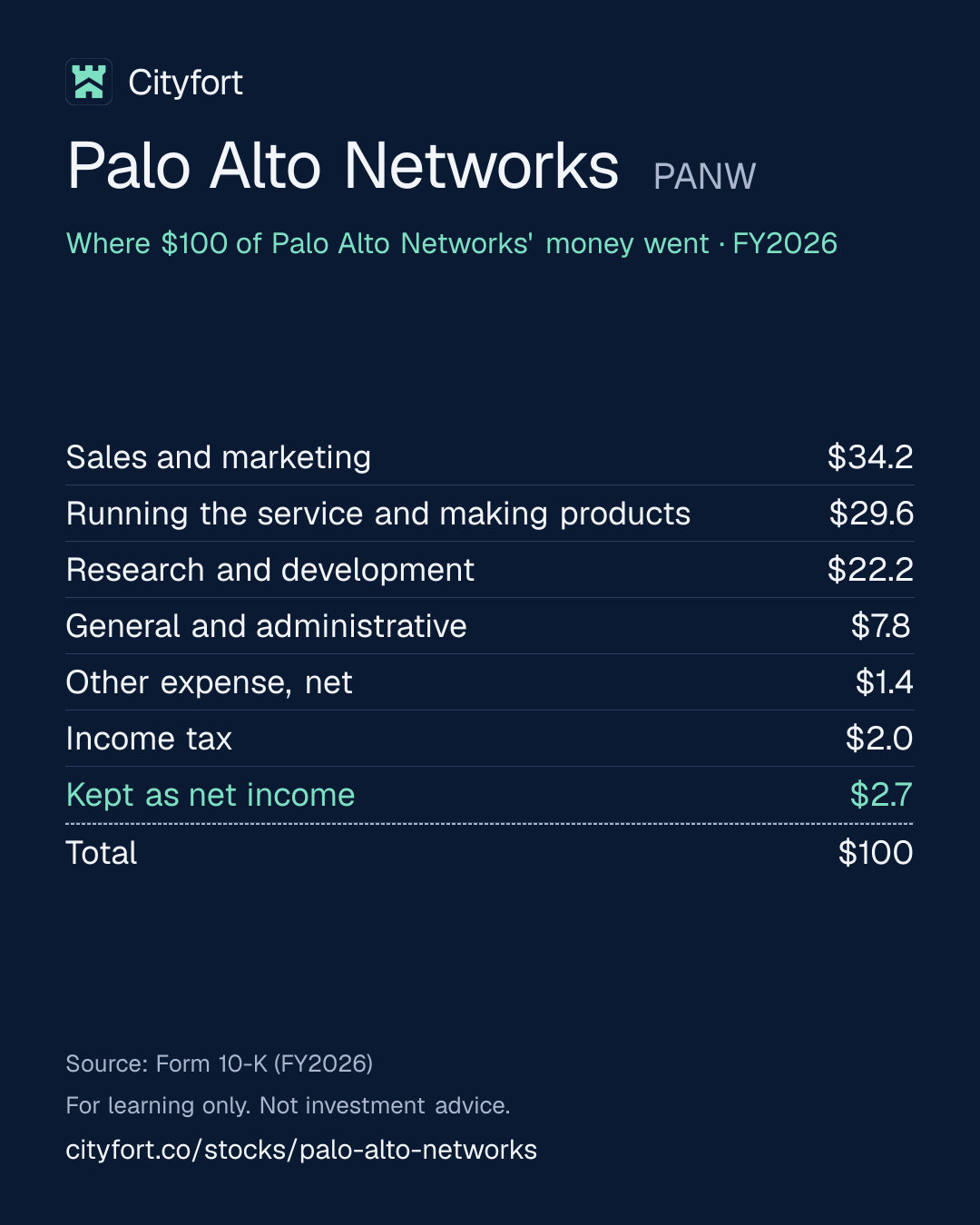
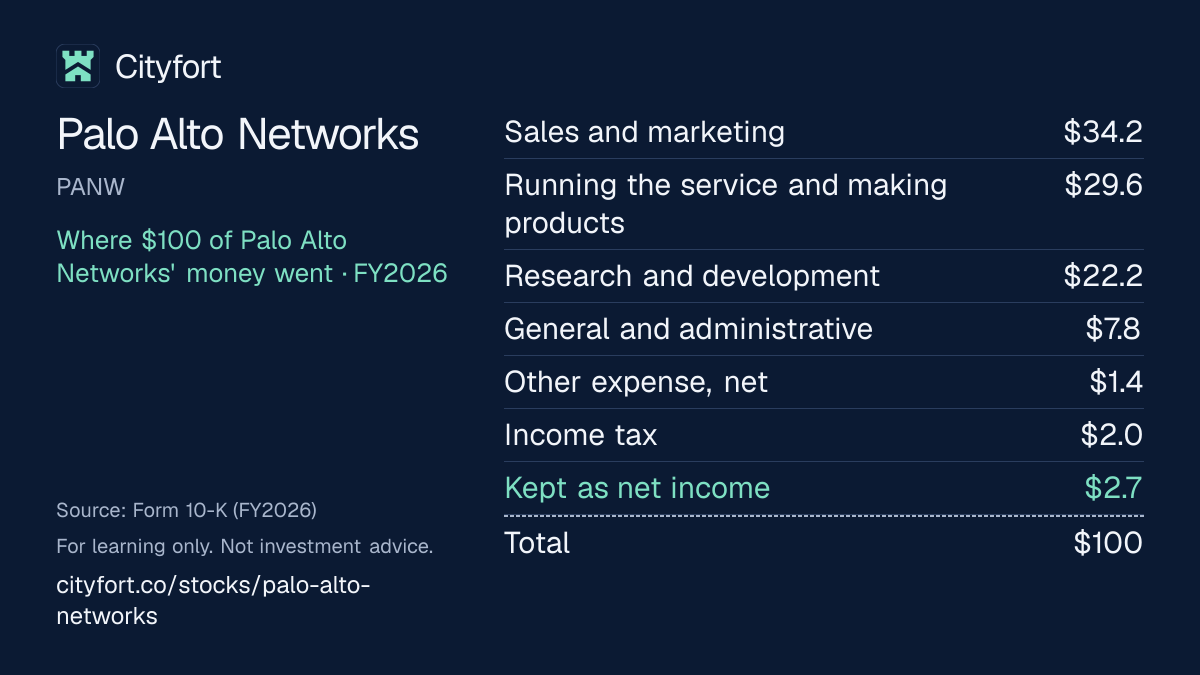
Where does $100 of Palo Alto Networks' money go?
Palo Alto Networks · FY2026
Receipt for every $100
| Sales and marketing | $34.2 |
|---|---|
| Running the service and making products | $29.6 |
| Research and development | $22.2 |
| General and administrative | $7.8 |
| Other expense, net | $1.4 |
| Income tax | $2.0 |
| Kept as net income | $2.7 |
| Total | $100 |
Each line = amount ÷ total money in × 100. Lines may not add to exactly $100 because of rounding.
How this is worked out
Cityfort calculation from the FY2026 10-K. Of every $100 of revenue in FY2026 ($11,480 million; other income and expense was a net expense, so it is a cost line here). The lines are rounded, so they add up to $99.9. Stock-based pay ($1,774 million) sits inside the cost lines. Measured the same way, operating income was $6.05 per $100.
Save this receipt as an image:
1080 × 1350 PNG for Instagram, LinkedIn1200 × 675 PNG for X
Embed this receipt
Paste this code into a blog or website to show the receipt, with a link back to this page:
Each week: one company explained in 5 points, picked by earnings date.
Free, no tips, unsubscribe anytime.
We'll send a confirmation email. See our privacy policy.
02The business in one line
What does Palo Alto Networks do?
Organizations pay Palo Alto Networks for firewalls and, mostly, for security subscriptions and support; most of the money goes on sales, running the service and engineers, and in FY2026 $2.7 of every $100 was left as net income.
- Subscriptions and support were 80.1% of Palo Alto Networks' $11,480 million of revenue in FY2026; firewalls and software licenses were the other 19.9%.
- Of every $100 that came in during FY2026, $34.2 went on sales and marketing, $29.6 on running the service and making products, and $22.2 on research and development.
03Who pays it
Who pays Palo Alto Networks?
Organizations paying for subscriptions
54%
of revenue
Yearly fees for cloud-delivered security, security operations, cloud security and, since 2026, identity security and observability: $6,239 million, 54.3% of FY2026 revenue.
Organizations paying for support
26%
of revenue
Security updates, upgrades, bug fixes and repairs, usually bought with firewalls: $2,961 million, 25.8% of FY2026 revenue.
Organizations buying products
20%
of revenue
Firewall hardware and software licenses: $2,280 million, 19.9% of FY2026 revenue.
- Organizations paying for subscriptions54%
- Organizations paying for support26%
- Organizations buying products20%
Customer concentration
Two distributors, not named, each accounted for 15% of Palo Alto Networks' FY2026 revenue, 30% together, and one distributor was 19% of gross accounts receivable at Jul 31, 2026. Distributors resell to end customers; no end customer was 10% or more of revenue in FY2024, FY2025 or FY2026.
- Largest customer
- 15%
04Why it makes money
Why does Palo Alto Networks make money?
Subscriptions and support renew year after year and are billed ahead, so cash comes in well before profit shows.
Deferred revenue, amounts billed before the service is delivered, was $14,756 million at Jul 31, 2026. Cash from operations was $4,553 million in FY2026, against net income of $307 million. Stock-based payPay given as shares instead of cash, which spreads ownership more thinly. Learn more of $1,774 million, a cost paid in shares, and acquisition amortization explain much of the gap.
Subscriptions and support per $100 of revenue
$75.2$80.1
FY2022 to FY2026
- A customer installs firewalls or software
- It adds security subscriptions on top
- Support and subscriptions renew each term
- Billing ahead brings in cash before revenue is booked
- Cash pays for engineers, sales and acquisitions
- New platforms are sold to the same customers
↺ Step 6 feeds back into step 1.
05The numbers · Consolidated · US$
How has Palo Alto Networks done?
Revenue
$11.5BFY2026
Revenue grew every year, from $5,501.5 million in FY2022 to $11,480 million in FY2026, and rose 34% in Q4 FY2026 as stated, a rise that includes CyberArk and Chronosphere, which added $930 million in FY2026.
US$
See the numbers
Net profit
$307MFY2026
Net income fell to $307 million in FY2026 from $1,134 million, after a $562 million net fair-value loss on convertible notes and capped calls, while FY2024's $2,578 million included a $1,590 million tax benefit; EPS is adjusted for the December 2024 2-for-1 split (FY2022 is a Cityfort calculation from the FY2024 10-K).
US$
See the numbers
Profit kept per $100 of revenue
$2.7FY2026
Gross profit was $70.4 per $100 of revenue in FY2026 and operating income $6.05 per $100, after stock-based pay of $1,774 million, or 15.5% of revenue and 5.8 times net income.
$ of profit per $100 of revenue (net margin)
See the numbers
Free cash flow
$4.1BFY2026
Free cash flow (cash from operations minus purchases of property, equipment and other assets) was $4,113 million in FY2026, far above net income because $1,774 million of stock-based pay and $855 million of depreciation and amortization cost no cash.
US$ · cash from operations minus spending on plants and equipment
See the numbers
See all yearly numbers
EBITDA here = operating income plus depreciation and amortization (from the cash flow statement). Fiscal years are the company's own (July 31 (FY2026 = year ended Jul 31, 2026)). Net profit is the share belonging to the company's owners.
Download Palo Alto Networks's yearly and quarterly numbers (CSV, with source ids)
Learn: Fiscal years that don't end in December: Nvidia's FY2027 explained · Stock-based compensation and dilution: pay that becomes shares
Sources (11)
- Form 10-K, fiscal year 2024 (ended July 31, 2024)
- Form 10-K, fiscal year 2025 (ended July 31, 2025)
- Form 10-K, fiscal year 2026 (ended July 31, 2026)
- Q1 fiscal 2025 earnings release (Form 8-K, Exhibit 99.1)
- Q1 fiscal 2026 earnings release (Form 8-K, Exhibit 99.1)
- Q2 fiscal 2025 earnings release (Form 8-K, Exhibit 99.1)
- Q3 fiscal 2025 earnings release (Form 8-K, Exhibit 99.1)
- Q4 and fiscal year 2025 earnings release (Form 8-K, Exhibit 99.1)
- Q2 fiscal 2026 earnings release (Form 8-K, Exhibit 99.1)
- Q3 fiscal 2026 earnings release (Form 8-K, Exhibit 99.1)
- Q4 and fiscal year 2026 earnings release (Form 8-K, Exhibit 99.1)
06Who runs it
Who runs Palo Alto Networks, and did they deliver?
Nikesh Arora
Chair and CEO · since 2018
Chair and CEO since June 2018; earlier an adviser to SoftBank Group. FY2026 total pay was $80,270,519, about 308 times the median employee's $260,431.
Dipak Golechha
Chief Financial Officer · since 2021
CFO since March 2021; joined in December 2020.
William "BJ" Jenkins
President · since 2021
President since August 2021; previously CEO of Barracuda Networks.
Lee Klarich
Chief Product and Technology Officer and director · since 2025
With the company since 2006; named Chief Product and Technology Officer and a director on Aug 14, 2025, when founder and CTO Nir Zuk resigned.
What they said, and what happened
3 delivered · 2 too early to tell
Said on Aug 18, 2025
Palo Alto Networks targeted FY2026 revenue of $10.475–10.525 billion, up about 14%.
DeliveredWhat happened
Revenue was $11,480 million, up 24%. The range was given before CyberArk and Chronosphere were bought; they added $930 million.
Said on Aug 18, 2025
Palo Alto Networks targeted Next-Generation Security ARR of $7.00–7.10 billion at the end of FY2026.
DeliveredWhat happened
It reported $9.10 billion, including the acquired businesses, which the range did not.
Said on Aug 18, 2025
Palo Alto Networks targeted a FY2026 non-GAAPThe company's own "adjusted" numbers, not the official (GAAP) ones. Always read them next to the official figure. Learn more operating margin of 29.2–29.7% and non-GAAP EPS of $3.75–3.85.
DeliveredWhat happened
Non-GAAP EPS was $3.84 and the non-GAAP operating margin 29.2% ($3,356 million ÷ $11,480 million, Cityfort calculation from the Q4 FY2026 earnings release), at the low end. The GAAP operating margin was 6.1%.
Said on Sep 1, 2026
Palo Alto Networks targeted FY2027 revenue of $14.10–14.20 billion and Q1 FY2027 revenue of $3.300–3.310 billion.
Too early to tellWhat happened
Q1 FY2027 ended Oct 31, 2026; results were not out in the documents read.
Said on Sep 1, 2026
CEO Nikesh Arora referred to a target of $20 billion of Next-Generation Security ARR in FY2030.
Too early to tellWhat happened
Next-Generation Security ARR was $9.10 billion at Jul 31, 2026.
Sources (5)
- Definitive proxy statement (DEF 14A) for the 2026 annual meeting
- Form 8-K filed Aug 18, 2025 (Item 5.02: founder and CTO Nir Zuk resigns; Lee Klarich named Chief Product and Technology Officer and director)
- Q4 and fiscal year 2025 earnings release (Form 8-K, Exhibit 99.1)
- Q4 and fiscal year 2026 earnings release (Form 8-K, Exhibit 99.1)
- Form 10-K, fiscal year 2026 (ended July 31, 2026)
07What could go wrong
What could go wrong for Palo Alto Networks?
- Concentration
Two distributors handle 30% of revenue
Two unnamed distributors each accounted for 15% of FY2026 revenue, and one was 19% of gross accounts receivable. The 10-K lists reliance on channel partners as a risk.
Watch Distributor shares of revenue in the next 10-K.
- Execution
Absorbing CyberArk
CyberArk cost $21,061 million, mostly in Palo Alto Networks shares. Goodwill reached $22,010 million and acquired intangibles $7,017 million. CyberArk and Chronosphere had an operating loss of $797 million in FY2026 after their purchase.
Watch Impairment charges and the GAAP operating margin each quarter.
- Debt
Convertible notes at fair value
The 2030 notes, about $1.1 billion of principal, are carried at fair value, $1,774 million at Jul 31, 2026. Changes in that value go through net income: a $562 million net loss with the capped calls in FY2026.
Watch The fair-value line in other income (expense) each quarter.
- Competition
Competition, including from cloud providers
The 10-K describes intense competition, including from cloud providers and AI companies that build security and observability into their own services.
Watch Revenue and Next-Generation Security ARR against the company's stated ranges.
- Other
Stock-based pay and dilution
Stock-based pay was $1,774 million in FY2026, 15.5% of revenue and 5.8 times net income. Diluted shares rose from 709 million in FY2025 to 764 million in FY2026; about 112 million shares were issued for CyberArk in February 2026.
Watch Diluted share count and stock-based pay in each 10-Q.
- Legal
Centripetal patent judgment
A $114 million judgment from October 2024 is under appeal; Palo Alto Networks had accrued $151 million with estimated interest at Jul 31, 2026. Related Centripetal cases are pending in Europe.
Watch Appeal rulings in the legal note of each 10-Q.
- Other
Operations in Israel
Palo Alto Networks has employees and research work in Israel, more of them since CyberArk, and the 10-K lists conditions there as a risk.
Watch Risk factor updates in each 10-Q.
- Execution
Hardware supply
Firewall hardware comes from manufacturing partners and some limited-source parts. The 10-K says supply chain challenges raised product costs in FY2026.
Watch Product gross margin and supply comments in each 10-Q.
08Both sides
What do supporters and critics point to?
What supporters point to
- Revenue grew every year, from $5,501.5 million in FY2022 to $11,480 million in FY2026.
- Free cash flow was $4,113 million in FY2026, and cash exceeded debt by $6,132 million at Jul 31, 2026.
- Subscriptions and support were 80.1% of FY2026 revenue, and remaining performance obligations were $21.2 billion.
- Next-Generation Security ARR was $9.10 billion at Jul 31, 2026, above the $7.00–7.10 billion range set in August 2025, including acquisitions.
What critics point to
- Net income fell from $1,134 million in FY2025 to $307 million in FY2026, with net losses in Q3 and Q4 FY2026.
- Stock-based pay was $1,774 million in FY2026, 5.8 times net income.
- Goodwill and acquired intangibles reached $29,027 million at Jul 31, 2026, after CyberArk and Chronosphere.
- Two unnamed distributors accounted for 30% of FY2026 revenue.
- CEO pay was $80,270,519 in FY2026, about 308 times the median employee's.
09What to watch next
What should you watch next at Palo Alto Networks?
Next event
Q1 FY2027 results
Date not announced yet.
Revenue against the company's Q1 FY2027 range
Palo Alto Networks said on Sep 1, 2026 that it expects $3.300–3.310 billion. Q4 FY2026 revenue was $3,410 million.
The gap between GAAP and non-GAAP
In Q4 FY2026 GAAP operating income was $172 million and non-GAAP operating income $1,011 million.
The 2030 convertible notes at fair value
Carried at $1,774 million at Jul 31, 2026 against about $1.1 billion of principal; changes go through net income.
CyberArk and Chronosphere
Together they added $930 million of revenue and an operating loss of $797 million in FY2026 after their purchase.
10Key dates
What are the key dates for Palo Alto Networks?
| Event | Date | Source |
|---|---|---|
| Annual meeting of stockholders (2026 proxy statement)Virtual, 11:00 a.m. PT; holders of record on Oct 9, 2026 may vote. | Definitive proxy statement (DEF 14A) for the 2026 annual meeting | |
| Share repurchase authorization expires$1.0 billion remained at Jul 31, 2026. | Form 10-K, fiscal year 2026 (ended July 31, 2026) | |
| Fiscal 2027 endsThe Q1 FY2027 results date was not announced in the filings read, up to the Oct 27, 2026 proxy. | Form 10-K, fiscal year 2026 (ended July 31, 2026); EDGAR filing list, Palo Alto Networks, Inc. (CIK 0001327567) | |
| Revolving credit facility matures$400 million, undrawn at Jul 31, 2026. | Form 10-K, fiscal year 2026 (ended July 31, 2026) | |
| CEO's prepaid variable forward contract expected to settleOctober 2029, per the 2026 proxy statement. | Not yet stated | Definitive proxy statement (DEF 14A) for the 2026 annual meeting |
| 2030 convertible notes matureAbout $1.1 billion of principal remained at Jul 31, 2026. | Form 10-K, fiscal year 2026 (ended July 31, 2026) |
Learn: How to read a proxy statement (DEF 14A): Nvidia's 2026 proxy · Fiscal years that don't end in December: Nvidia's FY2027 explained
11Key facts
Key facts about Palo Alto Networks
- What does Palo Alto Networks do?
- Palo Alto Networks, Inc. sells cybersecurity products and subscriptions that protect organizations' networks, cloud systems, computers, AI apps and user identities from attacks. Palo Alto Networks had revenue of $11,480 million in FY2026 (year ended Jul 31, 2026) and 21,921 employees at that date.
- How does Palo Alto Networks make money?
- Palo Alto Networks makes most of its money from subscriptions ($6,239 million, 54.3% of FY2026 revenue) and support ($2,961 million, 25.8%). Product sales, mainly firewall hardware and software licenses, brought in $2,280 million, or 19.9%, of its $11,480 million of revenue in FY2026.
- What is Palo Alto Networks' business model?
- Palo Alto Networks sells firewalls and software, then adds subscriptions and support that renew over time. At Jul 31, 2026 Palo Alto Networks held $14,756 million of deferred revenue (billed but not yet earned) and $21.2 billion of remaining performance obligationsSigned contracts with customers that have not been billed yet., of which about $9.3 billion is expected to be recognized within 12 months.
- Is Palo Alto Networks profitable?
- Yes, on a full-year GAAP basis. Palo Alto Networks reported net income of $307 million and operating income of $695 million in FY2026, down from $1,134 million and $1,243 million in FY2025. It reported net losses of $177 million in Q3 FY2026 and $282 million in Q4 FY2026, after buying CyberArk and Chronosphere.
- What is Palo Alto Networks' revenue by segment?
- Palo Alto Networks reports one segment. By customer location in FY2026, Palo Alto Networks earned 61.9% of revenue in the United States, 21.1% in Europe, the Middle East and Africa, 12.0% in Asia-Pacific and Japan and 5.0% in the rest of the Americas.
- Who are Palo Alto Networks' customers?
- Palo Alto Networks sells to businesses and government bodies in over 180 countries, mostly through channel partners. Two distributors, not named in the FY2026 10-K, each accounted for 15% of Palo Alto Networks' FY2026 revenue; no end customer reached 10%.
- Who owns Palo Alto Networks?
- Palo Alto Networks' 2026 proxy statementThe yearly filing about shareholder votes, the board and executive pay. Learn more names Vanguard Capital Management with 7.4% (Schedule 13GA filing by anyone who owns more than 5% of a company's shares and does not seek control. Learn more filed Apr 30, 2026) and BlackRock with 6.0% (Schedule 13G/A filed Jan 26, 2024) as its largest holders. Palo Alto Networks' current directors and executive officers held under 1% on Sep 18, 2026.
- How much does Palo Alto Networks earn from subscriptions?
- Palo Alto Networks' subscription revenue was $6,239 million in FY2026, up from $4,974 million in FY2025. It covers cloud-delivered security services, security operations, cloud security and, after the 2026 acquisitions, identity security and observability.
- How much does Palo Alto Networks earn from support?
- Palo Alto Networks earned $2,961 million from support in FY2026, 25.8% of revenue, up from $2,445 million in FY2025. Customers buying its firewalls typically also buy support for security updates, upgrades, bug fixes and repairs.
- How much does Palo Alto Networks earn from firewalls and other products?
- Palo Alto Networks' product revenue, mainly next-generation firewall hardware and software licenses, was $2,280 million in FY2026, 19.9% of revenue, up from $1,802 million in FY2025.
Terms on this page
- Annual recurring revenue (ARR)
- Capital expenditures (capex)
- Customer concentration
- Debt-to-equity
- Earnings per share (EPS)
- EBITDA
- Free cash flow
- Market cap
- Net debt
- Net margin
Each explains the term in plain English, with the same number from other companies on Cityfort.
Go deeper
More detail from the same filings. Open any section.
12What it sells
12What it sells
What does Palo Alto Networks sell?
Next-generation firewalls (Strata)
Hardware and software firewalls that inspect an organization's network traffic and block attacks, in offices, data centers and clouds. Product revenue, mainly these, was $2,280 million in FY2026.
Prisma SASE and cloud-delivered security services
Security delivered from the cloud for remote workers and branch offices, plus add-on subscriptions such as threat prevention, web filtering and data loss prevention.
Prisma AIRS
Tools that find and protect a customer's AI agents, apps, models and data.
Cortex security operations and cloud security
Software that collects security data in one place to detect and respond to attacks (Cortex XSIAM, XDR), and Cortex Cloud, which secures applications running in public clouds.
Idira identity security (from CyberArk)
Controls who and what can log in to which systems, including privileged administrator accounts, machine identities and AI agents. Added with CyberArk in February 2026.
Chronosphere observability
Monitors cloud systems and applications in real time so customers can find and fix problems. Added with Chronosphere in January 2026.
Unit 42 services
Threat research, incident response after a breach, security consulting and managed detection and response.
What it does
- Does: Sells firewall hardware and software licenses, then subscriptions and support that renew
- Does: Sells mostly through channel partners, including distributors and resellers
- Does: Has customers in over 180 countries
- Does: Buys other security companies to add products (CyberArk and Chronosphere in FY2026)
What it does not do
- Does not: Does not pay a dividend
- Does not: Does not report revenue or profit by platform (it reports one segment)
- Does not: Does not make its own hardware: manufacturing partners build it
- Does not: Does not name the two distributors that each made up 15% of FY2026 revenue
13How the money flows
13How the money flows · FY2026
How does money flow through Palo Alto Networks?
Money in
- Subscriptions$6.2B
- Support$3.0B
- Products (firewalls and software licenses)$2.3B
The company
Palo Alto Networks
$11.5B came in
Money out
- Running the service and making products (cost of revenue)$3.4B
- Sales and marketing$3.9B
- Research and development$2.6B
- General and administrative$899M
- Other expense, net (incl. loss on convertible notes)$159M
- Income tax$229M
- Net income$307M
- Customers paid Palo Alto Networks $11,480 million in FY2026; $9,200 million of it was subscriptions and support.
- Running the service and making products cost $3,403 million, leaving gross profit of $8,077 million.
- Sales and marketing took $3,931 million, research and development $2,552 million, and general and administrative $899 million.
- That left operating income of $695 million. Other expense, net, was $159 million, after a $562 million net fair-value loss on the convertible notes and capped calls taken on with CyberArk.
- After $229 million of income tax, net income was $307 million.
14What it needs to run
14What it needs to run
What does Palo Alto Networks need to run?
Manufacturing partners
Firewall hardware is built by manufacturing partners, and some parts come from limited sources. The FY2026 10-K lists this supply chain as a risk.
People
21,921 employees at Jul 31, 2026, up from 16,068 a year earlier; about 4,223 joined with CyberArk.
Research and development
$2,552 million in FY2026, up from $1,417.7 million in FY2022.
Channel partners
Distributors and resellers sell most of its products; two distributors handled 30% of FY2026 revenue between them.
Operations in Israel
Palo Alto Networks has employees and research work in Israel, and $222 million of its long-lived assets were there at Jul 31, 2026. The 10-K lists conditions in Israel as a risk.
15Where it sells
15Where it sells · FY2026
Where does Palo Alto Networks sell?
- United States62%
- Europe, Middle East and Africa21%
- Asia-Pacific and Japan12%
- Other Americas5%
16Competitors and what protects it
16Competitors and what protects it
Who does Palo Alto Networks compete with?
Microsoft
NASDAQ: MSFT
Named in Palo Alto Networks' FY2026 10-K among large companies whose products include security or observability features.
Cisco
NASDAQ: CSCO
Named in Palo Alto Networks' FY2026 10-K among large companies whose products include security or observability features.
CrowdStrike
NASDAQ: CRWD
Named in Palo Alto Networks' FY2026 10-K among independent vendors that offer a mix of security products.
Fortinet
NASDAQ: FTNT
Named in Palo Alto Networks' FY2026 10-K among independent vendors that offer a mix of security products.
Datadog
NASDAQ: DDOG
Named in Palo Alto Networks' FY2026 10-K among vendors that offer a mix of observability products.
What protects the business
Each strength is scored 1 (weak) to 5 (strong) for the business, with the reason. It is not a rating of the share.
- Recurring revenue4 of 5
Subscriptions and support were 80.1% of FY2026 revenue, and remaining performance obligations were $21.2 billion at Jul 31, 2026.
- Breadth of products3 of 5
The 10-K describes network, cloud, security operations, identity and observability platforms, and the company's strategy of replacing customers' separate point products with them.
Weak spot
Two distributors
Two unnamed distributors each accounted for 15% of FY2026 revenue. The 10-K lists reliance on channel partners as a risk.
17Where growth could come from
17Where growth could come from
Where could Palo Alto Networks' growth come from?
Palo Alto Networks said on Sep 1, 2026 that it expects FY2027 revenue of $14.10–14.20 billion, up 23% to 24%, and Next-Generation Security ARR of $11.075–11.175 billion. For Q1 FY2027 it expects revenue of $3.300–3.310 billion. CEO Nikesh Arora referred to a "$20 billion FY30 NGS ARR target."
Next-Generation Security ARR
Working$9.10B, +63%
The company's measure of yearly recurring revenue from its newer platforms reached $9.10 billion at Jul 31, 2026, up 63% as stated. At Q3 FY2026, $1.6 billion of it came from CyberArk and Chronosphere.
Status: Working, on track against what the company said.
Subscriptions
Working$6,239M in FY2026
Subscription revenue grew from $4,974 million in FY2025 to $6,239 million in FY2026, according to the 10-K, including the acquired businesses.
Status: Working, on track against what the company said.
CyberArk and Chronosphere
New$930M revenue in FY2026
Since their purchase in early 2026 the two businesses added $930 million of revenue and an operating loss of $797 million in FY2026, including acquisition costs and amortization.
Status: New, recently announced.
Contracted revenue
WorkingRPO $21.2B
Remaining performance obligations, revenue under contract not yet recognized, rose from $15.8 billion at Jul 31, 2025 to $21.2 billion at Jul 31, 2026; about $9.3 billion is expected within 12 months. At Q3 FY2026, $1.8 billion came from the acquisitions.
Status: Working, on track against what the company said.
Status compares progress with what the company itself said it would do: Working = on track against what the company said; Mixed = partly on track; Behind = behind the company's own plan; New = recently announced; Early = too early to judge.
18The company's own measures (non-GAAP)
18The company's own measures · FY2026 and Q4 FY2026
What do Palo Alto Networks' own measures show?
Official (GAAP): Operating income, FY2026
$695M
Company's own measure: Non-GAAP operating income, FY2026
$3.4B
Palo Alto Networks leaves out stock-based pay and related charges ($1,712 million), amortization of acquired intangible assets ($638 million), acquisition costs ($295 million) and litigation charges.
Official (GAAP): Net income, FY2026
$307M
Company's own measure: Non-GAAP net income, FY2026
$2.9B
Also leaves out the $562 million net fair-value loss on the convertible notes and capped calls, and adjusts taxes.
Official (GAAP): Diluted EPS, FY2026
$0.40
Company's own measure: Non-GAAP diluted EPS, FY2026
$3.84
Non-GAAP net income per diluted share, leaving out the same items.
Official (GAAP): Operating income, Q4 FY2026
$172M
Company's own measure: Non-GAAP operating income, Q4 FY2026
$1.0B
The quarter included $281 million of amortization of acquired intangible assets, mostly from CyberArk and Chronosphere.
Official (GAAP): Net cash from operating activities, FY2026
$4.6B
Company's own measure: Adjusted free cash flow (company measure), FY2026
$4.4B
Cash from operations minus equipment purchases, with a $91 million headquarters land purchase, certain corporate assets, acquisition-cost payments and a litigation payment added back. This page's own free cash flowCash from operations minus spending on buildings and equipment. Learn more was $4,113 million.
Official (GAAP): Remaining performance obligations, Jul 31, 2026
$21.2B
Company's own measure: Next-Generation Security ARR, Jul 31, 2026
$9.1B
The company's yearly value of active contracts for its newer platforms at period end, leaving out hardware, older attached subscriptions, support and professional services. It is not revenue.
Official (GAAP): Revenue growth, Q4 FY2026
34.4%
Company's own measure: Next-Generation Security ARR growth, Q4 FY2026 (as stated)
63%
Both include CyberArk and Chronosphere, which were not in the year-earlier figures. The GAAP growth figure is a Cityfort calculation from the Q4 FY2025 and Q4 FY2026 earnings releases.
These are the company's own measures, defined by the company. They are not comparable across companies, and they are not added together. Each sits beside the nearest official (GAAP) figure.
Learn: Non-GAAP measures: what a company's "adjusted" numbers leave out · Stock-based compensation and dilution: pay that becomes shares
19Financial strength and debt
19Financial strength · Jul 31, 2026
How much debt does Palo Alto Networks have?
- Total debt$1.8B
- Cash and investments$7.9B
- Net cash (cash minus debt)$6.1B
- Net worth (shareholders' money)$27.5B
- Debt to equity
- 0.06×
- $ of debt for every $1 of shareholders' money
- Net cash is a Cityfort calculation from the FY2026 10-K: cash and cash equivalents ($2,514 million) plus short-term ($557 million) and long-term ($4,835 million) investments, minus the convertible notes at their carrying value.
- The only debt is CyberArk's 0.0% convertible notes due Jun 15, 2030, which Palo Alto Networks took on with the purchase. About $1.1 billion of principal remains, but the notes are carried at fair value, $1,774 million, so the figure moves with Palo Alto Networks' share price.
- A $400 million revolving credit facility, maturing Apr 13, 2028, was undrawn at Jul 31, 2026.
- Goodwill rose to $22,010 million and acquired intangible assets to $7,017 million at Jul 31, 2026, from $4,567 million and $763 million a year earlier, after the CyberArk and Chronosphere purchases.
- Deferred revenue, money billed but not yet earned, was $14,756 million at Jul 31, 2026.
- Interest cover is not shown: the FY2026 10-K reports no interest expense for FY2026 (the 2030 notes carry a 0.0% coupon). Operating lease liabilities ($726 million long-term) are not counted as debt here.
20Who owns it
20Who owns it · ownership as of Sep 18, 2026
Who owns Palo Alto Networks?
- Officers and directors (as a group), shares
- 0.6%
Share classes
Holders of 5% or more
From the company's proxy statement (DEF 14A), later Schedule 13G filings and the share counts on its latest annual or quarterly report. Each holder row shows the date of its own filing.
Insider trades · Form 4 data as of Nov 6, 2026
What did Palo Alto Networks' insiders report trading?
Palo Alto Networks' insiders made 66 Form 4A filing an insider must make within two business days of buying or selling the company's shares. Learn more filings in the 12 months to Nov 6, 2026.
They reported 2 purchases (68,085 shares) and 138 sales (501,199 shares) in the open market or privately (codes P and S).
100 of the 138 sales were on forms with the Rule 10b5-1 plan box checked.
The same filings report 36 other share transactions (A: 18, F: 12, G: 4, M: 2).
They also report 7 transactions in options, stock units or other derivatives.
Insiders are a company's officers, directors and owners of more than 10% of a class of its shares. Most changes in their holdings must be reported to the SEC on a Form 4 within two business days. Source: SEC Form 4 filings on EDGAR.
- P
- a purchase in the open market or privately
- S
- a sale in the open market or privately
- A
- a grant, award or other acquisition from the company under Rule 16b-3
- F
- shares withheld or handed over to pay an exercise price or tax when an award is received, exercised or vests
- M
- exercise or conversion of an option or other derivative, exempt under Rule 16b-3
- G
- a bona fide gift
Code meanings: General Instruction 8 of Form 4 (SEC).
The latest 25 of 176 transactions
Shares: A = acquired, D = disposed of. A price the filing gives only in a footnote shows as “See filing”. The 10b5-1 box is checked when at least one trade on the form was made under a Rule 10b5-1 plan. A Form 4/A replaces the form it amends. See all of Palo Alto Networks' Form 4 filings on EDGAR.
Learn: How to read a proxy statement (DEF 14A): Nvidia's 2026 proxy · Form 4 insider filings: who files, the codes and the footnotes · Rule 10b5-1 trading plans: how insiders pre-schedule their trades
21What it does with profit
21What it does with profit
What does Palo Alto Networks do with its profit?
Buyback · Feb 24, 2026
Bought back about 6.8 million shares on the open market from Feb 20 to 24, 2026 at an average of $147.69; FY2026 repurchases totaled $1,000 million for 7 million shares. The board added $1.0 billion to the authorization on Mar 10, 2026.
$1.0B
Buyback · Jul 31, 2024
FY2024 repurchases: 4 million shares at an average of $142.00, $567 million in total. There were none in FY2025.
$567M
22Governance signals
22Governance signals
What do Palo Alto Networks' governance filings show?
- Auditor
- Ernst & Young LLP, since 2009
- Auditor changes
- None in the period covered
- Audit qualifications
- None reported
- Related-party dealings
- The 2026 proxy statement lists employment arrangements with executive officers and indemnification agreements with directors and officers under its related person transactions; any transaction over $120,000 with a related person needs Audit Committee review.
- Credit rating
- No public credit rating found in a search of rating agency sites on Nov 6, 2026
Flags to know about
shares as collateral · Oct 12, 2026
Shares used as collateral by the CEO and a former director
On Oct 12, 2026, CEO Nikesh Arora's trust entered a prepaid variable forward contract on up to 500,000 shares, all used as collateral, expected to settle in October 2029. Former director and founder Nir Zuk has 892,286 shares used as collateral under forward contracts and covered calls. Company policy caps executives' shares used this way at $100 million in total.
disclosure
Two unnamed distributors
Two distributors each accounted for 15% of FY2026 revenue, and one was 19% of gross accounts receivable at Jul 31, 2026. The 10-K does not name them.
other · Jan 31, 2024
Centripetal patent judgment
A jury found against Palo Alto Networks in Centripetal Networks' patent suit on Jan 31, 2024, awarding $152 million; the judgment was reduced to $114 million on Oct 3, 2024. Palo Alto Networks had accrued $151 million, including estimated interest, at Jul 31, 2026, and appeals are pending.
other
CEO pay of $80.3 million
Nikesh Arora's FY2026 total pay was $80,270,519, about 308 times the median employee's $260,431.
other
Audit fees rose
Fees to Ernst & Young were $15,831,000 in FY2026, including $10,209,000 for the audit and $5,610,000 for tax work, up from $8,486,000 in FY2025.
23What the market paid
23What the market paid · price as of Nov 5, 2026
What did the market pay for Palo Alto Networks on Nov 5, 2026?
Price as of Nov 5, 2026 (shown for education; prices change daily).
Price as of Nov 5, 2026: Palo Alto Networks closed at $314.67 on Nasdaq, 9.6% below its Nov 4 close of $348.04. Times 818.8 million shares (Oct 9, 2026 record date) that is a market value of about $257.6 billion (Cityfort calculation from the Nov 5, 2026 Nasdaq closing price and the 2026 proxy statement). P/E, the share price divided by a year's earnings per share, was 786.7 on FY2026 diluted EPS of $0.40 (Cityfort calculation from the Nov 5, 2026 Nasdaq closing price and the FY2026 10-K). FY2026 GAAP earnings carried acquisition amortization and a loss on the convertible notes.
- Share price
- $314.67
- Market value (market cap)
- $257.6B
- P/E
- 786.7×
More price-based ratios · as of Nov 5, 2026
Each ratio divides a number from the company's filings by the market value or share price on Nov 5, 2026. Prices change daily, so these ratios do too.
Price to sales (P/S)
22.4×
$257.6B market value ÷ $11.5B revenue (four quarters to Jul 31, 2026) = 22.4×
Cityfort calculation from the Nov 5, 2026 closing price and the Q1 FY2026 to Q4 FY2026 earnings releases. Source: PANW historical prices, Oct 27 to Nov 5, 2026 (closing price Nov 5, 2026); Definitive proxy statement (DEF 14A) for the 2026 annual meeting; Form 10-K, fiscal year 2026 (ended July 31, 2026) and 4 more
How price ratios workFree cash flow yield
1.6%
$4.1B free cash flow (FY2026) ÷ $257.6B market value = 1.6%
Cityfort calculation from the FY2026 10-K and the Nov 5, 2026 closing price. Source: PANW historical prices, Oct 27 to Nov 5, 2026 (closing price Nov 5, 2026); Definitive proxy statement (DEF 14A) for the 2026 annual meeting; Form 10-K, fiscal year 2026 (ended July 31, 2026)
What free cash flow means
Shares used for the market value: 818.8 million ($314.67 × 818.8 million shares ≈ $257.6B). Source: Definitive proxy statement (DEF 14A) for the 2026 annual meeting
Source: PANW historical prices, Oct 27 to Nov 5, 2026 (closing price Nov 5, 2026); Definitive proxy statement (DEF 14A) for the 2026 annual meeting; Form 10-K, fiscal year 2026 (ended July 31, 2026)
Sources (7)
- PANW historical prices, Oct 27 to Nov 5, 2026 (closing price Nov 5, 2026)
- Definitive proxy statement (DEF 14A) for the 2026 annual meeting
- Form 10-K, fiscal year 2026 (ended July 31, 2026)
- Q1 fiscal 2026 earnings release (Form 8-K, Exhibit 99.1)
- Q2 fiscal 2026 earnings release (Form 8-K, Exhibit 99.1)
- Q3 fiscal 2026 earnings release (Form 8-K, Exhibit 99.1)
- Q4 and fiscal year 2026 earnings release (Form 8-K, Exhibit 99.1)
24How it got here
24How it got here
How did Palo Alto Networks get here?
2005
Milestone
Incorporated
Palo Alto Networks was incorporated in Delaware in March 2005 and began operating in April 2005.
2022
Milestone
3-for-1 stock split
Each share became three in a 3-for-1 stock split in September 2022.
2024
Crisis
Centripetal jury verdict
A jury awarded Centripetal Networks $152 million in a patent case on Jan 31, 2024; the judgment was later reduced to $114 million and is under appeal.
2024
Milestone
$1,590 million tax benefit
In FY2024 Palo Alto Networks released most of a US valuation allowance on deferred tax assets, so net income ($2,578 million) exceeded pre-tax income.
2024
Milestone
2-for-1 stock split
A 2-for-1 split took effect after the close on Dec 12, 2024.
2025
Business-model change
Agreement to buy CyberArk
Palo Alto Networks agreed on Jul 30, 2025 to buy CyberArk, an Israeli identity security company, for $45.00 in cash plus 2.2005 Palo Alto Networks shares per CyberArk share. US antitrust waiting period ended early on Sep 24, 2025.
2025
Milestone
Founder leaves
Founder and CTO Nir Zuk resigned on Aug 14, 2025; Lee Klarich became Chief Product and Technology Officer.
2026
Business-model change
Chronosphere bought
Palo Alto Networks agreed to buy Chronosphere, an observability company, in November 2025 and completed the $2,951 million purchase on Jan 29, 2026.
2026
Business-model change
CyberArk deal closes
The $21,061 million CyberArk purchase closed on Feb 11, 2026, adding identity security and about 4,223 employees. The company also said it intends to list on the Tel Aviv Stock Exchange.
2026
Milestone
$1.0 billion buyback
Palo Alto Networks bought back about 6.8 million shares in February 2026, and the board added $1.0 billion to the authorization on Mar 10, 2026.
Sources (11)
- Form 10-K, fiscal year 2026 (ended July 31, 2026)
- Form 10-K, fiscal year 2024 (ended July 31, 2024)
- Q2 fiscal 2025 earnings release (Form 8-K, Exhibit 99.1)
- Form 8-K filed Jul 31, 2025 (Item 1.01: merger agreement with CyberArk)
- Form 8-K filed Sep 25, 2025 (Item 8.01: early termination of the HSR waiting period for the CyberArk merger)
- Form 8-K filed Aug 18, 2025 (Item 5.02: founder and CTO Nir Zuk resigns; Lee Klarich named Chief Product and Technology Officer and director)
- Form 8-K filed Nov 19, 2025, Exhibit 99.2 (press release: agreement to acquire Chronosphere)
- Form 8-K filed Jan 29, 2026, Exhibit 99.1 (press release: Chronosphere acquisition completed)
- Form 8-K filed Feb 11, 2026 (Items 1.01, 2.03, 8.01: CyberArk acquisition completed, 2030 convertible notes)
- Form 8-K filed Feb 11, 2026, Exhibit 99.1 (press release: CyberArk acquisition completed, intent to dual-list on the Tel Aviv Stock Exchange)
- Form 8-K filed Mar 11, 2026 (Item 8.01: additional $1.0 billion share repurchase authorization)
25Sources and changes
Where every number on this page comes from
Sources (23 documents)
- S1Form 10-K, fiscal year 2026 (ended July 31, 2026) · Palo Alto Networks, Inc. (SEC EDGAR) · Tier 1: company or exchange filing · Sep 10, 2026
- S2Form 10-K, fiscal year 2025 (ended July 31, 2025) · Palo Alto Networks, Inc. (SEC EDGAR) · Tier 1: company or exchange filing · Aug 29, 2025
- S3Form 10-K, fiscal year 2024 (ended July 31, 2024) · Palo Alto Networks, Inc. (SEC EDGAR) · Tier 1: company or exchange filing · Sep 6, 2024
- S5Form 10-Q, Q3 fiscal 2026 (quarter ended April 30, 2026) · Palo Alto Networks, Inc. (SEC EDGAR) · Tier 1: company or exchange filing · Jun 3, 2026
- S8Q4 and fiscal year 2026 earnings release (Form 8-K, Exhibit 99.1) · Palo Alto Networks, Inc. (SEC EDGAR) · Tier 1: company or exchange filing · Sep 1, 2026
- S9Q3 fiscal 2026 earnings release (Form 8-K, Exhibit 99.1) · Palo Alto Networks, Inc. (SEC EDGAR) · Tier 1: company or exchange filing · Jun 2, 2026
- S10Q2 fiscal 2026 earnings release (Form 8-K, Exhibit 99.1) · Palo Alto Networks, Inc. (SEC EDGAR) · Tier 1: company or exchange filing · Feb 17, 2026
- S11Q1 fiscal 2026 earnings release (Form 8-K, Exhibit 99.1) · Palo Alto Networks, Inc. (SEC EDGAR) · Tier 1: company or exchange filing · Nov 19, 2025
- S12Q4 and fiscal year 2025 earnings release (Form 8-K, Exhibit 99.1) · Palo Alto Networks, Inc. (SEC EDGAR) · Tier 1: company or exchange filing · Aug 18, 2025
- S13Q3 fiscal 2025 earnings release (Form 8-K, Exhibit 99.1) · Palo Alto Networks, Inc. (SEC EDGAR) · Tier 1: company or exchange filing · May 20, 2025
- S14Q2 fiscal 2025 earnings release (Form 8-K, Exhibit 99.1) · Palo Alto Networks, Inc. (SEC EDGAR) · Tier 1: company or exchange filing · Feb 13, 2025
- S15Q1 fiscal 2025 earnings release (Form 8-K, Exhibit 99.1) · Palo Alto Networks, Inc. (SEC EDGAR) · Tier 1: company or exchange filing · Nov 20, 2024
- S16Definitive proxy statement (DEF 14A) for the 2026 annual meeting · Palo Alto Networks, Inc. (SEC EDGAR) · Tier 1: company or exchange filing · Oct 27, 2026
- S17Form 8-K filed Jul 31, 2025 (Item 1.01: merger agreement with CyberArk) · Palo Alto Networks, Inc. (SEC EDGAR) · Tier 1: company or exchange filing · Jul 31, 2025
- S18Form 8-K filed Feb 11, 2026 (Items 1.01, 2.03, 8.01: CyberArk acquisition completed, 2030 convertible notes) · Palo Alto Networks, Inc. (SEC EDGAR) · Tier 1: company or exchange filing · Feb 11, 2026
- S19Form 8-K filed Feb 11, 2026, Exhibit 99.1 (press release: CyberArk acquisition completed, intent to dual-list on the Tel Aviv Stock Exchange) · Palo Alto Networks, Inc. (SEC EDGAR) · Tier 1: company or exchange filing · Feb 11, 2026
- S20Form 8-K filed Jan 29, 2026, Exhibit 99.1 (press release: Chronosphere acquisition completed) · Palo Alto Networks, Inc. (SEC EDGAR) · Tier 1: company or exchange filing · Jan 29, 2026
- S21Form 8-K filed Nov 19, 2025, Exhibit 99.2 (press release: agreement to acquire Chronosphere) · Palo Alto Networks, Inc. (SEC EDGAR) · Tier 1: company or exchange filing · Nov 19, 2025
- S22Form 8-K filed Aug 18, 2025 (Item 5.02: founder and CTO Nir Zuk resigns; Lee Klarich named Chief Product and Technology Officer and director) · Palo Alto Networks, Inc. (SEC EDGAR) · Tier 1: company or exchange filing · Aug 18, 2025
- S23Form 8-K filed Mar 11, 2026 (Item 8.01: additional $1.0 billion share repurchase authorization) · Palo Alto Networks, Inc. (SEC EDGAR) · Tier 1: company or exchange filing · Mar 11, 2026
- S27Form 8-K filed Sep 25, 2025 (Item 8.01: early termination of the HSR waiting period for the CyberArk merger) · Palo Alto Networks, Inc. (SEC EDGAR) · Tier 1: company or exchange filing · Sep 25, 2025
- S28PANW historical prices, Oct 27 to Nov 5, 2026 (closing price Nov 5, 2026) · Nasdaq · Tier 1: company or exchange filing · Nov 6, 2026
- S29EDGAR filing list, Palo Alto Networks, Inc. (CIK 0001327567) · U.S. Securities and Exchange Commission · Tier 1: company or exchange filing · Nov 6, 2026
Changes to this page (v1 · Nov 6, 2026)
- v1 · Nov 6, 2026First version, through Q4 FY2026 (quarter ended Jul 31, 2026). (first version)
Numbers come only from tier 1 and tier 2 sources. Read how we research.
Disclaimer
For learning only. Cityfort is not a registered investment adviser or broker-dealer and does not recommend buying or selling any security. Prices shown are dated and may be out of date.
Investing in securities involves risk, including loss of capital. Before making any investment decision, do your own research and consider consulting a registered investment adviser or other qualified professional.
Cityfort, its owners and contributors may or may not hold securities of companies covered. Cityfort is not paid by any company it covers. Content is not an offer or solicitation to buy or sell any security, including in any initial public offering.
Read the positions policyRead the full disclaimerHide the full disclaimer
Cityfort publishes general educational content that explains how listed companies work. Cityfort is not registered with the US Securities and Exchange Commission or any state securities regulator as an investment adviser, and is not a broker-dealer or a member of FINRA. Cityfort does not provide investment, tax or legal advice, recommendations, ratings, price targets or any opinion on whether to buy, sell or hold any security. Nothing on the site is tailored to any person's circumstances.
All information is taken from publicly available sources, mainly company filings with the SEC, which are listed on each page with dates. We work to keep it accurate and correct errors publicly, but we do not guarantee that it is complete, accurate or up to date. Any market price or price-based ratio shown is dated, may be out of date by the time you read it, and is included only to explain concepts.
Statements by company management, including forward-looking statements and guidance, are reported as the company's statements, with their date and source; they are not our forecasts. Adjusted (non-GAAP) figures are the company's own measures and are shown next to the official (GAAP) figures.