Technology · NASDAQ: DDOG
Datadog: how the business works
Datadog sells cloud software that watches companies' apps, servers and data for problems and attacks, with revenue of $3,427.2 million in FY2025.
By Hardik Bhandare · Checked against filings: . Editorial policy. Corrections
Follow Datadog
Email me when Datadog's page is updated after earnings.
We'll send a confirmation email first. See our privacy policy.
Datadog, Inc. · New York, New York · Founded 2010
Updated for Q3 FY2026 · checked
- Revenue, FY2025
- $3,427.2M
- Net income, FY2025
- $107.7M
- Operating loss, FY2025
- −$44.4M
- Customers, Sep 30, 2026 (approx.)
- 33,500
- Employees, Dec 31, 2025 (approx.)
- 8,100
The short version
Datadog in 5 points
1 · What it sells
Datadog sells cloud software that watches companies' apps, servers and data for problems and attacks, with revenue of $3,427.2 million in FY2025.
2 · Who pays it
Datadog does not split revenue by type of customer, but by billing address in FY2025 the US paid 67.7%, the rest of North America 3.3% and customers outside North America 29.0%, and it discloses no customer's share of revenue.
3 · What it keeps from $100
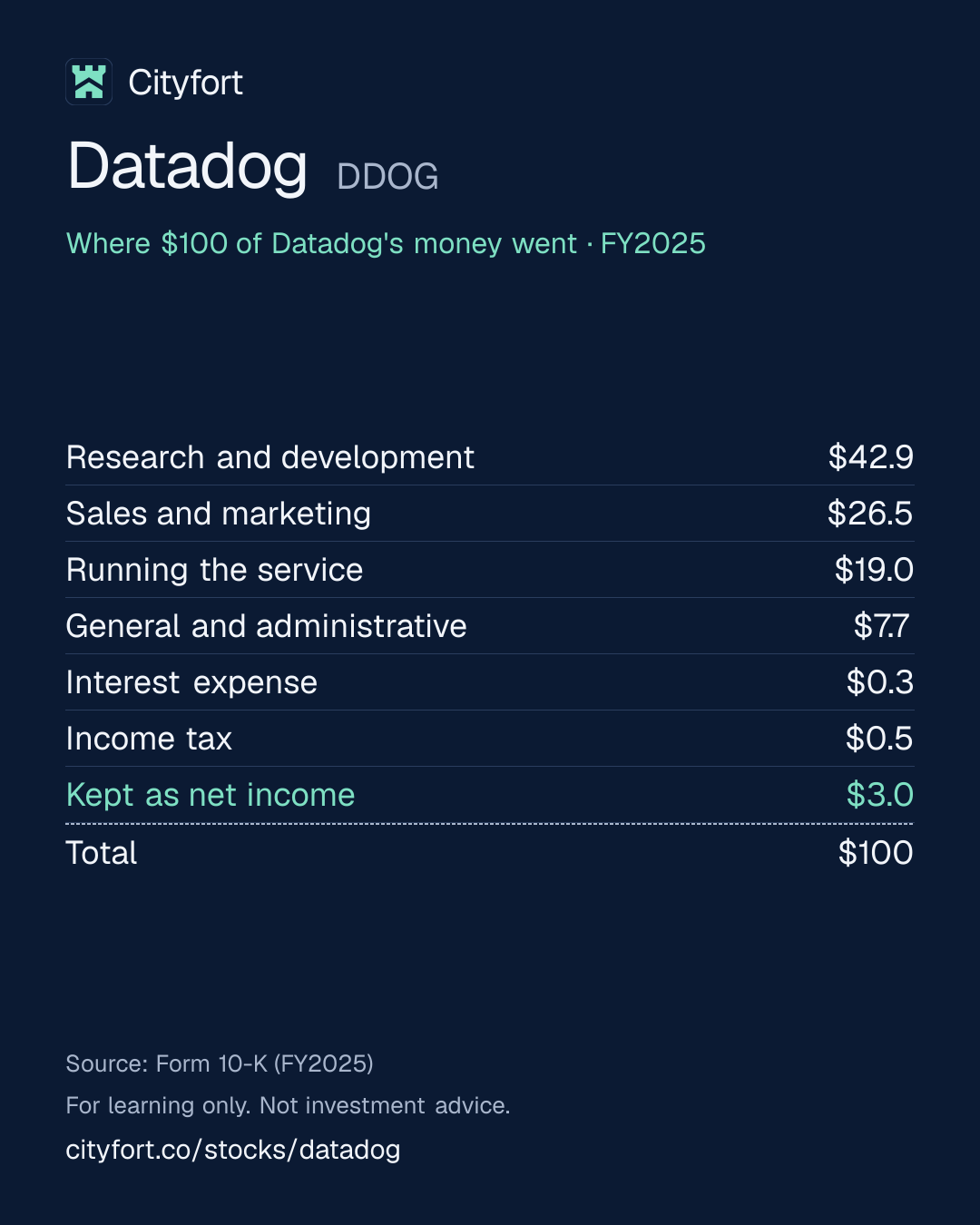
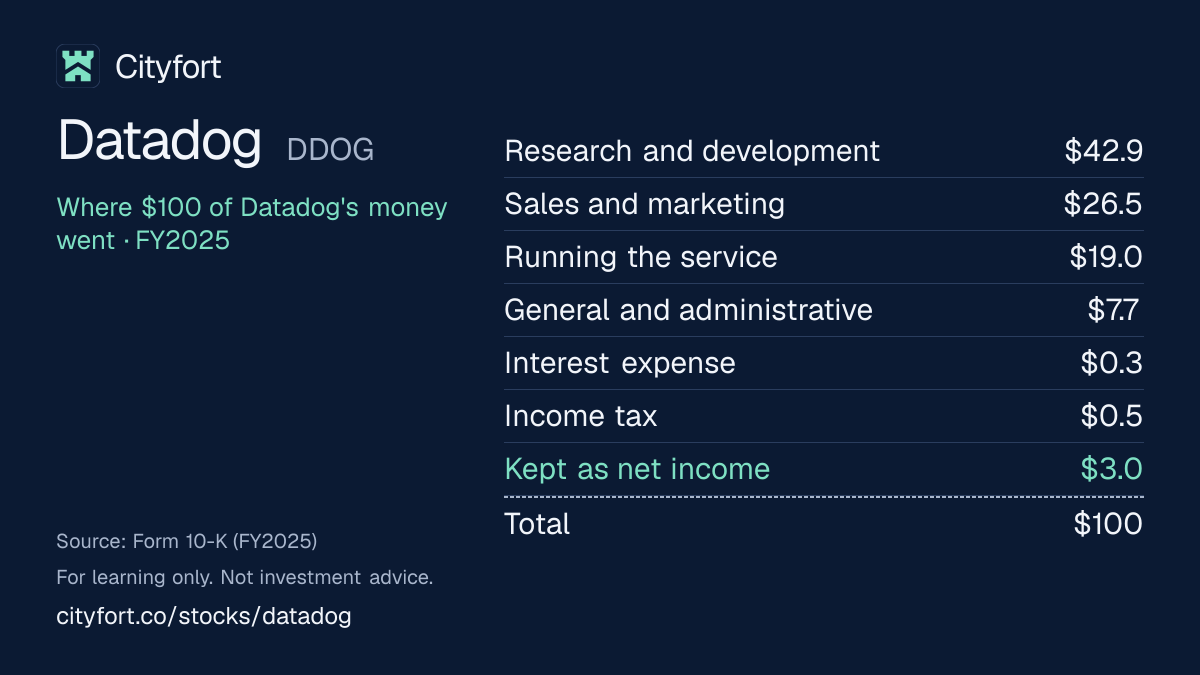
Of every $100 that came in during FY2025, Datadog kept $3.0 as net income, which came from $182.5 million of interest and other income because its operations lost $44.4 million.
4 · Where the operating profit comes from
Datadog reports one segment and no profit by product; in FY2025 gross profit of $2,740.2 million was less than the $2,784.6 million spent on research, sales and administration.
5 · The one thing to watch
Datadog's largest customer reduced usage in Q3 2026, and on Nov 4, 2026 the company guided Q4 FY2026 revenue to $1,190–1,200 million, against $1,197.1 million in Q3 FY2026.
Sources: From Datadog's FY2025 10-K, Q3 FY2026 10-Q and Q3 FY2026 earnings release · checked
See the full receipt and the management scorecard below
01Where the money goes · FY2025
Where does $100 of Datadog's money go?
Datadog · FY2025
Receipt for every $100
| Research and development | $42.9 |
|---|---|
| Sales and marketing | $26.5 |
| Running the service | $19.0 |
| General and administrative | $7.7 |
| Interest expense | $0.3 |
| Income tax | $0.5 |
| Kept as net income | $3.0 |
| Total | $100 |
Each line = amount ÷ total money in × 100. Lines may not add to exactly $100 because of rounding.
How this is worked out
Cityfort calculation from the FY2025 10-K. Of every $100 that came in during FY2025 (revenue $3,427.2 million + interest and other income $182.5 million = $3,609.7 million). The lines are rounded, so they add to $99.9. Measured on revenue alone, operations lost $1.3 per $100. Stock-based pay ($750.7 million) sits inside the cost lines.
Save this receipt as an image:
1080 × 1350 PNG for Instagram, LinkedIn1200 × 675 PNG for X
Embed this receipt
Paste this code into a blog or website to show the receipt, with a link back to this page:
Each week: one company explained in 5 points, picked by earnings date.
Free, no tips, unsubscribe anytime.
We'll send a confirmation email. See our privacy policy.
02The business in one line
What does Datadog do?
Companies pay Datadog subscription and usage fees to monitor and secure their software; most of the money goes on engineers and sales, so in FY2025 operations lost money and interest income produced the profit.
- About 32,700 customers paid Datadog $3,427.2 million in FY2025. Revenue was $1,197.1 million in Q3 FY2026, up 35.2% from a year earlier.
- Of every $100 that came in during FY2025, $42.9 went on research and development, $26.5 on sales and marketing and $19.0 on running the service.
03Who pays it
Who pays Datadog?
Larger customers
Not disclosed
4,860 customers with $100,000 or more of annual recurring revenue (ARR, the company's measure) at Sep 30, 2026, up from 4,060 a year earlier. They made up about 91% of ARR; their share of GAAP revenue is not disclosed.
All other paying customers
Not disclosed
Datadog had about 33,500 customers in all at Sep 30, 2026, up from 32,000 a year earlier. They range from small businesses to large enterprises.
How spread out the customers are
Datadog discloses no customer's share of revenue and does not name its largest customer. Its Q3 FY2026 10-Q says: "We saw a reduction in usage from our largest customer in the third quarter of 2026, which may cause a deceleration in revenue growth."
04Why it makes money
Why does Datadog make money?
Customers start small and add usage and products, but research and sales costs have kept operations near break-even.
Datadog calls its model land-and-expand: customers adopt one product, then use more and add others. About 70% of the Q3 FY2026 revenue increase came from existing customers, the 10-Q says. Gross profit was $80.0 per $100 of revenue in FY2025, yet research, sales and admin took more, leaving a $1.3 operating loss per $100.
Customers using 8 or more Datadog products
16%26%
Sep 30, 2025 to Sep 30, 2026
- A free tier and trials bring in engineers
- Customers start with one product
- Usage grows as their cloud workloads grow
- They add more of Datadog's 20+ products
- Larger contracts lift recurring revenue
- Revenue pays for more research and new products
↺ Step 6 feeds back into step 1.
05The numbers · Consolidated · US$
How has Datadog done?
Revenue
$3.4BFY2025
Revenue grew every year, from $1,028.8 million in FY2021 to $3,427.2 million in FY2025, and was $1,197.1 million in Q3 FY2026, up 35.2% from a year earlier (Cityfort calculation from the Q3 FY2026 earnings release).
US$
See the numbers
Net profit
$108MFY2025
Datadog had an operating loss in four of the five years from FY2021 to FY2025, and its net income since FY2023 came mainly from interest and other income, $182.5 million in FY2025.
US$
See the numbers
Profit kept per $100 of revenue
$3.1FY2025
Gross profit was $80.0 per $100 of revenue in FY2025, but stock-based pay of $750.7 million, 21.9% of revenue and more than net income in every year shown, sits inside the costs.
$ of profit per $100 of revenue (net margin)
See the numbers
Free cash flow
$1.0BFY2025
Free cash flow (cash from operations minus equipment purchases) rose from $276.6 million in FY2021 to $1,000.6 million in FY2025, helped by $750.7 million of stock-based pay that costs no cash and $273.3 million of growth in prepaid customer contracts.
US$ · cash from operations minus spending on plants and equipment
See the numbers
See all yearly numbers
EBITDA here = operating income plus depreciation and amortization (from the cash flow statement). Fiscal years are the company's own (December 31 (FY2025 = year ended Dec 31, 2025)). Net profit is the share belonging to the company's owners.
Download Datadog's yearly and quarterly numbers (CSV, with source ids)
Learn: Stock-based compensation and dilution: pay that becomes shares
Sources (13)
- Form 10-K, fiscal year 2023 (year ended December 31, 2023)
- Form 10-K, fiscal year 2025 (year ended December 31, 2025)
- Fourth quarter and fiscal year 2024 earnings release (Form 8-K, Exhibit 99.1)
- Fourth quarter and fiscal year 2025 earnings release (Form 8-K, Exhibit 99.1)
- First quarter 2025 earnings release (Form 8-K, Exhibit 99.1)
- First quarter 2026 earnings release (Form 8-K, Exhibit 99.1)
- Second quarter 2025 earnings release (Form 8-K, Exhibit 99.1)
- Second quarter 2026 earnings release (Form 8-K, Exhibit 99.1)
- Third quarter 2025 earnings release (Form 8-K, Exhibit 99.1)
- Third quarter 2026 earnings release (Form 8-K, Exhibit 99.1)
- Form 10-Q, Q1 fiscal 2026 (quarter ended March 31, 2026)
- Form 10-Q, Q2 fiscal 2026 (quarter ended June 30, 2026)
- Form 10-Q, Q3 fiscal 2026 (quarter ended September 30, 2026)
06Who runs it
Who runs Datadog, and did they deliver?
Olivier Pomel
Co-founder and Chief Executive Officer
2025 total pay was $27,055,481, including $25,831,947 of stock awards, against $19,842,554 in 2024. He held 17.3% of the votes at Mar 31, 2026.
Alexis Lê-Quôc
Co-founder and Chief Technology Officer
He held 15.5% of the votes at Mar 31, 2026.
David Obstler
Chief Financial Officer
Listed as an executive officer in the 2026 proxy.
Adam Blitzer
Chief Operating Officer
Listed as an executive officer in the 2026 proxy.
What they said, and what happened
3 delivered · 2 too early to tell
Said on Feb 13, 2025
Datadog said it expected FY2025 revenue of $3,175–3,195 million.
DeliveredWhat happened
FY2025 revenue was $3,427.2 million, 7.3% above the top of the range (Cityfort calculation from the FY2025 10-K).
Said on Feb 13, 2025
Datadog said it expected FY2025 non-GAAPThe company's own "adjusted" numbers, not the official (GAAP) ones. Always read them next to the official figure. Learn more operating income of $655–675 million.
DeliveredWhat happened
It reported $768.0 million; the GAAP operating loss was $44.4 million.
Said on Aug 6, 2026
Datadog said it expected Q3 FY2026 revenue of $1,135–1,145 million.
DeliveredWhat happened
Q3 FY2026 revenue was $1,197.1 million, 4.6% above the top of the range (Cityfort calculation from the Q3 FY2026 earnings release).
Said on Feb 10, 2026
Datadog said it expected FY2026 revenue of $4,060–4,100 million.
Too early to tellWhat happened
Raised three times, to $4,515–4,525 million on Nov 4, 2026. Revenue was $3,325.0 million in the first nine months of FY2026.
Said on Nov 4, 2026
Datadog said it expected Q4 FY2026 revenue of $1,190–1,200 million and non-GAAP operating income of $280–290 million.
Too early to tellWhat happened
Q4 FY2026 ends Dec 31, 2026. Q3 FY2026 revenue was $1,197.1 million.
Sources (7)
- Definitive proxy statement for the 2026 annual meeting (DEF 14A)
- Fourth quarter and fiscal year 2024 earnings release (Form 8-K, Exhibit 99.1)
- Form 10-K, fiscal year 2025 (year ended December 31, 2025)
- Fourth quarter and fiscal year 2025 earnings release (Form 8-K, Exhibit 99.1)
- Second quarter 2026 earnings release (Form 8-K, Exhibit 99.1)
- Third quarter 2026 earnings release (Form 8-K, Exhibit 99.1)
- First quarter 2026 earnings release (Form 8-K, Exhibit 99.1)
07What could go wrong
What could go wrong for Datadog?
- Concentration
Largest customer reduced its usage
Datadog's Q3 FY2026 10-Q says usage from its largest customer fell in the quarter, "which may cause a deceleration in revenue growth". The customer and its share of revenue are not disclosed. On Nov 4, 2026 Datadog guided Q4 FY2026 revenue to $1,190–1,200 million, against Q3's $1,197.1 million.
Watch Q4 FY2026 revenue against the company's $1,190–1,200 million range, and the largest-customer note in the FY2026 10-K.
- Governance
Founders and insiders hold a large share of the votes
Class B shares, with 10 votes each, were 6.6% of all shares but held approximately 41% of the votes at Sep 30, 2026. Directors and executive officers held 35.5% of the votes at Mar 31, 2026, and the company moved to Nevada in April 2026.
Watch Class B's share of the votes in each 10-Q, approximately 41% at Sep 30, 2026.
- Other
Profit depends on interest income
Datadog had an operating loss of $44.4 million in FY2025; net income of $107.7 million came from $182.5 million of interest and other income on its cash and securities. The 10-K says changes in interest rates may affect that interest income.
Watch GAAP operating income each quarter: $74.7 million in Q3 FY2026, against a $5.8 million loss a year earlier.
- Other
Stock-based pay and share count
Stock-based payPay given as shares instead of cash, which spreads ownership more thinly. Learn more was $750.7 million in FY2025, 21.9% of revenue, and higher than net income in every year from FY2021 to FY2025. Diluted weighted shares rose from 309.0 million in FY2021 to 363.5 million in FY2025.
Watch Stock-based pay as a share of revenue: 19.8% in Q3 FY2026.
- Competition
Competition, including from cloud providers
Datadog's 10-K names Cisco, Dynatrace, Elastic, IBM, Microsoft, New Relic and SolarWinds, and the built-in tools of AWS, Google Cloud and Azure. It says some competitors offer lower prices, which has caused pricing pressure.
Watch Customer growth: about 33,500 at Sep 30, 2026, up from 32,000 a year earlier.
- Technology
Relies on outside hosting providers
Datadog outsources substantially all of its infrastructure to third-party hosting services. A lasting outage or the end of those agreements could interrupt the service, its 10-K says.
Watch Hosting-related disruptions described in 10-Q risk factors or 8-Ks.
- Debt
$1 billion of convertible notes
Datadog owes $1,000.0 million of 0% notes due Dec 1, 2029, convertible at about $217.60 a share. Full conversion into shares would add 4,595,500 Class A shares (Cityfort calculation from the 8-K filed Dec 12, 2024).
Watch Cash and marketable securities against the notes: $5,233.6 million and $986.6 million at Sep 30, 2026.
Sources (8)
- Form 10-Q, Q3 fiscal 2026 (quarter ended September 30, 2026)
- Form 10-Q, Q2 fiscal 2026 (quarter ended June 30, 2026)
- Third quarter 2026 earnings release (Form 8-K, Exhibit 99.1)
- Definitive proxy statement for the 2026 annual meeting (DEF 14A)
- Form 8-K filed Apr 22, 2026: redomiciliation to Nevada and special meeting vote (Items 3.03, 5.03, 5.07)
- Form 10-K, fiscal year 2025 (year ended December 31, 2025)
- Form 10-K, fiscal year 2023 (year ended December 31, 2023)
- Form 8-K filed Dec 12, 2024: $1.0 billion 0.00% convertible senior notes due 2029 (Items 1.01, 2.03)
08Both sides
What do supporters and critics point to?
What supporters point to
- Revenue grew every year from $1,028.8 million in FY2021 to $3,427.2 million in FY2025, and rose 35.2% in Q3 FY2026 from a year earlier.
- Cash from operations rose from $286.5 million in FY2021 to $1,050.1 million in FY2025.
- Revenue came in above the top of Datadog's own range in FY2025 and in each quarter from Q3 FY2025 to Q3 FY2026.
- Cash and marketable securities of $5,233.6 million exceeded convertible notes carried at $986.6 million at Sep 30, 2026.
- Customers using eight or more products rose from 16% to 26% in the year to Sep 30, 2026.
What critics point to
- Datadog had an operating loss in FY2025, and its $107.7 million of net income came from $182.5 million of interest and other income.
- Stock-based pay was $750.7 million in FY2025, 21.9% of revenue, more than net income in every year from FY2021 to FY2025.
- Its largest customer reduced usage in Q3 2026, and Datadog's Q4 FY2026 revenue range of $1,190–1,200 million is close to Q3's $1,197.1 million.
- Class B shares were 6.6% of all shares but held approximately 41% of the votes, and the Nevada move passed with 332.2 million votes for and 199.6 million against.
- Customers grew 4.7% in the year to Sep 30, 2026, to about 33,500, while revenue grew 35.2%.
09What to watch next
What should you watch next at Datadog?
Next event
Q4 FY2026 results
Date not announced yet.
Revenue against the company's Q4 FY2026 range
Datadog said on Nov 4, 2026 that it expects $1,190–1,200 million. Q3 FY2026 revenue was $1,197.1 million.
The largest customer
The Q2 and Q3 FY2026 10-Qs report reduced usage from Q3 2026. The next 10-K may say more.
GAAP operating income
Q3 FY2026 operating income was $74.7 million, the largest of the last eight quarters; non-GAAP operating income was $334.3 million.
10Key dates
What are the key dates for Datadog?
| Event | Date | Source |
|---|---|---|
| Fiscal 2026 endsThe Q4 FY2026 results date was not announced in the documents read. | Form 10-Q, Q3 fiscal 2026 (quarter ended September 30, 2026) | |
| 2029 convertible notes can first be redeemedDatadog may not redeem the notes before this date. | Form 10-Q, Q3 fiscal 2026 (quarter ended September 30, 2026) | |
| $1,000.0 million of 0% convertible notes dueConversion price about $217.60 a share. | Form 10-Q, Q3 fiscal 2026 (quarter ended September 30, 2026); Form 8-K filed Dec 12, 2024: $1.0 billion 0.00% convertible senior notes due 2029 (Items 1.01, 2.03) |
11Key facts
Key facts about Datadog
- What does Datadog do?
- Datadog, Inc. sells cloud software that monitors companies' servers, applications, logs and security in one place. Datadog had revenue of $3,427.2 million in FY2025 (year ended Dec 31, 2025) and about 33,500 customers at Sep 30, 2026.
- How does Datadog make money?
- Datadog makes money from subscriptions to its software, mostly on annual contracts, plus charges for usage above the committed amount; professional services are immaterial. Datadog's revenue was $3,427.2 million in FY2025 and $1,197.1 million in Q3 FY2026 (quarter ended Sep 30, 2026).
- What is Datadog's business model?
- Datadog's business model is what it calls land-and-expand: customers start with one product, then use more of it and add others. At Sep 30, 2026, 61% of Datadog's customers used four or more of its products, up from 54% a year earlier.
- Is Datadog profitable?
- Datadog reported GAAP net income of $107.7 million in FY2025, but an operating loss of $44.4 million; the profit came from $182.5 million of interest and other income. In Q3 FY2026 Datadog had operating income of $74.7 million and net income of $118.3 million.
- What is Datadog's revenue by segment?
- Datadog reports one segment and does not split revenue by product. By customer billing address in FY2025, Datadog earned $2,320.3 million (67.7%) in the United States and $994.1 million (29.0%) outside North America.
- What are Datadog's infrastructure monitoring and APM products?
- Datadog's Infrastructure Monitoring, launched in 2012, tracks servers, containers and cloud services, and its Application Performance Monitoring (APM), launched in 2017, traces how code runs. Datadog does not report revenue for either product; its total FY2025 revenue was $3,427.2 million.
- What is Datadog Log Management?
- Datadog Log Management, launched in 2018, collects, indexes and searches the text records that software writes as it runs. Datadog does not report revenue for log management; across all products it had 4,860 customers with $100,000 or more of annual recurring revenue at Sep 30, 2026.
- What security products does Datadog sell?
- Datadog sells Cloud SIEM, Cloud Security, Code Security, Threat Management and Sensitive Data Scanner, which look for attacks, weak settings and exposed data. Datadog does not report security revenue separately; its Q3 FY2026 revenue was $1,197.1 million.
- Who are Datadog's customers?
- Datadog had about 33,500 customers at Sep 30, 2026, from small companies to large enterprises across many industries. Datadog's 4,860 customers with $100,000 or more of annual recurring revenue made up about 91% of that revenue measure at Sep 30, 2026.
- Who owns Datadog?
- Datadog's officers and directors held 35.5% of the votes at Mar 31, 2026, mainly through unlisted Class B shares with 10 votes each, according to the 2026 proxy statementThe yearly filing about shareholder votes, the board and executive pay. Learn more. Datadog's Class A stock trades on Nasdaq as DDOG; Vanguard Capital Management reported 7.46% of it as of Mar 31, 2026.
Sources (6)
- Form 10-K, fiscal year 2025 (year ended December 31, 2025)
- Form 10-Q, Q3 fiscal 2026 (quarter ended September 30, 2026)
- Third quarter 2026 earnings release (Form 8-K, Exhibit 99.1)
- Definitive proxy statement for the 2026 annual meeting (DEF 14A)
- Schedule 13G filed by Vanguard Capital Management on Datadog Class A common stock (event date Mar 31, 2026)
- EDGAR filing list for Datadog, Inc. (CIK 0001561550): ticker, exchange, fiscal year end, state of incorporation, filings
Terms on this page
- Annual recurring revenue (ARR)
- Capital expenditures (capex)
- Debt-to-equity
- Earnings per share (EPS)
- EBITDA
- Free cash flow
- Market cap
- Net debt
- Net margin
- P/E ratio
Each explains the term in plain English, with the same number from other companies on Cityfort.
Go deeper
More detail from the same filings. Open any section.
12What it sells
12What it sells
What does Datadog sell?
Infrastructure Monitoring
Datadog's first product, launched in 2012. Tracks servers, containers and serverless functions across public clouds, private clouds and companies' own data centers.
Application Performance Monitoring (APM)
Follows each request through an app's code, so engineers can see which part is slow or failing. Related tools include Continuous Profiler, Database Monitoring and Error Tracking.
Log Management
Collects and searches the text records that software writes as it runs. Launched in 2018; Observability Pipelines routes logs and other data to any destination.
User experience and product analytics
Real User Monitoring and Synthetics measure how websites and mobile apps perform for real and simulated users. Product Analytics, launched in 2025, tracks how people use a product.
Security
Cloud SIEM, Cloud Security, Code Security, Threat Management and Sensitive Data Scanner look for attacks, weak settings, vulnerable code and exposed personal data.
Incident response and AI tools
Incident Response and OnCall manage alerts and who gets paged. Bits AI SRE, launched in 2025, investigates alerts on its own. LLM Observability traces AI model apps.
What it does
- Does: Sells more than 20 products on one software platform, with over 1,000 integrations
- Does: Charges subscriptions, mostly annual, plus fees for usage above the committed amount
- Does: Offers free trials and a free tier to bring in new users
- Does: Sells to customers worldwide; 29.0% of FY2025 revenue came from outside North America
What it does not do
- Does not: Does not own its data centers: substantially all its infrastructure runs on third-party hosting services
- Does not: Does not report revenue by product
- Does not: Does not earn meaningful revenue from consulting; professional services are immaterial
- Does not: Does not pay a dividend or buy back shares
13How the money flows
13How the money flows · FY2025
How does money flow through Datadog?
Money in
- Revenue from customers$3.4B
- Interest and other income$183M
The company
Datadog
$3.6B came in
Money out
- Running the service (cost of revenue)$687M
- Research and development$1.5B
- Sales and marketing$956M
- General and administrative$280M
- Interest expense$11.1M
- Income tax$19.3M
- Net income$108M
- Customers paid Datadog $3,427.2 million in FY2025.
- Running the service, including cloud hosting, cost $687.0 million, leaving gross profit of $2,740.2 million.
- Research and development took $1,548.5 million, sales and marketing $956.4 million and administration $279.7 million: $2,784.6 million in all.
- That left an operating loss of $44.4 million. Interest and other income of $182.5 million, mostly on cash and securities, more than covered it.
- After $11.1 million of interest expense and $19.3 million of income tax, net income was $107.7 million.
14What it needs to run
14What it needs to run
What does Datadog need to run?
Third-party cloud hosting
Datadog outsources substantially all of its infrastructure to third-party hosting services. Cost of revenue, which includes payments to cloud hosting providers, was $687.0 million in FY2025.
Engineers
Research and development cost $1,548.5 million in FY2025, 45.2% of revenue, up from $419.8 million in FY2021.
People
About 8,100 employees in 35 countries at Dec 31, 2025. About 44% of full-time staff worked outside the US, 34% of them in France.
Integrations with other software
More than 1,000 ready-made integrations connect Datadog to public clouds, databases, hardware and third-party software.
15Where it sells
15Where it sells · FY2025
Where does Datadog sell?
- United States68%
- Rest of North America3%
- International (outside North America)29%
16Competitors and what protects it
16Competitors and what protects it
Who does Datadog compete with?
Cisco Systems
NASDAQ: CSCO
Named in Datadog's 10-K as a competitor in application performance monitoring and in log management.
Dynatrace
Named in Datadog's 10-K as a competitor in application performance monitoring, with New Relic.
Elastic
Named in Datadog's 10-K as a competitor in log management.
Microsoft
NASDAQ: MSFT
Named twice in Datadog's 10-K: in on-premise infrastructure monitoring (with IBM and SolarWinds) and through Azure's own cloud monitoring tools.
Amazon Web Services
NASDAQ: AMZN
Named in Datadog's 10-K for the cloud monitoring tools built into AWS, as are Google Cloud and Microsoft Azure.
What protects the business
Each strength is scored 1 (weak) to 5 (strong) for the business, with the reason. It is not a rating of the share.
- Many products on one platform4 of 5
At Sep 30, 2026, 61% of customers used four or more Datadog products and 16% used ten or more, up from 54% and 8% a year earlier.
- Contracted revenue3 of 5
Remaining performance obligationsSigned contracts with customers that have not been billed yet. (contracted revenue not yet recognized) were $3,847.7 million at Sep 30, 2026; Datadog expects substantially all within 24 months.
- Integrations3 of 5
More than 1,000 ready-made integrations connect Datadog to clouds, databases and other software, according to its 10-K.
Weak spot
Runs on its competitors' clouds
Datadog outsources substantially all of its infrastructure to third-party hosting services, and names AWS, Google Cloud and Microsoft Azure as competitors in cloud monitoring. Its 10-K says sales through cloud marketplaces could lower its margins.
17Where growth could come from
17Where growth could come from
Where could Datadog's growth come from?
Datadog said on Nov 4, 2026 that it expects Q4 FY2026 revenue of $1,190–1,200 million and FY2026 revenue of $4,515–4,525 million, with FY2026 non-GAAP operating income of $1,095–1,105 million. Its first FY2026 revenue range, given on Feb 10, 2026, was $4,060–4,100 million; it raised the range in May, August and November.
Larger customers
Working4,860 at Sep 30, 2026
Customers with $100,000 or more of annual recurring revenue rose from 4,060 a year earlier, up 19.7% (Cityfort calculation from the Q3 FY2026 and Q3 FY2025 earnings releases). They made up about 91% of ARR, against 89% a year earlier.
Status: Working, on track against what the company said.
Customers using more products
Working26% use 8+ products
At Sep 30, 2026, 26% of customers used eight or more Datadog products, up from 16% a year earlier, and 41% used six or more, up from 31%.
Status: Working, on track against what the company said.
Contracted revenue
Working$3,847.7M RPO
Remaining performance obligations rose from $3,461.2 million at Dec 31, 2025 to $3,847.7 million at Sep 30, 2026.
Status: Working, on track against what the company said.
New customers
Mixed33,500 customers
Customers rose 4.7% from about 32,000 a year earlier (Cityfort calculation from the Q3 FY2026 10-Q), while revenue grew 35.2%. About 30% of the Q3 FY2026 revenue increase came from new customers, the 10-Q says.
Status: Mixed, partly on track.
New products, including AI tools
New3 launches in 2025
Datadog launched OnCall, Product Analytics and Bits AI SRE in 2025, after LLM Observability in 2024. It does not report revenue for any of them.
Status: New, recently announced.
Status compares progress with what the company itself said it would do: Working = on track against what the company said; Mixed = partly on track; Behind = behind the company's own plan; New = recently announced; Early = too early to judge.
Sources (7)
- Third quarter 2026 earnings release (Form 8-K, Exhibit 99.1)
- Fourth quarter and fiscal year 2025 earnings release (Form 8-K, Exhibit 99.1)
- First quarter 2026 earnings release (Form 8-K, Exhibit 99.1)
- Second quarter 2026 earnings release (Form 8-K, Exhibit 99.1)
- Third quarter 2025 earnings release (Form 8-K, Exhibit 99.1)
- Form 10-Q, Q3 fiscal 2026 (quarter ended September 30, 2026)
- Form 10-K, fiscal year 2025 (year ended December 31, 2025)
18The company's own measures (non-GAAP)
18The company's own measures · FY2025 and Q3 FY2026
What do Datadog's own measures show?
Official (GAAP): Operating loss, FY2025
−$44.4M
Company's own measure: Non-GAAP operating income, FY2025
$768M
Datadog leaves out stock-based pay, amortization of acquired intangibles, employer payroll taxes on employee stock transactions and, from Apr 1, 2025, acquisition costs.
Official (GAAP): Operating income, Q3 FY2026
$74.7M
Company's own measure: Non-GAAP operating income, Q3 FY2026
$334M
Stock-based pay was $237.2 million in the quarter, 19.8% of revenue (Cityfort calculation from the Q3 FY2026 earnings release).
Official (GAAP): Diluted EPS, Q3 FY2026
$0.32
Company's own measure: Non-GAAP diluted EPS, Q3 FY2026
$0.81
Leaves out the same items and applies an assumed 21% long-term tax rate.
Official (GAAP): Net cash from operating activities, FY2025
$1.1B
Company's own measure: Free cash flow (company measure), FY2025
$915M
Cash from operations minus equipment purchases and capitalized software development costs. This page's own free cash flowCash from operations minus spending on buildings and equipment. Learn more, which deducts only equipment purchases, was $1,000.6 million.
Official (GAAP): Revenue, Q3 FY2026 ($ million)
$1.2B
Company's own measure: Customers with $100,000 or more of annual recurring revenue, Sep 30, 2026
4,860 customers
Annual recurring revenue (ARR) is Datadog's own measure of a customer's recurring revenue on a yearly basis. The count was 4,060 a year earlier.
These are the company's own measures, defined by the company. They are not comparable across companies, and they are not added together. Each sits beside the nearest official (GAAP) figure.
Learn: Non-GAAP measures: what a company's "adjusted" numbers leave out · Stock-based compensation and dilution: pay that becomes shares
19Financial strength and debt
19Financial strength · Sep 30, 2026
How much debt does Datadog have?
- Total debt$987M
- Cash and investments$5.2B
- Net cash (cash minus debt)$4.2B
- Net worth (shareholders' money)$4.7B
- Debt to equity
- 0.21×
- $ of debt for every $1 of shareholders' money
- Net cash is a Cityfort calculation from the Q3 FY2026 10-Q: cash and cash equivalents ($881.2 million) plus marketable securities ($4,352.4 million) minus the notes' carrying value.
- All the debt is $1,000.0 million of 0% convertible senior notes due Dec 1, 2029, issued in December 2024. The 2025 notes were repaid in FY2024 and FY2025.
- No credit line was found in the FY2025 10-K or the Q3 FY2026 10-Q.
- Interest cover is not shown: Datadog had an operating loss in FY2025, and the 2029 notes pay no interest. GAAP interest expense was $11.1 million in FY2025.
- Debt to equity compares the notes with stockholders' equity of $4,715.8 million (Cityfort calculation from the Q3 FY2026 10-Q).
- Operating lease liabilities ($320.6 million at Sep 30, 2026) are not counted as debt here.
20Who owns it
20Who owns it · ownership as of Mar 31, 2026
Who owns Datadog?
- Officers and directors (as a group), shares
- 6.5%
- Officers and directors (as a group), votes
- 35.5%
Shares vs votes by class
Datadog has more than one class of shares, and the classes carry different votes. The share of votes a class holds can differ a lot from its share of the shares.
- Class A common stock: share of all votes58.7%
- Class B common stock: share of all votes41.3%
Each class's part of all votes = its shares outstanding × votes per share ÷ the total for all classes.
Share classes
Holders of 5% or more
From the company's proxy statement (DEF 14A), later Schedule 13G filings and the share counts on its latest annual or quarterly report. Each holder row shows the date of its own filing.
Insider trades · Form 4 data as of Nov 6, 2026
What did Datadog's insiders report trading?
Datadog's insiders made 163 Form 4A filing an insider must make within two business days of buying or selling the company's shares. Learn more filings in the 12 months to Nov 6, 2026.
They reported no purchases and 685 sales (4.3 million shares) in the open market or privately (codes P and S).
626 of the 685 sales were on forms with the Rule 10b5-1 plan box checked.
The same filings report 121 other share transactions (C: 86, A: 28, G: 7).
They also report 140 transactions in options, stock units or other derivatives.
Insiders are a company's officers, directors and owners of more than 10% of a class of its shares. Most changes in their holdings must be reported to the SEC on a Form 4 within two business days. Source: SEC Form 4 filings on EDGAR.
- P
- a purchase in the open market or privately
- S
- a sale in the open market or privately
- A
- a grant, award or other acquisition from the company under Rule 16b-3
- C
- conversion of a derivative security
- G
- a bona fide gift
Code meanings: General Instruction 8 of Form 4 (SEC).
The latest 25 of 806 transactions
Shares: A = acquired, D = disposed of. A price the filing gives only in a footnote shows as “See filing”. The 10b5-1 box is checked when at least one trade on the form was made under a Rule 10b5-1 plan. A Form 4/A replaces the form it amends. See all of Datadog's Form 4 filings on EDGAR.
Learn: Dual-class shares: when votes and ownership don't match · How to read a proxy statement (DEF 14A): Nvidia's 2026 proxy · Form 4 insider filings: who files, the codes and the footnotes · Rule 10b5-1 trading plans: how insiders pre-schedule their trades
Sources (4)
- Form 10-Q, Q3 fiscal 2026 (quarter ended September 30, 2026)
- Definitive proxy statement for the 2026 annual meeting (DEF 14A)
- Schedule 13G filed by Vanguard Capital Management on Datadog Class A common stock (event date Mar 31, 2026)
- Schedule 13G filed by Vanguard Portfolio Management on Datadog Class A common stock (event date Mar 31, 2026)
21What it does with profit
21What it does with profit
What does Datadog do with its profit?
Money raised · Dec 12, 2024
Issued $1,000.0 million of 0.00% convertible senior notes due Dec 1, 2029, with net proceeds of about $979.1 million; related capped calls cost $100.9 million. The notes convert at about $217.60 a share.
$1.0B
22Governance signals
22Governance signals
What do Datadog's governance filings show?
- Auditor
- Deloitte & Touche LLP, since 2016
- Auditor changes
- None in the period covered
- Audit qualifications
- None reported
- Related-party dealings
- The 2026 proxy statement's related-person section, covering transactions since Jan 1, 2025, lists only indemnification agreements with directors and officers. Deloitte's FY2025 fees were $2.897 million, of which $2.614 million was for the audit.
- Credit rating
- No public credit rating found in a search of rating agency sites on Nov 6, 2026
Flags to know about
other · Apr 21, 2026
Moved from Delaware to Nevada
Datadog became a Nevada corporation on Apr 21, 2026, after a special meeting vote of 332,195,858 votes for and 199,605,477 against, with Class B shares carrying 10 votes each. The board's stated reasons included "flexibility for our founders' involvement". The company said its business, management and offices did not change.
other
Two share classes with unequal votes
Class B shares carry 10 votes each. They were 6.6% of all shares at Oct 28, 2026, and held approximately 41% of total voting power at Sep 30, 2026, according to the 10-Q.
disclosure
Largest customer not named
Datadog's 10-Qs for Q2 and Q3 FY2026 report reduced usage by its largest customer from Q3 2026, but do not name the customer or give its share of revenue.
other
CEO pay of $27.1 million
Olivier Pomel's 2025 total pay was $27,055,481, mostly stock awards, against $19,842,554 in 2024 and $11,644,934 in 2023. The CEO pay ratio was 131 to 1.
Sources (7)
- Form 10-K, fiscal year 2025 (year ended December 31, 2025)
- Definitive proxy statement for the 2026 annual meeting (DEF 14A)
- Form 10-Q, Q3 fiscal 2026 (quarter ended September 30, 2026)
- Form 8-K filed Dec 12, 2024: $1.0 billion 0.00% convertible senior notes due 2029 (Items 1.01, 2.03)
- Definitive proxy statement for the April 21, 2026 special meeting on the Nevada redomiciliation (DEF 14A)
- Form 8-K filed Apr 22, 2026: redomiciliation to Nevada and special meeting vote (Items 3.03, 5.03, 5.07)
- Form 10-Q, Q2 fiscal 2026 (quarter ended June 30, 2026)
23What the market paid
23What the market paid · price as of Nov 5, 2026
What did the market pay for Datadog on Nov 5, 2026?
Price as of Nov 5, 2026 (shown for education; prices change daily).
Price as of Nov 5, 2026: Datadog's Class A stock closed at $174.60 on Nasdaq. Times 361.0 million Class A and Class B shares (Oct 28, 2026), that is a market value of about $63.0 billion (Cityfort calculation from the Nov 5, 2026 Nasdaq closing price and the Q3 FY2026 10-Q). Class B shares are not listed but convert one-for-one into Class A. P/E (price ÷ earnings per share) was 242.5, on diluted EPS of $0.72 for the four quarters to Sep 30, 2026 (Cityfort calculation from the Q4 FY2025 to Q3 FY2026 earnings releases); interest and other income made up much of those earnings. The Q3 FY2026 results came out on Nov 4, 2026; the stock closed at $220.52 on Nov 3 and $188.72 on Nov 4 (Nasdaq).
- Share price
- $174.60
- Market value (market cap)
- $63.0B
- P/E
- 242.5×
More price-based ratios · as of Nov 5, 2026
Each ratio divides a number from the company's filings by the market value or share price on Nov 5, 2026. Prices change daily, so these ratios do too.
Price to sales (P/S)
14.7×
$63.0B market value ÷ $4.3B revenue (four quarters to Sep 30, 2026) = 14.7×
Cityfort calculation from the Nov 5, 2026 closing price and the Q4 FY2025 to Q3 FY2026 10-Qs and earnings releases. Source: DDOG historical prices, Oct 27 to Nov 5, 2026 (closing price Nov 5, 2026); Form 10-Q, Q3 fiscal 2026 (quarter ended September 30, 2026); Fourth quarter and fiscal year 2025 earnings release (Form 8-K, Exhibit 99.1) and 5 more
How price ratios workFree cash flow yield
1.6%
$1.0B free cash flow (FY2025) ÷ $63.0B market value = 1.6%
Cityfort calculation from the FY2025 10-K and the Nov 5, 2026 closing price. Source: DDOG historical prices, Oct 27 to Nov 5, 2026 (closing price Nov 5, 2026); Form 10-Q, Q3 fiscal 2026 (quarter ended September 30, 2026); Fourth quarter and fiscal year 2025 earnings release (Form 8-K, Exhibit 99.1) and 4 more
What free cash flow means
Shares used for the market value: 361.05 million ($174.60 × 361.05 million shares ≈ $63.0B). Source: Form 10-Q, Q3 fiscal 2026 (quarter ended September 30, 2026); Definitive proxy statement for the 2026 annual meeting (DEF 14A)
Source: DDOG historical prices, Oct 27 to Nov 5, 2026 (closing price Nov 5, 2026); Form 10-Q, Q3 fiscal 2026 (quarter ended September 30, 2026); Fourth quarter and fiscal year 2025 earnings release (Form 8-K, Exhibit 99.1) and 3 more
Sources (10)
- DDOG historical prices, Oct 27 to Nov 5, 2026 (closing price Nov 5, 2026)
- Form 10-Q, Q3 fiscal 2026 (quarter ended September 30, 2026)
- Fourth quarter and fiscal year 2025 earnings release (Form 8-K, Exhibit 99.1)
- First quarter 2026 earnings release (Form 8-K, Exhibit 99.1)
- Second quarter 2026 earnings release (Form 8-K, Exhibit 99.1)
- Third quarter 2026 earnings release (Form 8-K, Exhibit 99.1)
- Form 10-Q, Q1 fiscal 2026 (quarter ended March 31, 2026)
- Form 10-Q, Q2 fiscal 2026 (quarter ended June 30, 2026)
- Form 10-K, fiscal year 2025 (year ended December 31, 2025)
- Definitive proxy statement for the 2026 annual meeting (DEF 14A)
24How it got here
24How it got here
How did Datadog get here?
2010
Milestone
Incorporated
Datadog, Inc. was incorporated in Delaware on Jun 4, 2010 and is based in New York City.
2012
Milestone
First product
Datadog launched its first product, Infrastructure Monitoring, in 2012.
2018
Milestone
Adds log management
Log Management joined infrastructure monitoring and APM (launched 2017), which the company says made it the first to combine metrics, traces and logs on one platform.
2019
Milestone
Listed on Nasdaq
Listed on Nasdaq in September 2019; its Class A stock trades as DDOG.
2024
Milestone
$1 billion of 0% notes
Datadog issued $1,000.0 million of 0% convertible notes due 2029 on Dec 12, 2024, and repaid its 2025 notes in FY2024 and FY2025.
2025
Milestone
OnCall, Product Analytics and Bits AI SRE
Datadog launched three products in 2025 and bought three companies for $178.4 million in total, which it calls not material.
2026
Milestone
Moves to Nevada
Datadog became a Nevada corporation on Apr 21, 2026, after stockholders approved the change at a special meeting that day.
2026
Milestone
Largest customer cuts usage
Datadog reported reduced usage by its largest customer in Q3 2026, which it says may slow revenue growth.
Sources (6)
- Form 10-K, fiscal year 2025 (year ended December 31, 2025)
- EDGAR filing list for Datadog, Inc. (CIK 0001561550): ticker, exchange, fiscal year end, state of incorporation, filings
- Form 8-K filed Dec 12, 2024: $1.0 billion 0.00% convertible senior notes due 2029 (Items 1.01, 2.03)
- Form 10-Q, Q3 fiscal 2026 (quarter ended September 30, 2026)
- Form 8-K filed Apr 22, 2026: redomiciliation to Nevada and special meeting vote (Items 3.03, 5.03, 5.07)
- Form 10-Q, Q2 fiscal 2026 (quarter ended June 30, 2026)
25Sources and changes
Where every number on this page comes from
Sources (22 documents)
- S1Form 10-K, fiscal year 2025 (year ended December 31, 2025) · Datadog, Inc. (SEC EDGAR) · Tier 1: company or exchange filing · Feb 18, 2026
- S2Form 10-K, fiscal year 2023 (year ended December 31, 2023) · Datadog, Inc. (SEC EDGAR) · Tier 1: company or exchange filing · Feb 23, 2024
- S4Form 10-Q, Q3 fiscal 2026 (quarter ended September 30, 2026) · Datadog, Inc. (SEC EDGAR) · Tier 1: company or exchange filing · Nov 4, 2026
- S5Form 10-Q, Q2 fiscal 2026 (quarter ended June 30, 2026) · Datadog, Inc. (SEC EDGAR) · Tier 1: company or exchange filing · Aug 6, 2026
- S6Form 10-Q, Q1 fiscal 2026 (quarter ended March 31, 2026) · Datadog, Inc. (SEC EDGAR) · Tier 1: company or exchange filing · May 7, 2026
- S7Third quarter 2026 earnings release (Form 8-K, Exhibit 99.1) · Datadog, Inc. (SEC EDGAR) · Tier 1: company or exchange filing · Nov 4, 2026
- S8Second quarter 2026 earnings release (Form 8-K, Exhibit 99.1) · Datadog, Inc. (SEC EDGAR) · Tier 1: company or exchange filing · Aug 6, 2026
- S9First quarter 2026 earnings release (Form 8-K, Exhibit 99.1) · Datadog, Inc. (SEC EDGAR) · Tier 1: company or exchange filing · May 7, 2026
- S10Fourth quarter and fiscal year 2025 earnings release (Form 8-K, Exhibit 99.1) · Datadog, Inc. (SEC EDGAR) · Tier 1: company or exchange filing · Feb 10, 2026
- S11Third quarter 2025 earnings release (Form 8-K, Exhibit 99.1) · Datadog, Inc. (SEC EDGAR) · Tier 1: company or exchange filing · Nov 6, 2025
- S12Second quarter 2025 earnings release (Form 8-K, Exhibit 99.1) · Datadog, Inc. (SEC EDGAR) · Tier 1: company or exchange filing · Aug 7, 2025
- S13First quarter 2025 earnings release (Form 8-K, Exhibit 99.1) · Datadog, Inc. (SEC EDGAR) · Tier 1: company or exchange filing · May 6, 2025
- S14Fourth quarter and fiscal year 2024 earnings release (Form 8-K, Exhibit 99.1) · Datadog, Inc. (SEC EDGAR) · Tier 1: company or exchange filing · Feb 13, 2025
- S15Definitive proxy statement for the 2026 annual meeting (DEF 14A) · Datadog, Inc. (SEC EDGAR) · Tier 1: company or exchange filing · Apr 29, 2026
- S16Definitive proxy statement for the April 21, 2026 special meeting on the Nevada redomiciliation (DEF 14A) · Datadog, Inc. (SEC EDGAR) · Tier 1: company or exchange filing · Feb 27, 2026
- S17Form 8-K filed Apr 22, 2026: redomiciliation to Nevada and special meeting vote (Items 3.03, 5.03, 5.07) · Datadog, Inc. (SEC EDGAR) · Tier 1: company or exchange filing · Apr 22, 2026
- S18Form 8-K filed Dec 12, 2024: $1.0 billion 0.00% convertible senior notes due 2029 (Items 1.01, 2.03) · Datadog, Inc. (SEC EDGAR) · Tier 1: company or exchange filing · Dec 12, 2024
- S19Schedule 13G filed by Vanguard Capital Management on Datadog Class A common stock (event date Mar 31, 2026) · Vanguard Capital Management (SEC EDGAR) · Tier 1: company or exchange filing · Apr 29, 2026
- S20Schedule 13G filed by Vanguard Portfolio Management on Datadog Class A common stock (event date Mar 31, 2026) · Vanguard Portfolio Management (SEC EDGAR) · Tier 1: company or exchange filing · Apr 29, 2026
- S21Schedule 13G/A filed by The Vanguard Group on Datadog Class A common stock (event date Mar 13, 2026; 0%) · The Vanguard Group (SEC EDGAR) · Tier 1: company or exchange filing · Mar 26, 2026
- S22DDOG historical prices, Oct 27 to Nov 5, 2026 (closing price Nov 5, 2026) · Nasdaq · Tier 1: company or exchange filing · Nov 6, 2026
- S23EDGAR filing list for Datadog, Inc. (CIK 0001561550): ticker, exchange, fiscal year end, state of incorporation, filings · SEC EDGAR · Tier 1: company or exchange filing · Nov 6, 2026
Changes to this page (v1 · Nov 6, 2026)
- v1 · Nov 6, 2026First version, through Q3 FY2026 (quarter ended Sep 30, 2026). (first version)
Numbers come only from tier 1 and tier 2 sources. Read how we research.
Disclaimer
For learning only. Cityfort is not a registered investment adviser or broker-dealer and does not recommend buying or selling any security. Prices shown are dated and may be out of date.
Investing in securities involves risk, including loss of capital. Before making any investment decision, do your own research and consider consulting a registered investment adviser or other qualified professional.
Cityfort, its owners and contributors may or may not hold securities of companies covered. Cityfort is not paid by any company it covers. Content is not an offer or solicitation to buy or sell any security, including in any initial public offering.
Read the positions policyRead the full disclaimerHide the full disclaimer
Cityfort publishes general educational content that explains how listed companies work. Cityfort is not registered with the US Securities and Exchange Commission or any state securities regulator as an investment adviser, and is not a broker-dealer or a member of FINRA. Cityfort does not provide investment, tax or legal advice, recommendations, ratings, price targets or any opinion on whether to buy, sell or hold any security. Nothing on the site is tailored to any person's circumstances.
All information is taken from publicly available sources, mainly company filings with the SEC, which are listed on each page with dates. We work to keep it accurate and correct errors publicly, but we do not guarantee that it is complete, accurate or up to date. Any market price or price-based ratio shown is dated, may be out of date by the time you read it, and is included only to explain concepts.
Statements by company management, including forward-looking statements and guidance, are reported as the company's statements, with their date and source; they are not our forecasts. Adjusted (non-GAAP) figures are the company's own measures and are shown next to the official (GAAP) figures.