Health Care · NYSE: EW
Edwards Lifesciences: how the business works
Edwards Lifesciences makes replacement heart valves, most of them fitted through a catheter instead of open-heart surgery, and sold $6.07 billion of them in FY2025.
By Hardik Bhandare · Checked against filings: . Editorial policy. Corrections
Follow Edwards Lifesciences
Email me when Edwards Lifesciences's page is updated after earnings.
We'll send a confirmation email first. See our privacy policy.
Edwards Lifesciences Corporation · Irvine, California
Updated for Q3 FY2026 · checked
- Net sales, FY2025
- $6.07B
- Net income, FY2025
- $1.07B
- TAVR valves' share of net sales, FY2025
- 74%
- Cash and short-term investments, Sep 30, 2026
- $4.64B
- Employees, Dec 31, 2025
- About 16,000
The short version
Edwards Lifesciences in 5 points
1 · What it sells
Edwards Lifesciences sells replacement heart valves and valve repair systems: TAVR aortic valves brought in $4.49 billion of FY2025 net sales of $6.07 billion, surgical valves $1.03 billion and TMTT mitral and tricuspid devices $550.6 million.
2 · Who pays it
Hospitals and their heart teams pay Edwards: customers in the United States were 58.4% of FY2025 net sales and customers outside the United States 41.6%.
3 · What it keeps from $100
Of every $100 that came in during FY2025, Edwards kept $16.9 as net income from continuing operations, including interest income on its cash and a $146.9 million impairment loss; FY2025 operating income was $1.26 billion.
4 · Where the operating profit comes from
Edwards reports profit by region: the United States earned $2.35 billion of FY2025 segment profit and Europe $796 million, before $2.03 billion of corporate costs not assigned to regions.
5 · The one thing to watch
TAVR sales grew 8.0% in Q3 FY2026, against 11.1% for the first nine months of 2026, and on Nov 4, 2026 Edwards guided to 2026 TAVR growth of 9.0% to 9.5%.
Sources: From Edwards Lifesciences' FY2025 10-K, Q3 FY2026 10-Q and Q3 FY2026 earnings release · checked
01Where the money goes · FY2025
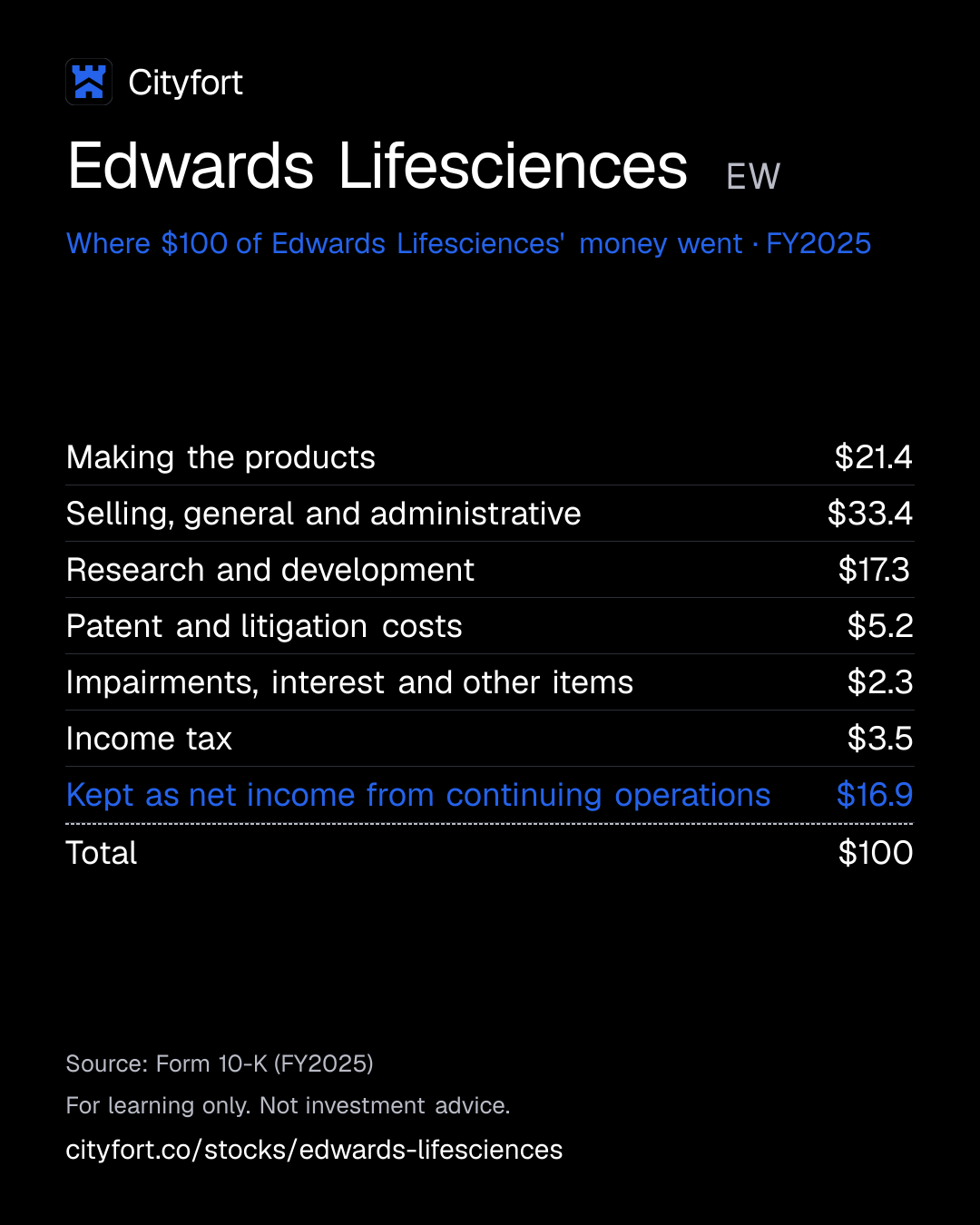
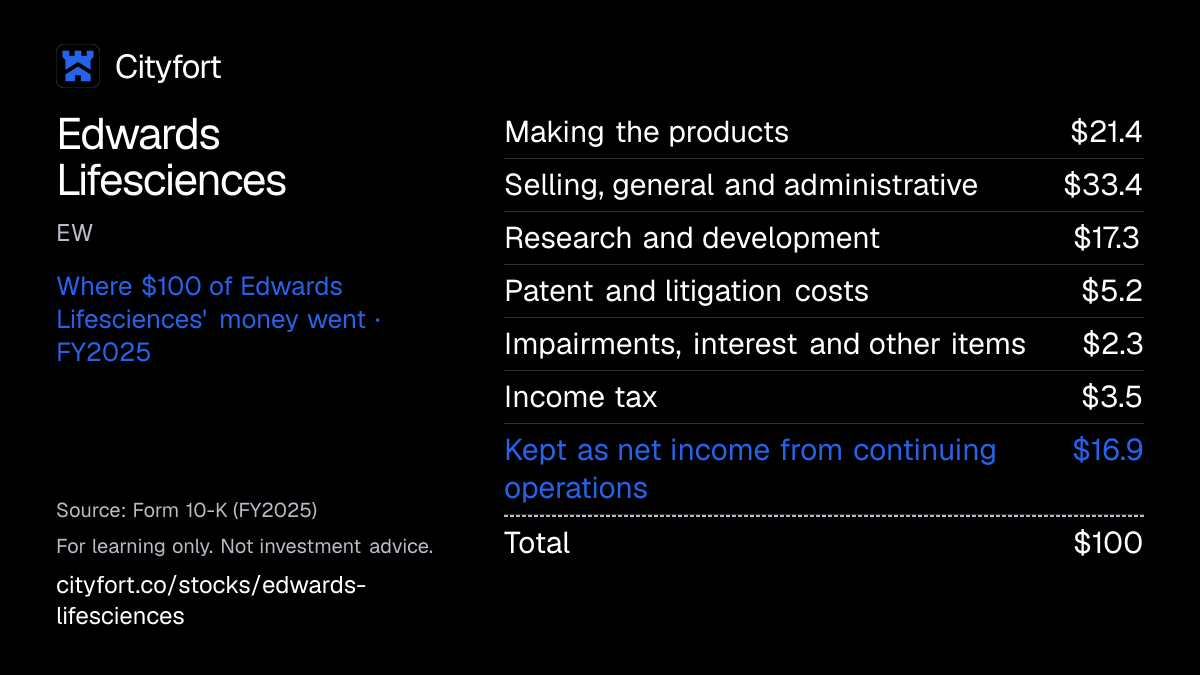
Where does $100 of Edwards Lifesciences' money go?
Edwards Lifesciences · FY2025
Receipt for every $100
| Making the products | $21.4 |
|---|---|
| Selling, general and administrative | $33.4 |
| Research and development | $17.3 |
| Patent and litigation costs | $5.2 |
| Impairments, interest and other items | $2.3 |
| Income tax | $3.5 |
| Kept as net income from continuing operations | $16.9 |
| Total | $100 |
Each line = amount ÷ total money in × 100. Lines may not add to exactly $100 because of rounding.
How this is worked out
Cityfort calculation from the FY2025 10-K. Of every $100 that came in during FY2025 (net sales of $6.07 billion plus $176 million of interest and other income): each line = line ÷ $6.24 billion × 100.
Save this receipt as an image
Embed this receipt or the key numbers
Paste this code into a blog or website to show the card you choose, with a link back to this page.
Each week: the next company due to report earnings, explained in 5 points.
No tips. Unsubscribe anytime.
We'll send a confirmation email. See our privacy policy.
02The business in one line
What does Edwards Lifesciences do?
Hospitals pay Edwards for heart valves and valve repair systems. In FY2025 making them took $21.4 of every $100 that came in, selling and administration $33.4 and research $17.3, leaving $16.9 as profit.
- Hospitals and their heart teams buy the devices; customers in the United States were 58.4% of FY2025 net sales and customers outside it 41.6%.
- TAVR aortic valves, put in through a thin tube passed through a blood vessel, brought in $4.49 billion, 74% of FY2025 net sales.
03Who pays it
Who pays Edwards Lifesciences?
Customers in the United States
58.4%
of revenue
Hospitals and their heart teams, served almost entirely by Edwards’ own sales forces. They were 58% of FY2025 net sales.
Customers outside the United States
41.6%
of revenue
Sold in about 100 countries through direct sales forces and independent distributors, often on consignment (stock kept at the hospital until used). Europe was 60% of these sales, Japan 14% and the rest of the world 26%.
- Customers in the United States58.4%
- Customers outside the United States41.6%
How spread out the customers are
No single customer accounted for 10% or more of Edwards’ net sales in FY2025, according to the FY2025 10-K.
Sources (1)
04How it makes money
How does Edwards Lifesciences make money?
Valves with a high gross margin pay for heavy research and a specialist sales force.
Edwards kept $78.0 of gross profit from every $100 of sales in FY2025. Selling and administration then took $34.4 and research $17.8 of each $100 (Cityfort calculation from the FY2025 10-K). New trial data and approvals widen the group of patients doctors can treat.
Gross profit per $100 of sales
$83.8$78.0
FY2022 to FY2025
- Run trials that test valves in more types of patient
- Win approvals and insurance coverage, such as Medicare’s Sep 2026 TAVR update
- Train doctors and send specialists into procedures
- Sell more valves at a gross margin near 78%
- Spend part of the gross profit on the next devices and trials
↺ Step 5 feeds back into step 1.
05Business segments · FY2025
Which businesses make up Edwards Lifesciences?
United States
58.4%Sales through Edwards’ own US sales forces. Segment profit here and below is before $2.03 billion of corporate costs not assigned to regions.
Revenue $3.5B ($3,543M) · Operating profit $2.3B ($2,345M)
Europe
25%The largest market outside the US; sales grew 14.8% in FY2025.
Revenue $1.5B ($1,518M) · Operating profit $796M
Japan
5.8%Sales grew 4.4% in FY2025, the slowest of the four regions.
Revenue $355M · Operating profit $234M
Rest of World
10.8%All other countries, through direct sales forces and distributors; sales grew 14.0% in FY2025.
Revenue $652M · Operating profit $299M
How the mix changed
- United States
- Europe
- Japan
- Rest of World
Revenue by segment, FY2023 to FY2025.
US$
See the numbers
Sources (1)
06The numbers · Consolidated · US$
How has Edwards Lifesciences done?
Revenue
$6.1BFY2025
Net sales rose every year from $4.46 billion in FY2022 to $6.07 billion in FY2025; FY2021 still includes the Critical Care business sold in 2024.
* FY2021: As first reported, incl. Critical Care.
US$
See the numbers
Net income
$1.1BFY2025
Net income reached $4.17 billion in FY2024, mostly from the gain on selling Critical Care, and was $1.07 billion in FY2025.
* FY2021: As first reported, incl. Critical Care.
US$
See the numbers
Net income for every $100 of revenue
$17.7FY2025
EBITDA per $100 of sales was $23.4 in FY2025, down from $28.2 in FY2024; FY2025 included $325.4 million of patent and litigation costs.
* FY2021: As first reported, incl. Critical Care.
Net margin: $ of net income per $100 of revenue
See the numbers
Free cash flow
$1.3BFY2025
Free cash flow was $1.34 billion in FY2025, up from $290 million in FY2024, when Critical Care sale taxes and a tax deposit cut operating cash.
* FY2021: As first reported, incl. Critical Care.
US$ · cash from operations minus spending on plants and equipment
See the numbers
See all yearly numbers
EBITDA here = operating income plus depreciation and amortization (from the cash flow statement). Fiscal years are the company's own: Fiscal year ends Dec 31 (the calendar year). Net income is the share belonging to the company's owners.
Learn: Fiscal years that don't end in December: Nvidia's FY2027 explained · Stock-based compensation and dilution: pay that becomes shares
Sources (21)
- Form 10-K for FY2022
- Form 10-K for FY2024
- Form 10-K for FY2025
- Form 10-K for FY2023
- Q4 FY2024 earnings release (8-K Ex. 99.1)
- Form 10-Q for Q1 FY2025
- Form 10-Q for Q1 FY2024
- Q1 FY2025 earnings release (8-K Ex. 99.1)
- Form 10-Q for Q2 FY2025
- Form 10-Q for Q2 FY2024
- Q2 FY2025 earnings release (8-K Ex. 99.1)
- Form 10-Q for Q3 FY2024
- Q3 FY2025 earnings release (8-K Ex. 99.1)
- Form 10-Q for Q3 FY2025
- Q4 FY2025 earnings release (8-K Ex. 99.1)
- Form 10-Q for Q1 FY2026
- Q1 FY2026 earnings release (8-K Ex. 99.1)
- Form 10-Q for Q2 FY2026
- Q2 FY2026 earnings release (8-K Ex. 99.1)
- Form 10-Q for Q3 FY2026
- Q3 FY2026 earnings release (8-K Ex. 99.1)
07Who runs it
Who runs Edwards Lifesciences, and did they deliver?
Bernard Zovighian
Chief Executive Officer · since 2023
Joined Edwards in Jan 2015 from Johnson & Johnson and was President from Jan to May 2023. 2025 total pay was $17.45 million (2026 proxy).
Theodora Mistras
Chief Financial Officer · since 2026
CFO from May 29, 2026 (8-K filed May 4, 2026). Scott B. Ullem had been CFO since Jan 2014.
Nicholas J. Valeriani
Independent Chair of the Board · since 2024
A director since 2014. All directors except the CEO are independent.
Daniel Lippis
Corporate Vice President, TAVR · since 2026
Leads the aortic valve business, 74% of FY2025 sales.
Daveen Chopra
Corporate Vice President, TMTT and Surgical · since 2023
Head of TMTT since Jan 2023; Surgical added Sep 2025.
Donald E. Bobo Jr.
Corporate Vice President, Strategy and Corporate Development · since 2007
Told the company he will retire by mid-2027 (8-K filed Aug 28, 2026).
What they said, and what happened
2 too early to tell
Said on Feb 10, 2026
In its Q4 FY2025 earnings release, Edwards guided to 2026 sales growth of 8% to 10% at constant currency.
Too early to tellWhat happened
In Nov 2026 it raised the range to about 11.5%. Nine-month sales rose 13.5% as reported.
Said on Feb 10, 2026
In the same release, Edwards guided to 2026 TMTT sales of $740 million to $780 million.
Too early to tellWhat happened
Nine-month TMTT sales were $583.2 million; in Nov 2026 the range became $780 million to $790 million.
08What could go wrong
What could go wrong for Edwards Lifesciences?
- Concentration
Most sales come from one product family
TAVR valves brought in $4.49 billion, 74% of FY2025 net sales. TAVR grew 8.0% in Q3 FY2026, against 11.1% for the first nine months.
Watch TAVR sales growth each quarter.
- Competition
Large rivals in every product line
The FY2025 10-K names Medtronic and Abbott as main competitors in TAVR and surgical valves, and Abbott in mitral and tricuspid devices. It adds that many companies are developing devices in those fields.
Watch Rival approvals and Edwards’ comments on its US TAVR position in earnings releases.
- Legal
Patent and litigation costs
Patent agreement and litigation expenses were $325.4 million in FY2025, up from $40.4 million in FY2024. In Jan 2026 Cardiovalve and MTH IP sued, alleging that the PASCAL system infringes a patent and seeking damages and an injunction.
Watch The “IP agreement and certain litigation expenses” line each quarter.
- Legal
Tax disputes
The IRS seeks $269.3 million of extra tax for 2015 to 2017, which Edwards contests. The nine-month FY2026 effective tax rate was 31.2%, including a $174.4 million item.
Watch Uncertain tax position liabilities in each 10-Q ($580.3 million non-current at Sep 30, 2026).
- Execution
Write-downs on deals and projects
Edwards booked a $146.9 million impairment loss in FY2025 and a $163.6 million loss on a convertible note and warrant in 2026. Q3 FY2026 added a $220.2 million impairment tied to a discontinued research project.
Watch Impairment lines in the statement of operations.
- Regulation
Tariffs on imported devices
The FY2025 10-K lists a US Commerce Department Section 232 investigation into imports of medical equipment as a risk. Edwards makes products in Singapore, Costa Rica and Ireland as well as the US.
Watch The outcome of the Section 232 investigation and any tariff cost in gross margin.
- Other
Single-source materials
Edwards buys some supplies from single sources and gets bovine tissue only from the United States and Australia, according to the FY2025 10-K.
Watch Supply problems or product holds mentioned in 10-Q filings.
09Supporters vs. critics
What do supporters and critics point to?
What supporters point to
- Net sales rose every year from $4.46 billion in FY2022 to $6.07 billion in FY2025, on the basis that leaves out the Critical Care business sold in 2024.
- TMTT mitral and tricuspid sales grew 47.7% to $583.2 million in the first nine months of 2026.
- In Sep 2026 Medicare extended its TAVR coverage to certain severe aortic stenosis patients without symptoms.
- At Sep 30, 2026, cash and short-term investments of $4.64 billion compared with $598.8 million of long-term debt.
- Free cash flow was $1.34 billion in FY2025, up from $290 million in FY2024.
What critics point to
- TAVR valves were 74% of FY2025 net sales, and TAVR grew 8.0% in Q3 FY2026 against 11.1% for the first nine months.
- Gross profit per $100 of sales went from $83.8 in FY2022 to $78.0 in FY2025.
- Patent agreement and litigation costs were $325.4 million in FY2025, up from $40.4 million, and a Jan 2026 suit alleges that the PASCAL system infringes a patent.
- The FTC sued to block Edwards’ merger agreement with JenaValve; a federal court granted an injunction on Jan 9, 2026, and Edwards ended the agreement.
- Edwards booked a $146.9 million impairment loss in FY2025 and a $220.2 million impairment in Q3 FY2026 tied to a discontinued research project.
10What to watch next
What should you watch next at Edwards Lifesciences?
Next event
Q4 FY2026 results
Date not announced yet.
TAVR growth against the raised 2026 range
TAVR sales grew 8.0% in Q3 FY2026. On Nov 4, 2026 Edwards said it expects 2026 TAVR growth of 9.0% to 9.5% at constant currency.
TMTT sales against the 2026 range
TMTT sales were $583.2 million in the first nine months of 2026. Edwards’ Nov 4, 2026 range for the full year is $780 million to $790 million.
Final hearing on the Patel class action settlement
The court preliminarily approved a proposed settlement on Aug 3, 2026, and the final hearing is set for Dec 16, 2026, according to the Q3 FY2026 10-Q.
11Key facts
Key facts about Edwards Lifesciences
- What does Edwards Lifesciences do?
- Edwards Lifesciences, based in Irvine, California, makes replacement heart valves and systems that repair or replace leaking heart valves. In FY2025, TAVR aortic valves, put in through a catheter (a thin tube passed through a blood vessel), were 74% of its $6.07 billion of net sales.
- How does Edwards Lifesciences make money?
- Edwards Lifesciences sells its valves and valve repair systems to hospitals, and kept $78.0 of gross profit from every $100 of FY2025 sales. Selling and administration then took $34.4 and research $17.8 of each $100 of sales (Cityfort calculation from the FY2025 10-K).
- Who are Edwards Lifesciences' customers?
- Edwards Lifesciences sells to hospitals and their heart teams. Customers in the United States were 58.4% of FY2025 net sales and customers outside the United States 41.6%, and no single customer reached 10% of net sales.
- How big is Edwards Lifesciences?
- Edwards Lifesciences had net sales of $6.07 billion in FY2025, up from $5.44 billion in FY2024. FY2025 operating income was $1.26 billion and net income $1.07 billion, and it had about 16,000 employees at Dec 31, 2025.
- Where does Edwards Lifesciences make its profit?
- Edwards Lifesciences reports profit by region. In FY2025 the United States segment earned $2.35 billion of segment profit on $3.54 billion of sales, and Europe $796 million on $1.52 billion, before $2.03 billion of corporate costs not assigned to regions.
- Who owns Edwards Lifesciences?
- Edwards Lifesciences has one class of common stock, with 575.0 million shares at Oct 31, 2026. Its 2026 proxy lists The Vanguard Group with 11.72% (Schedule 13GA filing by anyone who owns more than 5% of a company's shares and does not seek control. Learn more/A of Jan 30, 2025) and BlackRock with 7.5% (Schedule 13G of Oct 17, 2025); directors and executive officers held 0.31% at Jan 31, 2026.
- Does Edwards Lifesciences pay a dividend?
- Edwards Lifesciences has never paid a cash dividend, and its FY2025 10-K says it does not plan to. It bought back $893.4 million of shares in 2025 and about $700 million in the first nine months of 2026.
- How much debt does Edwards Lifesciences have?
- At Sep 30, 2026, Edwards Lifesciences held $4.64 billion of cash and short-term investments against $598.8 million of long-term debt, a 4.3% note due Jun 15, 2028.
- Why was Edwards Lifesciences' FY2024 net income higher than FY2025?
- Edwards Lifesciences sold its Critical Care monitoring business to Becton, Dickinson in September 2024. FY2024 net income of $4.17 billion came mostly from the gain on that sale; FY2025 net income was $1.07 billion.
- Who are Edwards Lifesciences' competitors?
- Edwards Lifesciences' FY2025 10-K names Medtronic and Abbott as its main competitors in TAVR and surgical valves, and Abbott as the main competitor in mitral and tricuspid therapies.
Terms on this page
- Capital expenditures (capex)
- Debt-to-equity
- Earnings per share (EPS)
- EBITDA
- Free cash flow
- Net debt
- Net margin
- Operating margin
- Revenue vs net income
- Stock buyback
Each explains the term in plain English, with the same number from other companies on Cityfort.
Go deeper
More detail from the same filings. Open any section.
12What it sells
12What it sells
What does Edwards Lifesciences sell?
TAVR: SAPIEN aortic valves
Transcatheter aortic valve replacement for patients with severe aortic stenosis, a narrowed aortic valve. Sales were $4.49 billion in FY2025, 74% of the total.
TMTT: PASCAL, EVOQUE and SAPIEN M3
Catheter systems that repair or replace the mitral and tricuspid valves. Sales were $550.6 million in FY2025, 9% of the total, up 56.4% on FY2024.
Surgical: INSPIRIS, MITRIS and KONECT RESILIA
Tissue heart valves that surgeons implant during open-heart operations. Sales were $1.03 billion in FY2025, 17% of the total.
What it does
- Does: Designs and makes replacement heart valves and valve repair systems
- Does: Runs clinical trials, such as EARLY TAVR, on which patients its valves can treat
- Does: Sends field clinical specialists into procedures to guide doctors using its devices
What it does not do
- Does not: Does not sell Critical Care monitoring products any more: it sold that business to Becton, Dickinson in September 2024
- Does not: Does not implant the devices itself: doctors in hospitals do
- Does not: Has never paid a cash dividend
Sources (1)
13How the money flows
13How the money flows · FY2025
How does money flow through Edwards Lifesciences?
Money in
- Net sales$6.1B
- Interest and other non-operating income$176M
The company
Edwards Lifesciences
$6.2B came in
Money out
- Cost of making the valves and systems$1.3B
- Selling, general and administrative costs$2.1B
- Research and development$1.1B
- Patent agreement and litigation costs$325M
- Impairments, interest, restructuring and other items (net)$147M
- Income tax$217M
- Net income from continuing operations$1.1B
- Edwards sold $6.07 billion of heart valves and valve repair systems in FY2025 and earned $168.8 million of interest on its cash.
- Making the products cost $1.33 billion, leaving $4.73 billion of gross profit.
- Selling and administration took $2.09 billion and research $1.08 billion; patent and litigation costs added $325.4 million.
- A $146.9 million impairment loss below operating income and $216.9 million of income tax left $1.06 billion from continuing operations.
- Adding $13.4 million from businesses already sold and $4.1 million of minority holders’ losses gives Edwards $1.07 billion of net income.
Sources (1)
14What it needs to run
14What it needs to run
What does Edwards Lifesciences need to run?
Animal tissue and single-source parts
Tissue valves use bovine (cow) tissue that Edwards sources only from the United States and Australia. Some other supplies come from a single supplier.
Factories in four countries
Production is mainly in Irvine, California and Draper, Utah, plus Singapore, Cartago in Costa Rica and Shannon in Ireland.
Research spending
Research and development cost $1.08 billion in FY2025, $17.80 of every $100 of sales.
Clinical specialists and staff
About 16,000 employees at Dec 31, 2025, most in the United States, Singapore and Costa Rica. Field clinical specialists attend procedures to guide doctors.
Sources (1)
15Competitors and what protects it
15Competitors and what protects it
Who does Edwards Lifesciences compete with?
Medtronic
NYSE: MDT
Named in the FY2025 10-K as a primary competitor in TAVR and in surgical valves. A 15-year patent covenant between the two companies has been in place since Apr 2023.
Abbott
NYSE: ABT
Named as a primary competitor in TAVR and surgical valves, and as the main competitor in mitral and tricuspid therapies (TMTT).
What protects the business
Each strength is scored 1 (weak) to 5 (strong) for the business, with the reason. It is not a rating of the share.
- Clinical record and approvals4 of 5
SAPIEN valves have been sold in Europe since 2007, the US since 2011 and Japan since 2013. Edwards ran the EARLY TAVR and PROGRESS trials on earlier-stage patients.
- Specialist sales and training4 of 5
Field clinical specialists attend procedures to guide doctors, and nearly all US sales go through Edwards’ own sales forces.
- Patents3 of 5
The Apr 2023 covenant with Medtronic stops patent suits between them for 15 years. Edwards paid $300 million plus royalties for it and still faces other patent suits.
- Tissue technology3 of 5
Its surgical valves use RESILIA tissue; the 10-K cites published data of over 99% freedom from structural valve deterioration through eight years.
Weak spot
Reliance on one product family
TAVR valves were 74% of FY2025 net sales, and both main rivals sell competing TAVR valves.
16Where growth could come from
16Where growth could come from
Where could Edwards Lifesciences' growth come from?
In its Q3 FY2026 earnings release of Nov 4, 2026, Edwards said it expects 2026 sales growth of about 11.5%, up from 10% to 11%. It guided to TAVR growth of 9.0% to 9.5%, TMTT sales of $780 million to $790 million and adjusted EPS of $2.97 to $3.05. Growth rates are at constant currency, which leaves out exchange-rate moves. The release says Edwards assumes growth "will be mainly driven by continued increases in procedure volumes and less by share gains".
TAVR aortic valves
Working+11.1%, nine months of 2026
TAVR sales were $3.70 billion in the first nine months of 2026, up 11.1%. Edwards raised its 2026 TAVR growth range in April, July and November, from 6% to 8% to 9.0% to 9.5%.
Status: Working, on track against what the company said.
Mitral and tricuspid therapies (TMTT)
Working+47.7%, nine months of 2026
TMTT sales were $583.2 million in the first nine months of 2026, up 47.7%. The 2026 sales range rose from $740 million to $780 million in February to $780 million to $790 million in November.
Status: Working, on track against what the company said.
Surgical valves
Working+6.3%, nine months of 2026
Surgical sales were $824.7 million in the first nine months of 2026, against a reaffirmed guide of mid-single-digit growth. Q3 FY2026 growth was 2.5%, and the 2026 figures include transition-service revenue from a business sold in 2025.
Status: Working, on track against what the company said.
Wider Medicare coverage for TAVR
NewSep 2026
In Sep 2026 Medicare issued an updated National Coverage Determination for TAVR, extending coverage to certain severe aortic stenosis patients without symptoms.
Status: New, recently announced.
New device approvals
Early2026 approvals
The Q3 FY2026 release lists three US approvals: PASCAL Precision for tricuspid repair, PASCAL Ace with Capture Clarity, and AUTUS, a surgical pulmonary valve for children. SAPIEN M3 RESILIA won European approval.
Status: Early, too early to judge.
Status compares progress with what the company itself said it would do: Working = on track against what the company said; Mixed = partly on track; Behind = behind the company's own plan; New = recently announced; Early = too early to judge.
17The company's own measures (non-GAAP)
17The company's own measures · Q3 FY2026
What do Edwards Lifesciences' own measures show?
Official (GAAP): Diluted EPS, Q3 FY2026
$0.53
Company's own measure: Adjusted EPS, Q3 FY2026
$0.80
Edwards leaves out items including certain litigation expenses, amortization of intangible assets, restructuring, acquisition contract termination costs and impairments of intangible and long-lived assets.
Official (GAAP): Operating margin, Q3 FY2026 (as stated in the Q3 FY2026 earnings release)
17.4%
Company's own measure: Adjusted operating margin, Q3 FY2026
30.3%
Same exclusions; the GAAP figure includes a $220.2 million impairment of intangible and long-lived assets.
Official (GAAP): TMTT sales in the product-group table, Q3 FY2026
$210M
Company's own measure: Adjusted TMTT sales, Q3 FY2026
$207M
The adjusted figure leaves out $2.9 million of Implantable Heart Failure Management revenue.
These are the company's own measures, defined by the company. They are not comparable across companies, and they are not added together. Each sits beside the nearest official (GAAP) figure.
Learn: Non-GAAP measures: what a company's "adjusted" numbers leave out
18Financial strength and debt
18Financial strength · Sep 30, 2026
How much debt does Edwards Lifesciences have?
- Total debt$599M
- Cash and investments$4.6B
- Net cash (cash minus debt)$4.0B
- Net worth (shareholders' money)$10.9B
- Debt to equity
- 0.06×
- $ of debt for every $1 of shareholders' money
- Net cash of $4.05 billion = cash ($3,110.8 million) + short-term investments ($1,533.9 million) − long-term debt ($598.8 million); Cityfort calculation from the Q3 FY2026 10-Q. It leaves out long-term investments and leases.
- The debt is a 4.3% note due Jun 15, 2028. A $750 million credit line maturing Jul 15, 2027 was undrawn at Dec 31, 2025.
- Edwards also carried a $580.3 million non-current liability for uncertain tax positions at Sep 30, 2026.
Sources (2)
19Who owns it
19Who owns it · ownership as of Jan 31, 2026
Who owns Edwards Lifesciences?
- Officers and directors (as a group), shares
- 0.3%
Share classes
Holders of 5% or more
From the company's proxy statement (DEF 14A), later Schedule 13G filings and the share counts on its latest annual or quarterly report. Each holder row shows the date of its own filing.
Learn: How to read a proxy statement (DEF 14A): Nvidia's 2026 proxy · Form 4 insider filings: who files, the codes and the footnotes
20What it does with profit
20What it does with profit
What does Edwards Lifesciences do with its profit?
Buyback · Dec 31, 2023
Bought back 11.4 million shares in 2023, paying $879.6 million.
$880M
Buyback · Dec 31, 2024
Bought back 16.8 million shares in 2024, paying $1.16 billion, including accelerated repurchases of $150 million (Apr) and $500 million (Aug).
$1.2B
Buyback · Dec 31, 2025
Bought back 11.8 million shares in 2025, paying $893.4 million, including accelerated repurchases of $250 million (Feb) and $500 million (Aug).
$893M
Buyback · Sep 30, 2026
About $700 million repurchased in the first nine months of 2026. That includes a $500 million accelerated repurchase from Feb 2026: 6.1 million shares at an average $81.50.
$700M
21Governance signals
21Governance signals
What do Edwards Lifesciences' governance filings show?
- Auditor
- PricewaterhouseCoopers LLP, since 1999
- Auditor changes
- None in the period covered
- Audit qualifications
- None reported
- Related-party dealings
- The 2026 proxy says the Audit Committee reviews and approves or ratifies related person transactions over $120,000; its related persons section lists no such transaction.
- Credit rating
- No public credit rating found in a search of rating agency sites on Nov 20, 2026
Flags to know about
other
Securities class action and derivative suits
A putative (proposed, not yet certified) securities class action filed Oct 14, 2024 (Patel v. Edwards Lifesciences) alleges false or misleading statements about the company’s business prospects. According to the Q3 FY2026 10-Q, the court preliminarily approved a proposed settlement on Aug 3, 2026, for an amount the company calls not material. The final hearing is set for Dec 16, 2026. Related shareholder derivative suits are pending.
regulatory
JenaValve merger blocked
The FTC sued on Aug 6, 2025 to block Edwards’ merger agreement with JenaValve, signed in Jul 2024. A federal court granted an injunction on Jan 9, 2026, and Edwards ended the merger agreement on Jan 14, 2026.
other
IRS tax dispute
The IRS issued a notice of deficiency for 2015 to 2017 seeking $269.3 million of additional tax before interest. Edwards is contesting it in court and made a $305.1 million deposit in 2024.
disclosure
No credit rating in the filings
Edwards’ FY2025 10-K and 2026 10-Qs do not state a credit rating, and no agency document was collected for this page.
22How it got here
22How it got here
How did Edwards Lifesciences get here?
2007
Milestone
First catheter-delivered aortic valves sold
SAPIEN valves were first sold in Europe in 2007, the US in 2011 and Japan in 2013.
2023
Milestone
Patent covenant with Medtronic
On Apr 12, 2023 the two signed a 15-year global covenant not to sue; Edwards paid $300 million plus yearly royalties.
2023
Milestone
Bernard Zovighian becomes CEO
Zovighian, at Edwards since 2015, became CEO after serving as President from Jan to May 2023.
2024
Business-model change
Critical Care sold to Becton, Dickinson
The sale closed on Sep 3, 2024 for about $3.9 billion. The FY2025 10-K describes Edwards as a structural heart company.
2024
Milestone
Innovalve acquired
Edwards bought Innovalve, a mitral valve replacement developer, on Oct 1, 2024 for $380.9 million.
2026
Crisis
JenaValve merger ended
After the FTC sued and a court granted an injunction, Edwards ended the JenaValve merger agreement on Jan 14, 2026.
2026
Milestone
Medicare widens TAVR coverage
In Sep 2026 Medicare extended TAVR coverage to certain severe aortic stenosis patients without symptoms.
23Sources and changes
Where every number on this page comes from
Sources (25 documents)
- S1Form 10-Q for Q3 FY2026 · SEC EDGAR · Tier 1: company or exchange filing · Nov 4, 2026
- S2Form 10-Q for Q2 FY2026 · SEC EDGAR · Tier 1: company or exchange filing · Aug 4, 2026
- S3Form 10-Q for Q1 FY2026 · SEC EDGAR · Tier 1: company or exchange filing · May 6, 2026
- S4Form 10-K for FY2025 · SEC EDGAR · Tier 1: company or exchange filing · Feb 25, 2026
- S5Form 10-Q for Q3 FY2025 · SEC EDGAR · Tier 1: company or exchange filing · Nov 5, 2025
- S6Form 10-Q for Q2 FY2025 · SEC EDGAR · Tier 1: company or exchange filing · Aug 6, 2025
- S7Form 10-Q for Q1 FY2025 · SEC EDGAR · Tier 1: company or exchange filing · May 6, 2025
- S8Form 10-K for FY2024 · SEC EDGAR · Tier 1: company or exchange filing · Feb 28, 2025
- S9Form 10-Q for Q3 FY2024 · SEC EDGAR · Tier 1: company or exchange filing · Nov 6, 2024
- S10Form 10-Q for Q2 FY2024 · SEC EDGAR · Tier 1: company or exchange filing · Jul 31, 2024
- S11Form 10-Q for Q1 FY2024 · SEC EDGAR · Tier 1: company or exchange filing · Apr 29, 2024
- S12Form 10-K for FY2023 · SEC EDGAR · Tier 1: company or exchange filing · Feb 12, 2024
- S132026 proxy statement (DEF 14A) · SEC EDGAR · Tier 1: company or exchange filing · Mar 26, 2026
- S14Q3 FY2026 earnings release (8-K Ex. 99.1) · SEC EDGAR · Tier 1: company or exchange filing · Nov 4, 2026
- S15Q2 FY2026 earnings release (8-K Ex. 99.1) · SEC EDGAR · Tier 1: company or exchange filing · Jul 23, 2026
- S16Q1 FY2026 earnings release (8-K Ex. 99.1) · SEC EDGAR · Tier 1: company or exchange filing · Apr 23, 2026
- S17Q4 FY2025 earnings release (8-K Ex. 99.1) · SEC EDGAR · Tier 1: company or exchange filing · Feb 10, 2026
- S18Q3 FY2025 earnings release (8-K Ex. 99.1) · SEC EDGAR · Tier 1: company or exchange filing · Oct 30, 2025
- S19Q2 FY2025 earnings release (8-K Ex. 99.1) · SEC EDGAR · Tier 1: company or exchange filing · Jul 24, 2025
- S20Q1 FY2025 earnings release (8-K Ex. 99.1) · SEC EDGAR · Tier 1: company or exchange filing · Apr 23, 2025
- S21Q4 FY2024 earnings release (8-K Ex. 99.1) · SEC EDGAR · Tier 1: company or exchange filing · Feb 11, 2025
- S228-K filed Aug 28, 2026 (Item 5.02, officer departure) · SEC EDGAR · Tier 1: company or exchange filing · Aug 28, 2026
- S238-K filed May 4, 2026 (Item 5.02, new CFO) · SEC EDGAR · Tier 1: company or exchange filing · May 4, 2026
- S248-K filed Aug 19, 2025 (Item 8.01, accelerated share repurchase) · SEC EDGAR · Tier 1: company or exchange filing · Aug 19, 2025
- S25Form 10-K for FY2022 · SEC EDGAR · Tier 1: company or exchange filing · Feb 13, 2023
Changes to this page (v1 · Nov 20, 2026)
- v1 · Nov 20, 2026First version. (first version)
Numbers come only from tier 1 and tier 2 sources. Read how we research.
Disclaimer
For learning only. Cityfort is not a registered investment adviser or broker-dealer and does not recommend buying or selling any security. Prices shown are dated and may be out of date.
Investing in securities involves risk, including loss of capital. Before making any investment decision, do your own research and consider consulting a registered investment adviser or other qualified professional.
Cityfort, its owners and contributors may or may not hold securities of companies covered. Cityfort is not paid by any company it covers. Content is not an offer or solicitation to buy or sell any security, including in any initial public offering.
Read the positions policyRead the full disclaimerHide the full disclaimer
Cityfort publishes general educational content that explains how listed companies work. Cityfort is not registered with the US Securities and Exchange Commission or any state securities regulator as an investment adviser, and is not a broker-dealer or a member of FINRA. Cityfort does not provide investment, tax or legal advice, recommendations, ratings, price targets or any opinion on whether to buy, sell or hold any security. Nothing on the site is tailored to any person's circumstances.
All information is taken from publicly available sources, mainly company filings with the SEC, which are listed on each page with dates. We work to keep it accurate and correct errors publicly, but we do not guarantee that it is complete, accurate or up to date. Any market price or price-based ratio shown is dated, may be out of date by the time you read it, and is included only to explain concepts.
Statements by company management, including forward-looking statements and guidance, are reported as the company's statements, with their date and source; they are not our forecasts. Adjusted (non-GAAP) figures are the company's own measures and are shown next to the official (GAAP) figures.