Consumer Discretionary · NASDAQ: MAR
Marriott: how the business works
Marriott puts its brands on hotels that other companies own and charges them fees to franchise or run them, with 10,241 properties at Sep 30, 2026 and FY2025 revenue of $26.2 billion.
By Hardik Bhandare · Checked against filings: . Editorial policy. Corrections
Follow Marriott
Email me when Marriott's page is updated after earnings.
We'll send a confirmation email first. See our privacy policy.
Marriott International, Inc. · Bethesda, Maryland
Updated for Q3 FY2026 · checked
- Revenue, FY2025
- $26.2B
- Net income, FY2025
- $2.6B
- Gross fee revenues, FY2025
- $5.4B
- Rooms, Sep 30, 2026
- 1,833,801
- Marriott family stake, Mar 1, 2026
- 13.22%
The short version
Marriott in 5 points
1 · What it sells
Marriott franchises and manages hotels other companies own, 10,241 properties with 1,833,801 rooms at Sep 30, 2026, and had $26.2 billion of revenue in FY2025.
2 · Who pays it
In FY2025, hotel owners' cost reimbursements were 73.3% of revenue, franchise fees 12.7%, management fees after contract amortization 7.6% and owned, leased and other hotels 6.4%.
3 · What it keeps from $100
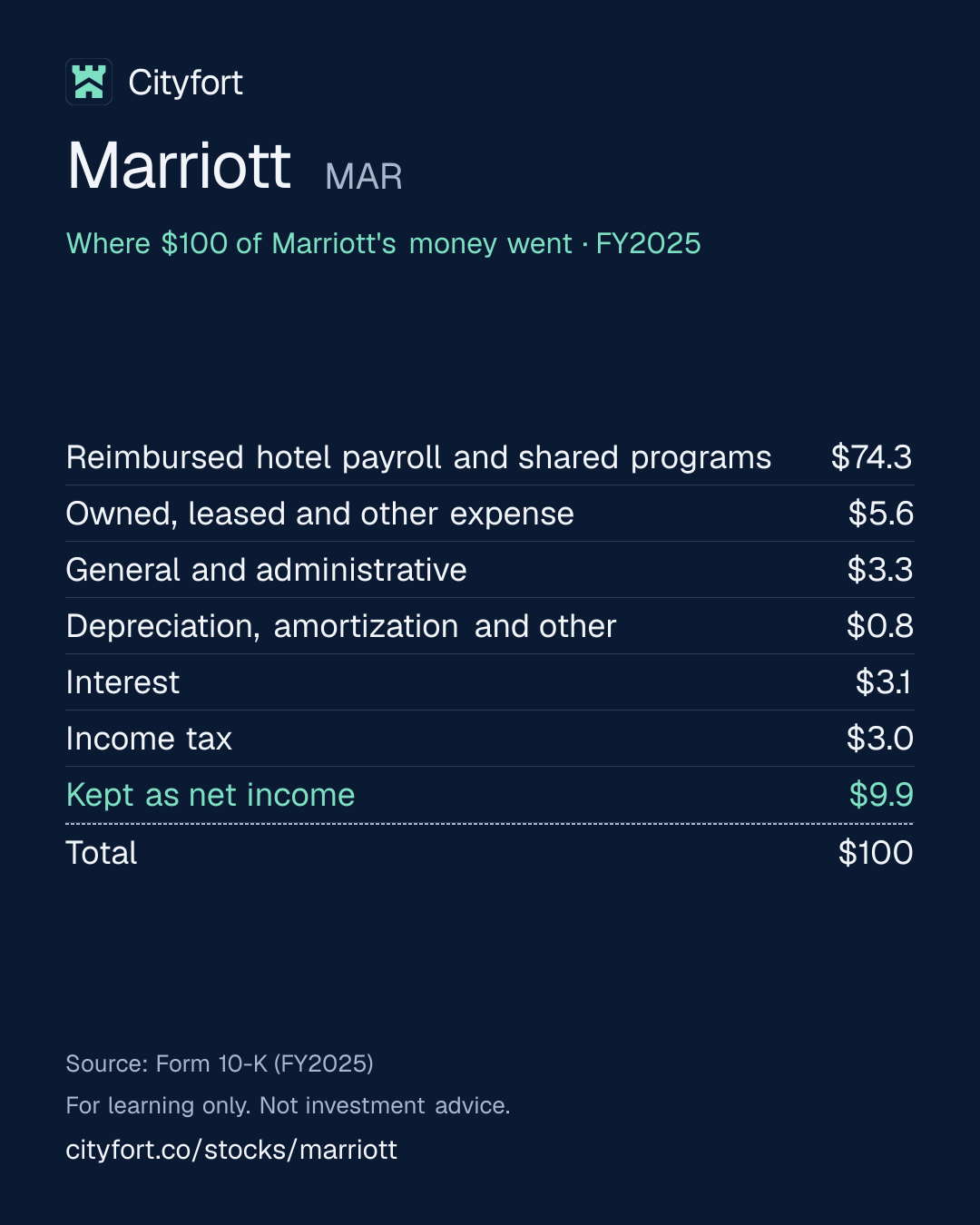
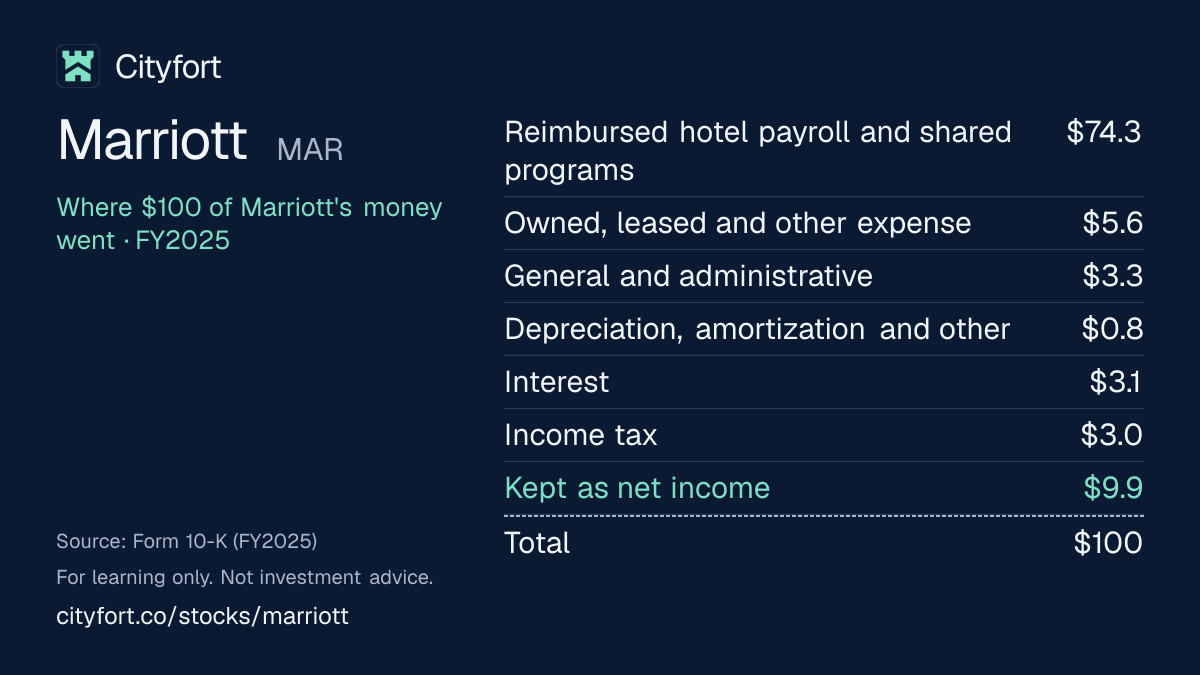
Of every $100 that came in during FY2025, Marriott kept $9.9 as net income, and operating income was $15.8 per $100 of revenue because $74.3 went straight out as reimbursed hotel payroll and program costs.
4 · Where the operating profit comes from
In FY2025, U.S. & Canada earned 72.6% of reportable segment profit, EMEA 14.2%, APEC 8.2% and Greater China 5.0%, while card and loyalty fees sit in unallocated corporate and other.
5 · The one thing to watch
Marriott spent $3.1 billion on buybacks in the first nine months of 2026, while total debt was $16.8 billion and the shareholders' deficit $5.1 billion at Sep 30, 2026.
Sources: From Marriott's FY2025 10-K, Q3 FY2026 10-Q and Q3 FY2026 earnings release · checked
See the full receipt and the management scorecard below
01Where the money goes · FY2025
Where does $100 of Marriott's money go?
Marriott · FY2025
Receipt for every $100
| Reimbursed hotel payroll and shared programs | $74.3 |
|---|---|
| Owned, leased and other expense | $5.6 |
| General and administrative | $3.3 |
| Depreciation, amortization and other | $0.8 |
| Interest | $3.1 |
| Income tax | $3.0 |
| Kept as net income | $9.9 |
| Total | $100 |
Each line = amount ÷ total money in × 100. Lines may not add to exactly $100 because of rounding.
How this is worked out
Cityfort calculation from FY2025 10-K. Of every $100 that came in during FY2025 (revenue plus $62 million of interest income, gains and equity earnings): each line = line ÷ $26,248 million × 100.
Save this receipt as an image:
1080 × 1350 PNG for Instagram, LinkedIn1200 × 675 PNG for X
Embed this receipt
Paste this code into a blog or website to show the receipt, with a link back to this page:
Each week: one company explained in 5 points, picked by earnings date.
Free, no tips, unsubscribe anytime.
We'll send a confirmation email. See our privacy policy.
02The business in one line
What does Marriott do?
Hotel owners pay Marriott fees to use its brands or to have it run their hotels, and they repay the hotel staff and shared program costs Marriott covers at no markup; the fees are where the profit comes from.
- In FY2025 cost reimbursements from hotel owners were $19.2 billion, or 73.3% of Marriott's $26.2 billion revenue, and reimbursed expenses were $19.5 billion.
- Gross fee revenues were $5.4 billion in FY2025: franchise fees $3.3 billion, base management fees $1.3 billion and incentive management fees $791 million.
03Who pays it
Who pays Marriott?
Hotel owners: cost reimbursements
73%
of revenue
Owners repaying payroll at managed hotels where Marriott is the employer, and shared program costs (loyalty, marketing, reservations), at no markup.
Franchisees, licensees and card partners: franchise fees
13%
of revenue
Fees from franchised hotels, co-branded credit cards, applications and relicensing, and residential branding.
Owners of managed hotels: management fees
8%
of revenue
Base and incentive management fees ($2,113 million), less $135 million of contract investment amortization.
Guests at owned and leased hotels, and other
6%
of revenue
Sales at the 51 hotels Marriott owned or leased at Dec 31, 2025, plus other revenue.
- Hotel owners: cost reimbursements73%
- Franchisees, licensees and card partners: franchise fees13%
- Owners of managed hotels: management fees8%
- Guests at owned and leased hotels, and other6%
How spread out the customers are
Marriott's FY2025 10-K names no customer with 10% or more of revenue. Its revenue depends on hotel owners as a group; the 10-K lists early termination of owner agreements and disagreements with owners as risks.
04Why it makes money
Why does Marriott make money?
Fees grow with the number of rooms carrying Marriott's brands and with what those rooms earn, while owners pay to build the hotels.
Owners put up the money for the hotels, so Marriott's own capital spending was $604 million in FY2025. Marriott said Q3 FY2026 fee growth came mainly from higher co-branded credit card fees, higher revenue per available room (RevPAR) and rooms growth. Gross fee revenues rose from $4.8 billion in FY2023 to $5.4 billion in FY2025.
Gross fee revenues (US$ million)
4,8245,438
FY2023 to FY2025
- Owners build or convert hotels under a Marriott brand
- The brand and Marriott Bonvoy bring guests and bookings
- Owners pay Marriott franchise or management fees
- Marriott keeps most of the fee income after its own overhead
- More owners sign up, growing rooms and the loyalty program
↺ Step 5 feeds back into step 1.
05Business segments · FY2025
Which businesses make up Marriott?
U.S. & Canada
74%6,360 properties at Dec 31, 2025. Net fee revenues were $2,921 million; the rest of segment revenue is mostly cost reimbursements. It earned 72.6% of reportable segment profit.
Revenue $19.3B · Operating profit $2.7B
EMEA
9%Europe, the Middle East and Africa: 1,385 properties, net fee revenues of $621 million and 14.2% of reportable segment profit.
Revenue $2.4B · Operating profit $525M
Greater China
2%684 properties, net fee revenues of $260 million and 5.0% of reportable segment profit.
Revenue $590M · Operating profit $185M
APEC
4%Asia Pacific excluding China: 733 properties, net fee revenues of $370 million and 8.2% of reportable segment profit.
Revenue $1.1B · Operating profit $301M
Unallocated corporate and other
11%Not a reportable segment: Caribbean and Latin America (CALA) hotels, co-branded credit card and timeshare licensing fees, the loyalty program and corporate overhead. It held $1,131 million of the $5,303 million of net fee revenues.
Revenue $2.8B · Operating profit $471M
How the mix changed
- U.S. & Canada
- EMEA
- Greater China
- APEC
- Unallocated corporate and other
Revenue by segment, FY2023 to FY2025.
US$
See the numbers
06The numbers · Consolidated · US$
How has Marriott done?
Revenue
$26.2BFY2025
Revenue rose every year from $13.9 billion in FY2021, a year hit by COVID, to $26.2 billion in FY2025, and 73.3% of FY2025 revenue was cost reimbursements passed through from hotel owners.
US$
See the numbers
Net profit
$2.6BFY2025
Net income reached $3.1 billion in FY2023, helped by one-off tax benefits that cut the tax rate to 8.7%, then was $2.4 billion in FY2024 and $2.6 billion in FY2025.
US$
See the numbers
Profit kept per $100 of revenue
$9.9FY2025
Operating income was $15.8 per $100 of revenue in FY2025, up from $12.6 in FY2021; the pass-through cost reimbursements keep this figure low.
$ of profit per $100 of revenue (net margin)
See the numbers
Free cash flow
$2.6BFY2025
Free cash flow (cash from operations minus capital and technology spending) was $2.6 billion in FY2025, while Marriott spent $3.3 billion on buybacks and $718 million on dividends.
US$ · cash from operations minus spending on plants and equipment
See the numbers
See all yearly numbers
EBITDA here = operating income plus depreciation and amortization (from the cash flow statement). Fiscal years are the company's own (Dec 31; Marriott's fiscal year is the calendar year, so Q3 FY2026 is July to September 2026). Net profit is the share belonging to the company's owners.
Download Marriott's yearly and quarterly numbers (CSV, with source ids)
Learn: Fiscal years that don't end in December: Nvidia's FY2027 explained · Stock-based compensation and dilution: pay that becomes shares
Sources (16)
- Form 10-K, fiscal year 2023 (ended Dec 31, 2023)
- Form 10-K, fiscal year 2022 (ended Dec 31, 2022)
- Form 10-K, fiscal year 2024 (ended Dec 31, 2024)
- Form 10-K, fiscal year 2025 (ended Dec 31, 2025)
- Earnings release, Q4 and full year 2024 (Form 8-K, Ex. 99)
- Earnings release, Q1 2025 (Form 8-K, Ex. 99)
- XBRL company facts (data.sec.gov), Marriott International
- Earnings release, Q2 2025 (Form 8-K, Ex. 99)
- Earnings release, Q3 2025 (Form 8-K, Ex. 99)
- Earnings release, Q4 and full year 2025 (Form 8-K, Ex. 99)
- Earnings release, Q1 2026 (Form 8-K, Ex. 99)
- Form 10-Q, Q1 2026 (quarter ended Mar 31, 2026)
- Earnings release, Q2 2026 (Form 8-K, Ex. 99)
- Form 10-Q, Q2 2026 (quarter ended Jun 30, 2026)
- Earnings release, Q3 2026 (Form 8-K, Ex. 99)
- Form 10-Q, Q3 2026 (quarter ended Sep 30, 2026)
07Who runs it
Who runs Marriott, and did they deliver?
Anthony G. Capuano
President and Chief Executive Officer
2025 total pay was $22,970,926; the 2026 proxy states a CEO pay ratio of 1 to 474.
David S. Marriott
Chairman of the Board
A member of the Marriott family; the proxy counts 10.67% of shares for him, overlapping with other family members' holdings.
Jennifer C. Mason
Executive Vice President and Chief Financial Officer · since 2026
Previously Global Officer, Treasurer and Risk Management. She became CFO on Feb 11, 2026, succeeding Kathleen K. Oberg, who the 2026 proxy said was expected to retire on Mar 31, 2026.
Satya Anand
Group President, U.S., Canada & CALA · since 2026
Effective Mar 28, 2026. Marriott announced on Jan 9, 2026 that Liam Brown and Brian King would retire at the end of June 2026.
What they said, and what happened
1 delivered · 3 too early to tell
Said on Feb 11, 2025
Marriott said on Feb 11, 2025 that it expected 2025 worldwide RevPAR growth of 2% to 4%, Adjusted EBITDAOperating profit before wear-and-tear charges (depreciation and amortization). As a margin: per $100 of sales. (its own measure) of $5,295 million to $5,435 million, net rooms growth of 4% to 5% and about $4.0 billion returned to shareholders.
DeliveredWhat happened
FY2025 worldwide RevPAR rose 2.0%, Adjusted EBITDA was $5,383 million and net rooms grew over 4.3%. Buybacks plus dividends paid were $4,018 million (Cityfort calculation from FY2025 10-K).
Said on Feb 10, 2026
Marriott said on Feb 10, 2026 that it expected 2026 net rooms growth of 4.5% to 5%.
Too early to tellWhat happened
On Aug 3, 2026 Marriott narrowed this to the low end of 4.5% to 5% and kept it on Nov 2, 2026; net rooms were up 4.6% from a year earlier at Sep 30, 2026.
Said on Feb 10, 2026
Marriott said on Feb 10, 2026 that it expected to return over $4.3 billion to shareholders in 2026.
Too early to tellWhat happened
Marriott raised this in each later release, to at least $4.8 billion on Nov 2, 2026. It spent $3,081 million on buybacks and $559 million on dividends in the first nine months of 2026.
Said on Feb 10, 2026
Marriott's Feb 10, 2026 outlook assumed around a 35% increase in the co-branded credit card fees it counts in franchise fees.
Too early to tellWhat happened
Co-branded credit card fees added $200 million to franchise fees in the first nine months of 2026, and new U.S. card agreements were signed by Aug 3, 2026. Full-year figures are not out yet.
Sources (9)
- Earnings release, Q3 2026 (Form 8-K, Ex. 99)
- Proxy statement (DEF 14A), 2026 annual meeting
- Form 8-K (Item 5.02): CFO transition (Oberg to Mason)
- Form 8-K (Item 5.02), Ex. 99.1: continent leadership changes
- Earnings release, Q4 and full year 2024 (Form 8-K, Ex. 99)
- Earnings release, Q4 and full year 2025 (Form 8-K, Ex. 99)
- Form 10-K, fiscal year 2025 (ended Dec 31, 2025)
- Earnings release, Q2 2026 (Form 8-K, Ex. 99)
- Form 10-Q, Q3 2026 (quarter ended Sep 30, 2026)
08What could go wrong
What could go wrong for Marriott?
- Debt
Large debt and a growing shareholders' deficit
Total debt was $16.8 billion at Sep 30, 2026, against $453 million of cash. Marriott spent $3.1 billion on buybacks in the first nine months of 2026, and its shareholders' deficit grew to $5.1 billion. Interest expense was $809 million in FY2025.
Watch Total debt, interest expense and the shareholders' deficit in each 10-Q.
- Execution
Owners can end agreements
Marriott's fees depend on owners keeping its brands. The FY2025 10-K lists early termination of owner agreements, disagreements with owners and owners' access to capital as risks; 253 properties left the system in 2025, including all Sonder properties.
Watch Deletions and net rooms growth in each release.
- Demand
Travel demand and conflict
Fees follow hotel revenue. In Q2 FY2026 Middle East RevPAR fell 43% and EMEA RevPAR fell more than 5%, according to Marriott. The 10-K lists economic and global conditions among its main risks.
Watch RevPAR by region in each release.
- Concentration
Credit card and loyalty program reliance
The FY2025 10-K says co-branded credit card payments are a significant funding source for Marriott Bonvoy and lists credit card regulation that could affect those revenues as a risk. Card fees added $200 million to franchise fees in nine months of 2026.
Watch Co-branded card fees in franchise fees and the loyalty liability in each 10-Q.
- Legal
Data security and the Starwood incident
Marriott says losses on U.S. consumer cases from the 2018 Starwood database incident are probable, and recorded an accrual it calls not material. The 10-K also lists cybersecurity and privacy laws as risks.
Watch The legal proceedings note in each 10-Q.
- Other
Pass-through costs swing profit
Reimbursed expenses exceeded cost reimbursement revenue by $299 million in FY2025 and by $311 million in Q4 FY2025 (Cityfort calculation from the FY2025 10-K and the Q4 FY2025 earnings release). Q4 operating income was $777 million (Q4 FY2025 earnings release).
Watch Cost reimbursement revenue against reimbursed expenses in each release.
09Both sides
What do supporters and critics point to?
What supporters point to
- Hotel owners funded most of the system: Marriott owned or leased 51 properties at Dec 31, 2025, and its capital and technology spending was $604 million in FY2025.
- Gross fee revenues rose from $4.8 billion in FY2023 to $5.4 billion in FY2025.
- Rooms reached 1,833,801 at Sep 30, 2026, with a pipeline of over 634,000 more.
- Free cash flow was $2.6 billion in FY2025 and $2.8 billion in the first nine months of 2026.
- Co-branded credit card fees added $200 million to franchise fees in the first nine months of 2026.
What critics point to
- Shareholders' equity has been negative since 2023 and the deficit was $5.1 billion at Sep 30, 2026, while total debt was $16.8 billion.
- Net income was $2.6 billion in FY2025, below the $3.1 billion of FY2023, which had one-off tax benefits.
- Middle East RevPAR fell 43% in Q2 FY2026, and International RevPAR fell 0.5% that quarter.
- Losses on U.S. consumer cases from the 2018 Starwood database incident are probable, according to Marriott.
- Marriott family entities had 2.13% of shares held as collateral, according to the 2026 proxy.
10What to watch next
What should you watch next at Marriott?
Next event
Q4 FY2026 results
Date not announced yet.
Co-branded card fees
Marriott's Feb 2026 outlook assumed about 35% higher card fees in franchise fees. Marriott said in its Q3 FY2026 10-Q (Nov 2, 2026) it expects its new U.S. card agreements to add revenue mainly in cost reimbursement revenue, followed by franchise fees.
International demand
International RevPAR rose 4.4% in Q3 FY2026 after falling 0.5% in Q2. Marriott said the Middle East conflict still affected results there.
Buybacks and debt
Marriott said on Nov 2, 2026 (Q3 FY2026 earnings release) that it expects to return at least $4.8 billion in 2026. Total debt was $16.8 billion and the shareholders' deficit $5.1 billion at Sep 30, 2026.
11Key facts
Key facts about Marriott
- What does Marriott do?
- Marriott International franchises, licenses and manages hotels under its brands, and owns or leases less than 1% of them. Marriott had 10,241 properties with 1,833,801 rooms in 148 countries and territories at Sep 30, 2026, and FY2025 revenue of $26.2 billion.
- How does Marriott make money?
- Marriott earns fees from hotel owners and other partners: $5.4 billion of gross fee revenues in FY2025 (franchise fees $3.3 billion, base management fees $1.3 billion, incentive management fees $791 million). It also had $1.7 billion of owned, leased and other revenue and $19.2 billion of cost reimbursements passed through from owners at no markup.
- What is Marriott's business model?
- Marriott's business model is asset-light: other companies own the hotels and pay Marriott to use its brands (franchised, 7,644 properties at Dec 31, 2025) or to run them (managed, 1,966 properties). Marriott owned or leased 51 properties at Dec 31, 2025, less than 1% of its system.
- Who are Marriott's customers?
- Marriott's main payers are the owners of the hotels it franchises and manages, who paid cost reimbursements (73.3%) and management fees net of contract investment amortization (7.6%) of FY2025 revenue. Franchisees, licensees and co-branded credit card partners paid franchise fees (12.7%), and guests pay directly at the 51 hotels Marriott owned or leased at Dec 31, 2025.
- Is Marriott profitable?
- Yes. Marriott had operating income of $4.1 billion and net income of $2.6 billion in FY2025 on revenue of $26.2 billion. In Q3 FY2026 (July to September 2026) net income was $794 million, up from $728 million a year earlier.
- What is Marriott's revenue by segment?
- In FY2025 Marriott's U.S. & Canada segment had revenue of $19.3 billion, EMEA $2.4 billion, APEC $1.1 billion, Greater China $590 million and unallocated corporate and other $2.8 billion. Most segment revenue is cost reimbursements; segment net fee revenues were $2.9 billion for U.S. & Canada.
- Who owns Marriott?
- Marriott has one class of common stock with one vote per share. The 2026 proxy states that J.W. Marriott, Jr., Deborah M. Harrison and David S. Marriott together held 13.22% on Mar 1, 2026, and 17.57% with other Marriott family holders of 5% or more. Vanguard Capital Management reported 6.12% at Mar 31, 2026.
- How much does Marriott earn from franchise fees?
- Marriott's franchise fees were $3.3 billion in FY2025, 61.1% of its gross fee revenues. They include fees from franchised hotels, co-branded credit cards, applications and relicensing, and residential branding; co-branded card and other brand fees rose $105 million in FY2025.
- How much does Marriott earn from managing hotels?
- Marriott earned $1.3 billion of base management fees and $791 million of incentive management fees in FY2025 from hotels it runs for their owners. Incentive fees came from 69% of managed hotels, and 67% of incentive fees came from International hotels.
- What are cost reimbursements in Marriott's revenue?
- Cost reimbursements are hotel owners repaying Marriott for costs it pays on their behalf, mainly payroll at managed hotels where Marriott is the employer and shared programs such as the Marriott Bonvoy loyalty program, with no markup. They were $19.2 billion, or 73.3% of Marriott's FY2025 revenue, against $19.5 billion of reimbursed expenses.
Terms on this page
- Capital expenditures (capex)
- Dividend payout ratio
- Earnings per share (EPS)
- EBITDA
- Free cash flow
- Interest coverage
- Market cap
- Net debt
- Net margin
- Operating margin
Each explains the term in plain English, with the same number from other companies on Cityfort.
Go deeper
More detail from the same filings. Open any section.
12What it sells
12What it sells
What does Marriott sell?
Franchise fees ($3.3B in FY2025)
Fees from 7,644 franchised, licensed and other properties at Dec 31, 2025, plus co-branded credit card, application, relicensing and residential branding fees.
Base management fees ($1.3B)
Fees for running the 1,966 hotels Marriott managed for their owners at Dec 31, 2025.
Incentive management fees ($791M)
Further fees from managed hotels: 69% of managed hotels paid them in FY2025, and 67% came from International hotels.
Owned, leased and other hotels ($1.7B)
Room and other sales at the 51 hotels Marriott owned or leased at Dec 31, 2025, plus other revenue.
Cost reimbursements ($19.2B)
Owners repay Marriott, at no markup, for payroll at managed hotels where Marriott is the employer and for shared programs such as loyalty, marketing and reservations.
What it does
- Does: Lends its brands, booking systems and Marriott Bonvoy loyalty program to hotels other companies own
- Does: Runs 1,966 hotels for their owners and is the employer at some of them
- Does: Earns fees from co-branded credit cards and timeshare and residential licensing
What it does not do
- Does not: Does not own most of its hotels: it owned or leased 51 properties at Dec 31, 2025, less than 1% of the system
- Does not: Does not earn a profit on cost reimbursements: owners repay those costs with no added markup
13How the money flows
13How the money flows · FY2025
How does money flow through Marriott?
Money in
- Cost reimbursements from hotel owners$19.2B
- Franchise fees$3.3B
- Base and incentive management fees, less contract investment amortization$2.0B
- Owned, leased and other revenue$1.7B
- Interest income, gains and equity earnings$62M
The company
Marriott
$26.2B came in
Money out
- Reimbursed expenses (hotel payroll and shared programs)$19.5B
- Owned, leased and other expense$1.5B
- General and administrative$870M
- Depreciation, amortization, restructuring and other$211M
- Interest$809M
- Income tax$793M
- Net income$2.6B
- Hotel owners repaid Marriott $19.2 billion in FY2025 for hotel payroll and shared programs, and Marriott spent $19.5 billion on those costs.
- Franchise and management fees brought in $5.3 billion after contract investment amortization.
- Owned, leased and other hotels brought in $1.7 billion and cost $1.5 billion to run.
- General and administrative costs took $870 million, leaving $4.1 billion of operating income.
- After $809 million of interest and $793 million of tax, $2.6 billion was left as net income.
14What it needs to run
14What it needs to run
What does Marriott need to run?
Hotel owners and their agreements
Marriott depends on owners to build or convert hotels under its brands. The pipeline was 4,209 properties with over 634,000 rooms at Sep 30, 2026, 44% of the rooms under construction.
Marriott Bonvoy loyalty program
Members booked about 75% of U.S. and 68% of global room nights in 2025. Marriott said membership was about 309 million in Q3 FY2026; the loyalty liability was $8.5 billion at Sep 30, 2026.
People
About 414,000 associates in FY2025: about 148,000 employed by Marriott and about 266,000 employed by hotel owners but managed by Marriott.
Brands and goodwill
Brands were carried at $6.2 billion and goodwill at $8.9 billion at Dec 31, 2025, together over half of total assets of $27.5 billion.
Borrowed money
Total debt was $16.8 billion at Sep 30, 2026, mostly 22 series of senior notes, plus a $5.0 billion credit facility running to Sep 23, 2031.
15Where it sells
15Where it sells · FY2025
Where does Marriott sell?
- United States78%
- Outside the United States22%
16Competitors and what protects it
16Competitors and what protects it
Who does Marriott compete with?
Hilton
Named in Marriott's FY2025 10-K among hotel companies with strong brands that compete with it for guests.
IHG Hotels & Resorts
Named in Marriott's FY2025 10-K among hotel companies with strong brands that compete with it for guests.
Hyatt
Named in Marriott's FY2025 10-K among hotel companies with strong brands that compete with it for guests.
Airbnb
NASDAQ: ABNB
Named in Marriott's FY2025 10-K as an online platform where travelers book homes and apartments instead of hotel rooms.
Booking.com
NASDAQ: BKNG
Named in Marriott's FY2025 10-K as an online travel site that competes with Marriott's own websites and apps for guest bookings.
What protects the business
Each strength is scored 1 (weak) to 5 (strong) for the business, with the reason. It is not a rating of the share.
- Size of the hotel system5 of 5
Marriott had 10,241 properties and 1,833,801 rooms in 148 countries and territories at Sep 30, 2026, up from 1,597,380 rooms at the end of 2023.
- Loyalty program4 of 5
Marriott Bonvoy members booked about 75% of U.S. and 68% of global room nights in 2025, according to the FY2025 10-K.
- Owners keep signing4 of 5
The pipeline held over 634,000 rooms at Sep 30, 2026; the FY2025 10-K counts nearly 1,200 deals with about 163,000 rooms signed in 2025.
- Few assets of its own3 of 5
Marriott owned or leased 51 properties at Dec 31, 2025, so owners fund most hotel building costs; capital and technology spending was $604 million in FY2025.
Weak spot
Dependence on hotel owners and travel demand
Fees depend on owners renewing agreements and on hotel revenue. In Q2 FY2026 RevPAR in the Middle East fell 43% during the conflict there, according to Marriott.
17Where growth could come from
17Where growth could come from
Where could Marriott's growth come from?
Marriott said on Nov 2, 2026 that for 2026 it expects worldwide RevPAR growth of 4.5% to 5.0%, net rooms growth at the low end of 4.5% to 5%, Adjusted EBITDA (its own measure) of $6,075 million to $6,098 million and capital returned to shareholders of at least $4.8 billion. It said the outlook assumes the macroeconomic environment continues and includes a planned Q4 hotel sale.
More rooms
WorkingNet rooms +4.6%, Sep 30, 2026
Rooms reached 1,833,801 at Sep 30, 2026. Marriott said conversions of existing hotels were over a third of signings and over 40% of openings in the first nine months of 2026.
Status: Working, on track against what the company said.
Co-branded credit cards
Working+$200M card fees, nine months FY2026
Higher co-branded credit card fees added $200 million to franchise fees in the first nine months of 2026. Marriott said on Aug 3, 2026 it had signed new long-term U.S. card agreements with JPMorgan Chase and American Express.
Status: Working, on track against what the company said.
U.S. & Canada RevPAR
WorkingRevPAR +7.4%, Q3 FY2026
Comparable systemwide RevPAR (a company measure) in U.S. & Canada fell 0.4% in Q3 FY2025 and 0.1% in Q4 FY2025, then rose 4.0%, 5.0% and 7.4% in the first three quarters of 2026.
Status: Working, on track against what the company said.
International RevPAR
MixedRevPAR +4.4%, Q3 FY2026
International RevPAR fell 0.5% in Q2 FY2026, when Middle East RevPAR fell 43%. Marriott said trends there improved in Q3, while the conflict still affected results.
Status: Mixed, partly on track.
Marriott Bonvoy members
WorkingAbout 309M members, Q3 FY2026
Marriott reported nearly 271 million members at the end of 2025 and about 309 million in Q3 FY2026, a company measure.
Status: Working, on track against what the company said.
Status compares progress with what the company itself said it would do: Working = on track against what the company said; Mixed = partly on track; Behind = behind the company's own plan; New = recently announced; Early = too early to judge.
18The company's own measures (non-GAAP)
18The company's own measures · FY2025 and Q3 FY2026
What do Marriott's own measures show?
Official (GAAP): Net income, FY2025
$2.6B
Company's own measure: Adjusted EBITDA, FY2025 (Marriott's measure)
$5.4B
Starts from net income, adds back interest, tax, depreciation and amortization, $236 million of stock-based compensationPay given as shares instead of cash, which spreads ownership more thinly. Learn more and some one-off items, and leaves out cost reimbursements.
Official (GAAP): Diluted EPS, FY2025
$9.51
Company's own measure: Adjusted diluted EPS, FY2025 (Marriott's measure)
$10.02
Like Marriott's other adjusted results, it leaves out cost reimbursement revenue, reimbursed expenses and certain impairments.
Official (GAAP): Net income, Q3 FY2026
$794M
Company's own measure: Adjusted EBITDA, Q3 FY2026 (Marriott's measure)
$1.5B
Same definition. Marriott said it rose 12% from Q3 FY2025.
Official (GAAP): Diluted EPS, Q3 FY2026
$3.04
Company's own measure: Adjusted diluted EPS, Q3 FY2026 (Marriott's measure)
$3.02
Leaves out cost reimbursements and certain impairments, so in this quarter it was below GAAP EPS.
Official (GAAP): Operating margin, Q3 FY2026
18.0%
Company's own measure: Adjusted operating income margin, Q3 FY2026 (Marriott's measure)
66%
Leaves out cost reimbursement revenue and reimbursed expenses, as Marriott states it.
Official (GAAP): Revenue growth, FY2025 (Cityfort calculation from FY2025 10-K)
4.3%
Company's own measure: Worldwide RevPAR growth, FY2025 (company measure)
2.0%
Revenue per available room at comparable hotels across the whole system, owned and not, in constant dollars: $128.80 in FY2025. Most of these room sales belong to hotel owners, not Marriott.
Official (GAAP): Revenue growth, Q3 FY2026 (Q3 FY2026 earnings release)
8.0%
Company's own measure: Worldwide RevPAR growth, Q3 FY2026 (company measure)
6.5%
Same definition. U.S. & Canada +7.4%, International +4.4%.
These are the company's own measures, defined by the company. They are not comparable across companies, and they are not added together. Each sits beside the nearest official (GAAP) figure.
Learn: Non-GAAP measures: what a company's "adjusted" numbers leave out · Stock-based compensation and dilution: pay that becomes shares
19Financial strength and debt
19Financial strength · Sep 30, 2026
How much debt does Marriott have?
- Total debt$16.8B
- Cash and investments$453M
- Net debt (debt minus cash)$16.4B
- Net worth (shareholders' money)−$5.1B
- Interest cover
- 5.1×
- how many times operating profit covers interest
- Total debt is as reported in the Q3 FY2026 10-Q ($16,843 million, including $529 million of commercial paper and $108 million of finance leases); it leaves out operating lease liabilities. Net debt is a Cityfort calculation from the Q3 FY2026 10-Q, and the 4.0 times figure is a Cityfort calculation from it, the FY2025 10-K and the Q3 FY2026 10-Q's cash flow statement.
- Shareholders' equity has been negative since Dec 31, 2023: a deficit of $682 million then, $3.8 billion at Dec 31, 2025 and $5.1 billion at Sep 30, 2026. Treasury stock bought back at cost was $27.9 billion at Dec 31, 2025, so debt-to-equity is not shown.
- At Dec 31, 2025 the weighted average interest rate on debt was 4.5% (including swaps) and the weighted average maturity about 5.4 years. The credit facility was raised to $5.0 billion on Sep 23, 2026, runs to Sep 23, 2031 and had nothing drawn at Sep 30, 2026.
- Marriott also owed $8.5 billion to Marriott Bonvoy members at Sep 30, 2026 (the loyalty program liability), which is not debt.
- Interest coverage (FY2025 operating income ÷ interest expense) is a Cityfort calculation from the FY2025 10-K. The credit facility requires Adjusted Total Debt to EBITDA, on the facility's own definition, of no more than 4.5 times.
20Who owns it
20Who owns it · ownership as of Mar 1, 2026
Who owns Marriott?
- Officers and directors (as a group), shares
- 11.4%
Share classes
Holders of 5% or more
From the company's proxy statement (DEF 14A), later Schedule 13G filings and the share counts on its latest annual or quarterly report. Each holder row shows the date of its own filing.
Insider trades · Form 4 data as of Nov 6, 2026
What did Marriott's insiders report trading?
Marriott's insiders made 92 Form 4A filing an insider must make within two business days of buying or selling the company's shares. Learn more filings in the 12 months to Nov 6, 2026.
They reported no purchases and 38 sales (272,969 shares) in the open market or privately (codes P and S).
None of the sales were on forms with the Rule 10b5-1 plan box checked.
The same filings report 118 other share transactions (A: 42, F: 32, G: 30, M: 9, J: 4, D: 1).
They also report 21 transactions in options, stock units or other derivatives.
Insiders are a company's officers, directors and owners of more than 10% of a class of its shares. Most changes in their holdings must be reported to the SEC on a Form 4 within two business days. Source: SEC Form 4 filings on EDGAR.
- P
- a purchase in the open market or privately
- S
- a sale in the open market or privately
- A
- a grant, award or other acquisition from the company under Rule 16b-3
- D
- shares handed back to the company under Rule 16b-3
- F
- shares withheld or handed over to pay an exercise price or tax when an award is received, exercised or vests
- M
- exercise or conversion of an option or other derivative, exempt under Rule 16b-3
- G
- a bona fide gift
- J
- another acquisition or disposition, described in a footnote
Code meanings: General Instruction 8 of Form 4 (SEC).
The latest 25 of 156 transactions
Shares: A = acquired, D = disposed of. A price the filing gives only in a footnote shows as “See filing”. The 10b5-1 box is checked when at least one trade on the form was made under a Rule 10b5-1 plan. A Form 4/A replaces the form it amends. See all of Marriott's Form 4 filings on EDGAR.
Learn: How to read a proxy statement (DEF 14A): Nvidia's 2026 proxy · Form 4 insider filings: who files, the codes and the footnotes · Rule 10b5-1 trading plans: how insiders pre-schedule their trades
21What it does with profit
21What it does with profit
What does Marriott do with its profit?
Dividend per share
$2.64FY2025
Dividend paid for each share, by financial year.
$ per share
See the numbers
Buyback · Dec 31, 2024
Cash paid for treasury stock in 2024.
$3.8B
Buyback · Dec 31, 2025
Bought back 12.1 million shares in 2025 for $3.3 billion.
$3.3B
Buyback · Sep 30, 2026
Cash paid for treasury stock in the first nine months of 2026; 3.5 million shares were bought in Q3 at an average $358.10. 18.0 million shares remained under the board's authorization, which has no expiration date.
$3.1B
22Governance signals
22Governance signals
What do Marriott's governance filings show?
- Auditor
- Ernst & Young LLP, since 2002
- Auditor changes
- None in the period covered
- Audit qualifications
- None reported
- Related-party dealings
- Marriott earned about $13 million of management fees in each of 2023 and 2024 from hotels in which JWM Family Enterprises, L.P., a Marriott family company, holds interests.
- Credit rating
- Moody's and S&P, as anticipated ratings for Marriott's Series NN and Series YY notes in its Aug 11, 2026 pricing term sheet Baa2 (Moody's) / BBB (S&P), anticipated ratings for those notes (not stated in the term sheet; the 10-K and 10-Qs do not name the ratings), Aug 11, 2026
A credit rating describes the company's ability to repay debt. It is not a rating of the share.
Flags to know about
shares as collateral
Family shares used as collateral
The 2026 proxy states that affiliates of JWM Family Enterprises, Inc. had 5,659,641 shares (2.13%) held as collateral, plus 60,636 shares in trusts with Deborah M. Harrison as trustee and 218,777 in trusts with David S. Marriott as trustee. Executive officers and independent directors may not do this.
other
Family-led board
Chairman David S. Marriott and director Deborah Marriott Harrison are members of the Marriott family, which the 2026 proxy states held 13.22% (17.57% with other family holders of 5% or more).
regulatory
Starwood guest database incident
Lawsuits followed the data security incident in the Starwood reservations database announced Nov 30, 2018. Marriott says it believes losses on U.S. consumer cases are probable and recorded an accrual it calls not material at Sep 30, 2026; further losses are reasonably possible but cannot be estimated.
other
CEO pay ratio
The 2026 proxy states CEO pay of $22,970,926 for 2025 against a median employee's $48,486, a ratio of 1 to 474.
other
Audit fees
Ernst & Young's total fees were $13.8 million for 2025, including $11.8 million of audit fees, against $12.2 million for 2024, including $10.5 million of audit fees, according to the 2026 proxy.
Sources (6)
- Form 10-K, fiscal year 2025 (ended Dec 31, 2025)
- Form 10-K, fiscal year 2024 (ended Dec 31, 2024)
- Form 10-K, fiscal year 2023 (ended Dec 31, 2023)
- Pricing term sheet (FWP), Series NN and Series YY notes, Aug 11, 2026
- Proxy statement (DEF 14A), 2026 annual meeting
- Form 10-Q, Q3 2026 (quarter ended Sep 30, 2026)
23What the market paid
23What the market paid · price as of Nov 5, 2026
What did the market pay for Marriott on Nov 5, 2026?
Price as of Nov 5, 2026 (shown for education; prices change daily).
Price as of Nov 5, 2026: Marriott closed at $417.28 on Nasdaq (Nasdaq historical data). Times 257.5 million shares (Oct 26, 2026) that is a market value of about $107.5 billion (Cityfort calculation from the Nov 5, 2026 closing price and the Q3 FY2026 10-Q cover). P/E is price ÷ earnings per share: 41.6 on diluted EPS of $10.02 for the 12 months to Sep 30, 2026 (Cityfort calculation from the Q4 FY2025 to Q3 FY2026 earnings releases).
- Share price
- $417.28
- Market value (market cap)
- $107.5B
- P/E
- 41.6×
More price-based ratios · as of Nov 5, 2026
Each ratio divides a number from the company's filings by the market value or share price on Nov 5, 2026. Prices change daily, so these ratios do too.
Price to sales (P/S)
3.9×
$107.5B market value ÷ $27.4B revenue (four quarters to Sep 30, 2026) = 3.9×
Cityfort calculation from the Nov 5, 2026 closing price and the Q4 FY2025 to Q3 FY2026 10-Ks and 10-Qs. Source: MAR historical prices (closing price Nov 5, 2026); Form 10-Q, Q3 2026 (quarter ended Sep 30, 2026); Earnings release, Q3 2026 (Form 8-K, Ex. 99) and 7 more
How price ratios workDividend yield
0.63%
$2.64 dividends per share (FY2025) ÷ $417.28 share price = 0.63%
Cityfort calculation from the FY2025 10-K and the Nov 5, 2026 closing price. Source: MAR historical prices (closing price Nov 5, 2026); Form 10-Q, Q3 2026 (quarter ended Sep 30, 2026); Earnings release, Q3 2026 (Form 8-K, Ex. 99) and 4 more
What dividend yield meansFree cash flow yield
2.4%
$2.6B free cash flow (FY2025) ÷ $107.5B market value = 2.4%
Cityfort calculation from the FY2025 10-K and the Nov 5, 2026 closing price. Source: MAR historical prices (closing price Nov 5, 2026); Form 10-Q, Q3 2026 (quarter ended Sep 30, 2026); Earnings release, Q3 2026 (Form 8-K, Ex. 99) and 4 more
What free cash flow means
Shares used for the market value: 257.5 million ($417.28 × 257.5 million shares ≈ $107.5B). Source: Form 10-Q, Q3 2026 (quarter ended Sep 30, 2026); Proxy statement (DEF 14A), 2026 annual meeting
Source: MAR historical prices (closing price Nov 5, 2026); Form 10-Q, Q3 2026 (quarter ended Sep 30, 2026); Earnings release, Q3 2026 (Form 8-K, Ex. 99) and 3 more
Sources (11)
- MAR historical prices (closing price Nov 5, 2026)
- Form 10-Q, Q3 2026 (quarter ended Sep 30, 2026)
- Earnings release, Q3 2026 (Form 8-K, Ex. 99)
- Earnings release, Q2 2026 (Form 8-K, Ex. 99)
- Earnings release, Q1 2026 (Form 8-K, Ex. 99)
- Earnings release, Q4 and full year 2025 (Form 8-K, Ex. 99)
- Form 10-K, fiscal year 2025 (ended Dec 31, 2025)
- XBRL company facts (data.sec.gov), Marriott International
- Form 10-Q, Q1 2026 (quarter ended Mar 31, 2026)
- Form 10-Q, Q2 2026 (quarter ended Jun 30, 2026)
- Proxy statement (DEF 14A), 2026 annual meeting
24How it got here
24How it got here
How did Marriott get here?
2018
Crisis
Starwood database incident
On Nov 30, 2018 Marriott announced a data security incident in the Starwood reservations database; about 100 lawsuits followed.
2021
Crisis
COVID year
FY2021 revenue was $13.9 billion and net income $1.1 billion, including a $164 million loss on paying off debt early.
2023
Milestone
Shareholders' equity turns negative
After $3.95 billion of buybacks in 2023, shareholders' equity was a deficit of $682 million at Dec 31, 2023.
2024
Milestone
Sheraton Grand Chicago
Marriott paid $300 million to settle a guarantee on the Sheraton Grand Chicago and spent about $200 million on hotel capital spending in 2024.
2025
Business-model change
citizenM brand bought
Marriott bought the citizenM brand and intellectual property for $355 million, adding 37 properties; it also removed all Sonder properties from its system.
2026
Milestone
New CFO
Jennifer C. Mason became Chief Financial Officer on Feb 11, 2026, succeeding Kathleen K. Oberg, who the 2026 proxy said was expected to retire on Mar 31, 2026.
2026
Business-model change
New U.S. credit card agreements
On Aug 3, 2026 Marriott said it had signed new long-term U.S. co-branded credit card agreements with JPMorgan Chase and American Express.
25Sources and changes
Where every number on this page comes from
Sources (24 documents)
- S1Form 10-K, fiscal year 2025 (ended Dec 31, 2025) · Marriott International, Inc. (SEC EDGAR) · Tier 1: company or exchange filing · Feb 10, 2026
- S2Form 10-K, fiscal year 2024 (ended Dec 31, 2024) · Marriott International, Inc. (SEC EDGAR) · Tier 1: company or exchange filing · Feb 11, 2025
- S3Form 10-K, fiscal year 2023 (ended Dec 31, 2023) · Marriott International, Inc. (SEC EDGAR) · Tier 1: company or exchange filing · Feb 13, 2024
- S4Form 10-K, fiscal year 2022 (ended Dec 31, 2022) · Marriott International, Inc. (SEC EDGAR) · Tier 1: company or exchange filing · Feb 14, 2023
- S5Form 10-Q, Q3 2026 (quarter ended Sep 30, 2026) · Marriott International, Inc. (SEC EDGAR) · Tier 1: company or exchange filing · Nov 2, 2026
- S6Form 10-Q, Q2 2026 (quarter ended Jun 30, 2026) · Marriott International, Inc. (SEC EDGAR) · Tier 1: company or exchange filing · Aug 3, 2026
- S7Form 10-Q, Q1 2026 (quarter ended Mar 31, 2026) · Marriott International, Inc. (SEC EDGAR) · Tier 1: company or exchange filing · May 6, 2026
- S8Earnings release, Q3 2026 (Form 8-K, Ex. 99) · Marriott International, Inc. (SEC EDGAR) · Tier 1: company or exchange filing · Nov 2, 2026
- S9Earnings release, Q2 2026 (Form 8-K, Ex. 99) · Marriott International, Inc. (SEC EDGAR) · Tier 1: company or exchange filing · Aug 3, 2026
- S10Earnings release, Q1 2026 (Form 8-K, Ex. 99) · Marriott International, Inc. (SEC EDGAR) · Tier 1: company or exchange filing · May 6, 2026
- S11Earnings release, Q4 and full year 2025 (Form 8-K, Ex. 99) · Marriott International, Inc. (SEC EDGAR) · Tier 1: company or exchange filing · Feb 10, 2026
- S12Earnings release, Q3 2025 (Form 8-K, Ex. 99) · Marriott International, Inc. (SEC EDGAR) · Tier 1: company or exchange filing · Nov 4, 2025
- S13Earnings release, Q2 2025 (Form 8-K, Ex. 99) · Marriott International, Inc. (SEC EDGAR) · Tier 1: company or exchange filing · Aug 5, 2025
- S14Earnings release, Q1 2025 (Form 8-K, Ex. 99) · Marriott International, Inc. (SEC EDGAR) · Tier 1: company or exchange filing · May 6, 2025
- S15Earnings release, Q4 and full year 2024 (Form 8-K, Ex. 99) · Marriott International, Inc. (SEC EDGAR) · Tier 1: company or exchange filing · Feb 11, 2025
- S16Proxy statement (DEF 14A), 2026 annual meeting · Marriott International, Inc. (SEC EDGAR) · Tier 1: company or exchange filing · Mar 27, 2026
- S17Pricing term sheet (FWP), Series NN and Series YY notes, Aug 11, 2026 · Marriott International, Inc. (SEC EDGAR) · Tier 1: company or exchange filing · Aug 11, 2026
- S19Form 8-K (Items 1.01, 2.03): Seventh Amended and Restated Credit Agreement ($5.0B) · Marriott International, Inc. (SEC EDGAR) · Tier 1: company or exchange filing · Sep 24, 2026
- S20Form 8-K (Item 5.02), Ex. 99.1: continent leadership changes · Marriott International, Inc. (SEC EDGAR) · Tier 1: company or exchange filing · Jan 9, 2026
- S21Form 8-K (Item 5.02): CFO transition (Oberg to Mason) · Marriott International, Inc. (SEC EDGAR) · Tier 1: company or exchange filing · Jul 14, 2025
- S23Schedule 13G/A, The Vanguard Group (event Mar 13, 2026) · Marriott International, Inc. (SEC EDGAR) · Tier 1: company or exchange filing · Mar 27, 2026
- S24Schedule 13G, Vanguard Capital Management (event Mar 31, 2026) · Marriott International, Inc. (SEC EDGAR) · Tier 1: company or exchange filing · Apr 30, 2026
- S25XBRL company facts (data.sec.gov), Marriott International · Marriott International, Inc. (SEC EDGAR) · Tier 1: company or exchange filing · Nov 7, 2026
- S26MAR historical prices (closing price Nov 5, 2026) · Nasdaq · Tier 1: company or exchange filing · Nov 5, 2026
Changes to this page (v1 · Nov 6, 2026)
- v1 · Nov 6, 2026First version, through Q3 FY2026 (quarter ended Sep 30, 2026) from the Nov 2, 2026 earnings release and 10-Q. (first version)
Numbers come only from tier 1 and tier 2 sources. Read how we research.
Disclaimer
For learning only. Cityfort is not a registered investment adviser or broker-dealer and does not recommend buying or selling any security. Prices shown are dated and may be out of date.
Investing in securities involves risk, including loss of capital. Before making any investment decision, do your own research and consider consulting a registered investment adviser or other qualified professional.
Cityfort, its owners and contributors may or may not hold securities of companies covered. Cityfort is not paid by any company it covers. Content is not an offer or solicitation to buy or sell any security, including in any initial public offering.
Read the positions policyRead the full disclaimerHide the full disclaimer
Cityfort publishes general educational content that explains how listed companies work. Cityfort is not registered with the US Securities and Exchange Commission or any state securities regulator as an investment adviser, and is not a broker-dealer or a member of FINRA. Cityfort does not provide investment, tax or legal advice, recommendations, ratings, price targets or any opinion on whether to buy, sell or hold any security. Nothing on the site is tailored to any person's circumstances.
All information is taken from publicly available sources, mainly company filings with the SEC, which are listed on each page with dates. We work to keep it accurate and correct errors publicly, but we do not guarantee that it is complete, accurate or up to date. Any market price or price-based ratio shown is dated, may be out of date by the time you read it, and is included only to explain concepts.
Statements by company management, including forward-looking statements and guidance, are reported as the company's statements, with their date and source; they are not our forecasts. Adjusted (non-GAAP) figures are the company's own measures and are shown next to the official (GAAP) figures.