Health Care · NASDAQ: DXCM
Dexcom: how the business works
Dexcom makes continuous glucose monitors, wearable sensors that read blood sugar all day, with revenue of $4.66 billion in FY2025.
By Hardik Bhandare · Checked against filings: . Editorial policy. Corrections
Follow Dexcom
Email me when Dexcom's page is updated after earnings.
We'll send a confirmation email first. See our privacy policy.
DexCom, Inc. · San Diego, California · Founded 1999
Updated for Q3 FY2026 · checked
- Revenue, FY2025
- $4.66B
- Net income, FY2025
- $836.3M
- Sensor life (G7 and G7 15 Day)
- 10 to 15.5 days
- Employees, Dec 31, 2025
- About 11,100
- Founded
- 1999
The short version
Dexcom in 5 points
1 · What it sells
Dexcom sells continuous glucose monitors, such as the prescription G7 and the Stelo biosensor sold without a prescription, with FY2025 revenue of $4.66 billion.
2 · Who pays it
Distributors and wholesalers brought in 84.9% of Dexcom's FY2025 revenue and its direct sales 15.1%; Medicare, Medicaid and insurers pay much of the cost in the end.
3 · What it keeps from $100
Of every $100 that came in during FY2025, Dexcom kept $17.3 as net income, which included $78.1 million of gains on equity investments; operating income was $19.6 per $100 of revenue.
4 · Where the operating profit comes from
Dexcom reports one segment, so its operating profit comes from sensors and systems: gross profit was $2.80 billion in FY2025, before $599.1 million of research and $1.29 billion of selling and administrative costs.
5 · The one thing to watch
International revenue grew 5% as reported in Q3 FY2026, after 26% in Q1 FY2026, while US revenue grew 14% in Q3 FY2026.
Sources: From Dexcom's FY2025 10-K and its Q1 and Q3 FY2026 earnings releases · checked
01Where the money goes · FY2025
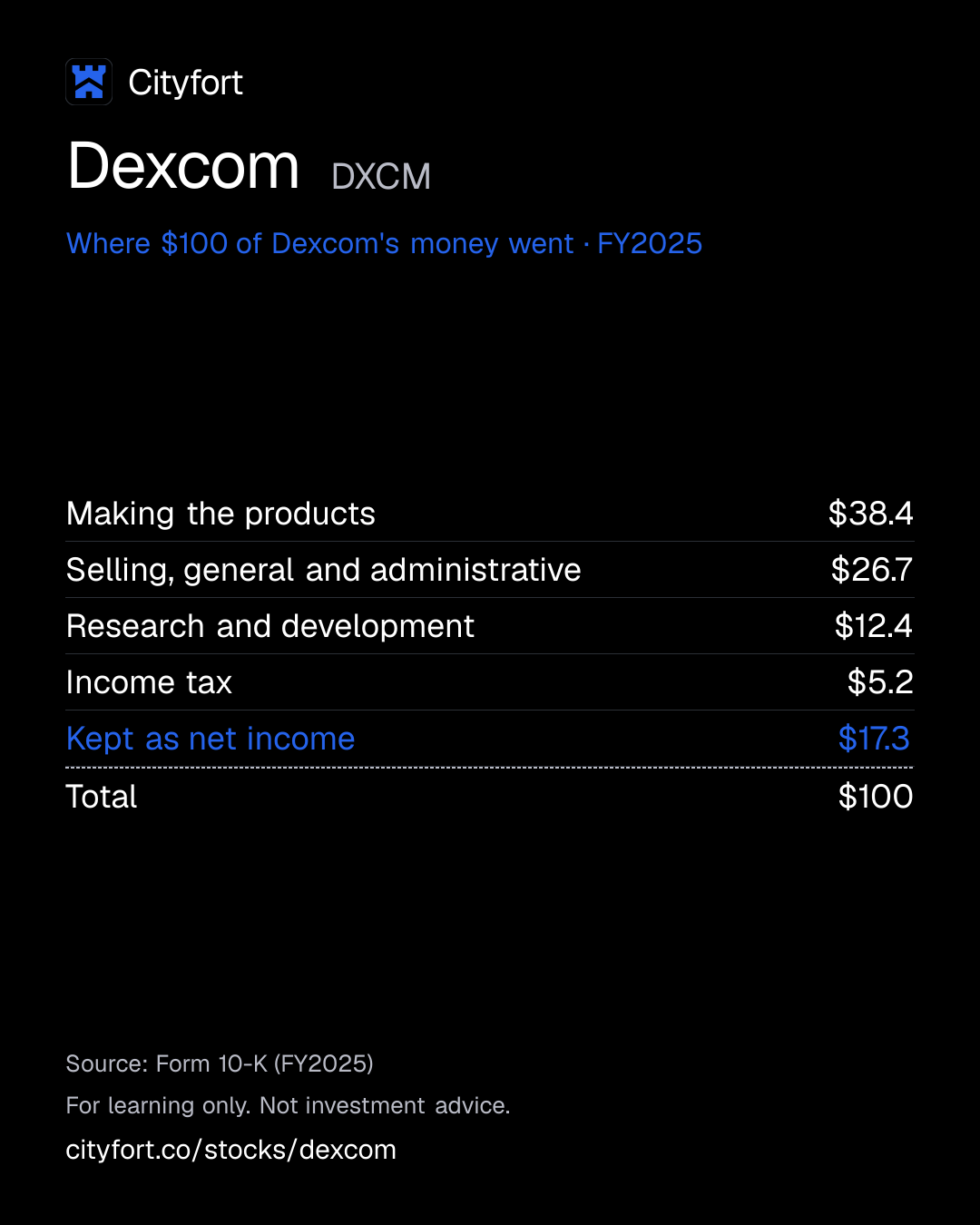
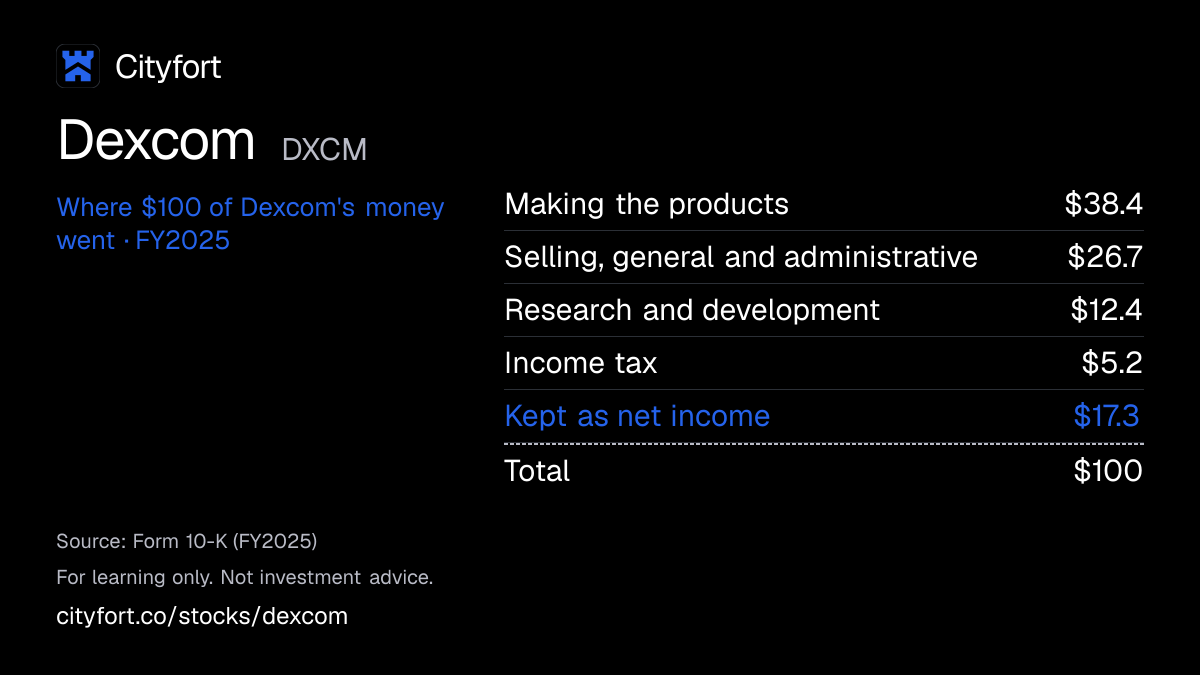
Where does $100 of Dexcom's money go?
Dexcom · FY2025
Receipt for every $100
| Making the products | $38.4 |
|---|---|
| Selling, general and administrative | $26.7 |
| Research and development | $12.4 |
| Income tax | $5.2 |
| Kept as net income | $17.3 |
| Total | $100 |
Each line = amount ÷ total money in × 100. Lines may not add to exactly $100 because of rounding.
How this is worked out
Cityfort calculation from the FY2025 10-K. Of every $100 that came in during FY2025 (revenue of $4.66 billion plus $176.6 million of other income, net): each line = line ÷ $4.84 billion × 100.
Save this receipt as an image
Embed this receipt or the key numbers
Paste this code into a blog or website to show the card you choose, with a link back to this page.
Each week: the next company due to report earnings, explained in 5 points.
No tips. Unsubscribe anytime.
We'll send a confirmation email. See our privacy policy.
02The business in one line
What does Dexcom do?
Distributors pay Dexcom for glucose sensors that users replace every 10 to 15.5 days; making them is the biggest cost.
- Distributors and wholesalers brought in 84.9% of FY2025 revenue, and US customers 71.5%. Medicare, Medicaid and insurers pay much of the cost in the end.
- Of every $100 that came in during FY2025, making the products took $38.4 and Dexcom kept $17.3 as net income, or $836.3 million.
03Who pays it
Who pays Dexcom?
Distributors and wholesalers
84.9%
of revenue
Companies that buy the sensors and supply pharmacies, patients and health systems. They brought in $3.96 billion of FY2025 revenue.
Direct sales
15.1%
of revenue
Sales Dexcom makes itself, mainly outside the US: $703.0 million in FY2025.
Medicare, Medicaid and insurers (who pay in the end)
Share of revenue not disclosed
In the US the G7 is covered by Medicare, by Medicaid in most states and by commercial insurers for eligible people with diabetes. Rebates to pharmacy benefit managers and payers reduce the revenue Dexcom records.
- Distributors and wholesalers84.9%
- Direct sales15.1%
Customer concentration
Three customers, named only as A, B and C in the FY2025 10-K, each brought in 10% or more of FY2025 revenue: Customer A 55%, Customer B 35% and Customer C 46%. They add up to more than 100% because the company counts each customer's sales net of its own rebates only. Distributor and direct shares are a Cityfort calculation from the FY2025 10-K.
- Largest customer
- 55%
Sources (1)
04How it makes money
How does Dexcom make money?
Users replace a disposable sensor every 10 to 15.5 days, so each user brings repeat revenue.
A G7 sensor lasts 10 days and a G7 15 Day sensor 15.5 days, then the user needs a new one. Research and selling costs grew more slowly than revenue, so more of each dollar reached operating income. From FY2023 to FY2025 revenue rose $1.04 billion while operating expenses rose $198.9 million.
Operating income per $100 of revenue (Cityfort calculation from the FY2021 and FY2025 10-Ks)
$10.9$19.6
FY2021 to FY2025
- A doctor prescribes a CGM and an insurer agrees to cover it.
- The user wears a sensor and replaces it every 10 to 15.5 days.
- Each replacement is a new sale through a distributor or pharmacy.
- Higher volume spreads factory, research and sales costs over more sensors.
- Profit pays for new sensors, software and plants.
↺ Step 5 feeds back into step 1.
05The numbers · Consolidated · US$
How has Dexcom done?
Revenue
$4.7BFY2025
Revenue grew every year, from $2.45 billion in FY2021 to $4.66 billion in FY2025.
US$
See the numbers
Net income
$836MFY2025
Net income rose from $216.9 million in FY2021 (restated) to $836.3 million in FY2025, which included $78.1 million of gains on equity investments.
US$
See the numbers
Net income for every $100 of revenue
$17.9FY2025
Net income per $100 of revenue rose from $8.9 in FY2021 to $17.9 in FY2025.
Net margin: $ of net income per $100 of revenue
See the numbers
Free cash flow
$1.1BFY2025
Free cash flow reached $1.08 billion in FY2025, up from $630.7 million in FY2024, as operating cash flow rose to $1.44 billion.
US$ · cash from operations minus spending on plants and equipment
See the numbers
See all yearly numbers
EBITDA here = operating income plus depreciation and amortization (from the cash flow statement). Fiscal years are the company's own: Fiscal year ends Dec 31. Net income is the share belonging to the company's owners.
Learn: Fiscal years that don't end in December: Nvidia's FY2027 explained · Stock-based compensation and dilution: pay that becomes shares
Sources (15)
- Form 10-K for FY2021
- Form 10-K for FY2023
- Form 10-K for FY2022
- Form 10-K for FY2024
- Form 10-K for FY2025
- Form 10-Q for Q1 FY2024
- Form 10-Q for Q2 FY2024
- Form 10-Q for Q3 FY2024
- Q4 FY2025 earnings release (Form 8-K, Exhibit 99.1)
- Form 10-Q for Q1 FY2025
- Form 10-Q for Q2 FY2025
- Form 10-Q for Q3 FY2025
- Form 10-Q for Q1 FY2026
- Form 10-Q for Q2 FY2026
- Form 10-Q for Q3 FY2026
06Who runs it
Who runs Dexcom, and did they deliver?
Jacob (Jake) Leach
President and Chief Executive Officer · since 2026
CEO from Jan 1, 2026, after serving as President and COO. He was also interim principal executive officer from Sep 14, 2025, while the CEO was on medical leave.
Kevin Sayer
Executive Chairman · since 2026
CEO until Dec 31, 2025 and a director since 2007. He was on medical leave from Sep 14, 2025 to Mar 2, 2026.
Jereme Sylvain
Executive Vice President and Chief Financial Officer · since 2021
CFO since March 2021 and Chief Accounting Officer since March 2020.
Jon Coleman
Executive Vice President and Chief Commercial Officer · since 2025
In the role since March 2025; previously at Masimo.
Mark Foletta
Lead Independent Director
Signed the FY2025 10-K as Interim Chairman of the Board and Lead Independent Director. Ten of the 12 directors are independent, the 2026 proxy says.
What they said, and what happened
2 too early to tell
Said on Feb 12, 2026
Dexcom expects FY2026 revenue of $5.16 billion to $5.25 billion.
Too early to tellWhat happened
Raised to $5.20 billion to $5.25 billion on Oct 29, 2026; revenue for the first nine months of FY2026 was $3.84 billion. The full year is reported with Q4 FY2026 results.
Said on Feb 12, 2026
Dexcom expects a FY2026 non-GAAPThe company's own "adjusted" numbers, not the official (GAAP) ones. Always read them next to the official figure. Learn more operating margin of about 22% to 23%.
Too early to tellWhat happened
Raised to about 24% on Oct 29, 2026; the Q3 FY2026 non-GAAP operating margin was 25.3%.
07What could go wrong
What could go wrong for Dexcom?
- Competition
Competition from Abbott's Libre and others
The 10-K calls the market intensely competitive. Abbott, MiniMed, Roche and others sell glucose monitors, and Abbott has FDA clearance to link certain Libre sensors to insulin delivery systems.
Watch US and international revenue growth each quarter in the earnings release.
- Regulation
FDA warning letter
The March 2025 letter describes manufacturing and quality-system non-conformities. The 10-K warns that failing to satisfy the FDA could lead to restrictions or product withdrawals.
Watch Any FDA close-out letter or new action mentioned in a 10-Q.
- Pricing
Medicare competitive bidding and rebates
Medicare bidding for CGMs starts with contracting in 2027 and payment changes from Jan 1, 2028. The FY2025 10-K says CMS anticipates awarding 10 contracts for CGMs. Pharmacy rebates already lower the revenue Dexcom records.
Watch Contract awards in 2027 and any pricing effect the 10-K describes.
- Concentration
Reliance on three large customers
Customers A, B and C brought in 55%, 35% and 46% of FY2025 revenue. The 10-K says a large drop or loss of these sales could have a material adverse effect.
Watch Customer shares in the FY2026 10-K.
- Legal
Lawsuits over the G7 and past statements
Securities and consumer class actions allege that Dexcom made misleading statements and that its devices did not perform as advertised. The 10-Q states no amounts.
Watch A ruling on the motion to dismiss in Prime v. Dexcom, the Ninth Circuit appeal in the 2024 securities case, and the consolidated complaint in In re: Dexcom CGM Litigation.
- Execution
Few factories
Most products come from Mesa and Penang, and the Ireland plant is still being built. The 10-K notes the earthquake risk at its California sites.
Watch Capital spending and the Ireland plant's start-up.
08Supporters vs. critics
What do supporters and critics point to?
What supporters point to
- Revenue grew every year, from $2.45 billion in FY2021 to $4.66 billion in FY2025.
- Operating income rose from $10.9 per $100 of revenue in FY2021 to $19.6 in FY2025.
- Free cash flow reached $1.08 billion in FY2025, up from $630.7 million in FY2024.
- Cash and short-term investments of $1.82 billion were larger than the $1.24 billion of convertible notes at Sep 30, 2026.
- The G7 15 Day sensor launched in the US in late 2025 and won its first two international clearances in Q3 FY2026.
What critics point to
- Three distributor customers, named only as A, B and C, each brought in 35% to 55% of FY2025 revenue.
- The FDA's March 2025 warning letter described manufacturing and quality-system non-conformities, the FY2025 10-K says.
- Securities and consumer class actions allege that Dexcom made misleading statements and that its devices did not perform as advertised.
- International revenue growth, as reported, slowed from 26% in Q1 FY2026 to 5% in Q3 FY2026.
- Medicare competitive bidding for CGMs starts with contracting in 2027, and the FY2025 10-K says CMS anticipates awarding 10 contracts.
09What to watch next
What should you watch next at Dexcom?
Next event
Q4 FY2026 results
Date not announced yet.
Full-year revenue against the company's range
On Oct 29, 2026 Dexcom said it expects FY2026 revenue of $5.20 billion to $5.25 billion. Revenue for the first nine months was $3.84 billion.
International growth
International revenue growth, as reported, was 26% in Q1, 19% in Q2 and 5% in Q3 FY2026. US growth was 14% in Q3.
Medicare competitive bidding
Contracting for CGMs starts in 2027 and payment changes from Jan 1, 2028. The FY2025 10-K says CMS anticipates awarding 10 contracts.
Lawsuits and the FDA letter
A ruling on the motion to dismiss in Prime v. Dexcom, the Ninth Circuit appeal in the 2024 securities case, and the consolidated complaint in In re: Dexcom CGM Litigation, and any FDA close-out letter or new action reported in a 10-Q.
10Key facts
Key facts about Dexcom
- What does Dexcom do?
- DexCom, Inc., founded in 1999 and based in San Diego, makes continuous glucose monitors (CGMs): wearable sensors that read blood sugar all day. Dexcom had revenue of $4.66 billion in FY2025 and about 11,100 employees at Dec 31, 2025.
- How does Dexcom make money?
- Dexcom makes money by selling disposable sensors and the systems that read them. A Dexcom G7 sensor lasts 10 days and a G7 15 Day sensor 15.5 days, so each user buys replacements. Dexcom reports a single business segment.
- Who are Dexcom's customers?
- Distributors and wholesalers brought in 84.9% of Dexcom's FY2025 revenue and direct sales 15.1%. Three distributor customers, named only as A, B and C in the FY2025 10-K, each brought in 35% to 55% of Dexcom's FY2025 revenue.
- Where does Dexcom sell its products?
- Customers in the United States brought in 71.5% of Dexcom's FY2025 revenue and international customers 28.5%. In Q3 FY2026 Dexcom's US revenue was $969.8 million and international revenue $374.7 million.
- Is Dexcom profitable?
- Yes. Dexcom reported net income of $836.3 million in FY2025, up from $216.9 million (restated) in FY2021. FY2025 net income included $78.1 million of gains on equity investments. Dexcom's Q3 FY2026 net income was $275.1 million on revenue of $1.34 billion.
- What is Dexcom Stelo?
- Stelo is a Dexcom glucose biosensor sold without a prescription, launched in August 2024 for adults with prediabetes or Type 2 diabetes who do not use insulin. In June 2026 the FDA cleared Stelo for children aged 2 and older who do not use insulin.
- How much debt does Dexcom have?
- Dexcom's only debt at Sep 30, 2026 was $1.25 billion of 0.375% convertible notes due May 15, 2028, carried at $1.24 billion. Dexcom held $1.82 billion of cash and short-term investments at that date.
- Who owns Dexcom?
- Dexcom has one class of common shares with one vote each, and no holder controls the company. The Vanguard Group held 12.8% and BlackRock 8.4%, as quoted in Dexcom's 2026 proxy statementThe yearly filing about shareholder votes, the board and executive pay. Learn more. Dexcom's directors and executive officers held 0.3% (Cityfort calculation from the 2026 proxy statement).
- Who runs Dexcom?
- Jake Leach became Dexcom's President and Chief Executive Officer on Jan 1, 2026. Kevin Sayer, Dexcom's CEO until Dec 31, 2025, became Executive Chairman, and Jereme Sylvain has been Chief Financial Officer since March 2021.
Terms on this page
- Capital expenditures (capex)
- Customer concentration
- Debt-to-equity
- Earnings per share (EPS)
- EBITDA
- Free cash flow
- Gross margin
- Net debt
- Net margin
- Revenue vs net income
Each explains the term in plain English, with the same number from other companies on Cityfort.
Go deeper
More detail from the same filings. Open any section.
11What it sells
11What it sells
What does Dexcom sell?
Dexcom G7 and G7 15 Day
Prescription CGMs for people with Type 1 or Type 2 diabetes. The G7 sensor is thrown away after 10 days; the G7 15 Day sensor, launched in the US in late 2025, lasts 15.5 days.
Stelo
A glucose biosensor sold without a prescription, launched in August 2024 for adults with prediabetes or Type 2 diabetes who do not use insulin. In June 2026 the FDA cleared it for children aged 2 and older who do not use insulin.
Dexcom One and Dexcom ONE+
Other Dexcom CGM systems, sold mainly outside the US.
Software
Apps and tools built on the sensor data, such as Dexcom Smart Basal, cleared by the FDA in Q4 FY2025 to help clinicians set long-acting insulin doses.
What it does
- Does: Designs and makes wearable glucose sensors in San Diego, Mesa (Arizona) and Penang (Malaysia).
- Does: Sends readings to insulin pumps and smart pens made by partner companies, and to Apple Watch, Garmin and other apps.
- Does: Sells mostly through distributors and pharmacies; government programs and insurers pay much of the cost.
What it does not do
- Does not: Does not make insulin or insulin pumps: partners build Dexcom readings into their own devices.
- Does not: Does not report separate business segments: the 10-K treats the whole company as one segment.
- Does not: Has never paid a cash dividend.
12How the money flows
12How the money flows · FY2025
How does money flow through Dexcom?
Money in
- Revenue from sensors and systems$4.7B
- Other income, net (includes $78.1 million of gains on equity investments)$177M
The company
Dexcom
$4.8B came in
Money out
- Making the products (cost of sales)$1.9B
- Research and development$599M
- Selling, general and administrative$1.3B
- Income tax$252M
- Net income$836M
- Distributors, pharmacies and some patients paid Dexcom $4.66 billion for sensors and systems in FY2025.
- Making the products took $1.86 billion, leaving $2.80 billion of gross profit.
- Research cost $599.1 million and selling, general and administrative costs $1.29 billion.
- Other income, net, including $78.1 million of equity investment gains, added $176.6 million.
- After $252.1 million of income tax, $836.3 million was left as net income.
Sources (1)
13What it needs to run
13What it needs to run
What does Dexcom need to run?
Sensor factories
Dexcom makes most products in Mesa, Arizona and Penang, Malaysia. A new plant is being built in Athenry, Ireland; Ireland held $438.8 million of long-lived assets at Dec 31, 2025, up from $185.7 million a year earlier.
FDA clearance
Each new sensor needs FDA marketing authorization, usually through the 510(k) review. The G7 and G7 15 Day are Class II devices under special accuracy rules for integrated CGMs.
Insurance coverage
Most US users rely on Medicare, Medicaid or a commercial insurer to pay. Coverage rules decide who can get a sensor and at what price.
People
About 11,100 employees at Dec 31, 2025, up from about 10,300 a year earlier.
Sources (2)
14Where it sells
14Where it sells · FY2025
Where does Dexcom sell?
- United States71.5%
- International28.5%
Sources (1)
15Competitors and what protects it
15Competitors and what protects it
Who does Dexcom compete with?
Abbott Laboratories (Diabetes Care)
NYSE: ABT
Sells the Libre family of CGMs. The 10-K says Dexcom has competed with Libre for many years. A settlement and patent license on Dec 20, 2024 ended all their pending patent cases.
MiniMed (spun off from Medtronic's Diabetes Group)
Sells the Guardian Connect and Simplera CGMs in the US and abroad.
Roche Diabetes Care
A division of Roche Diagnostics that the 10-K names as a direct competitor in glucose monitoring.
LifeScan and Ascensia Diabetes Care
Glucose monitoring companies the 10-K lists as direct competitors; LifeScan is privately held.
What protects the business
Each strength is scored 1 (weak) to 5 (strong) for the business, with the reason. It is not a rating of the share.
- Device ecosystem4 of 5
The 10-K says the G7 is designed to work with the largest connected CGM ecosystem, including insulin pumps, smart pens and Apple Watch.
- Regulatory clearances3 of 5
Each sensor needs FDA authorization; the G7 15 Day was cleared in April 2025 and won its first two international clearances in Q3 FY2026.
- Insurance coverage3 of 5
The G7 is covered by Medicare, by Medicaid in most states and by commercial insurers, subject to eligibility rules.
- Manufacturing scale3 of 5
Plants in Arizona and Malaysia, with a third in Ireland under construction, made sensors for $4.66 billion of FY2025 revenue.
Weak spot
Price set by payers and a few large customers
Three customers, named only as A, B and C in the FY2025 10-K, each brought in 35% to 55% of FY2025 revenue, and Medicare competitive bidding for CGMs starts with contracting in 2027.
16Where growth could come from
16Where growth could come from
Where could Dexcom's growth come from?
In its Q3 FY2026 earnings release of Oct 29, 2026, Dexcom said it expects FY2026 revenue of $5.20 billion to $5.25 billion (about 12% to 13% growth). It also said it expects a non-GAAP gross margin of about 64%, a non-GAAP operating margin of about 24% and an Adjusted EBITDA marginOperating profit before wear-and-tear charges (depreciation and amortization). As a margin: per $100 of sales. of about 32%. It raised the midpoint of its revenue range and its non-GAAP operating margin and Adjusted EBITDA margin guidance at that time.
G7 15 Day rollout
WorkingUS launch late 2025; 2 international clearances in Q3 FY2026
The longer-lasting sensor expanded across all US channels in Q1 FY2026, the Q1 release says. The Q3 release says the global user base is moving to it.
Status: Working, on track against what the company said.
Stelo without a prescription
EarlyLaunched Aug 2024; children 2+ added Jun 2026
Stelo is designed for people with prediabetes or Type 2 diabetes who do not use insulin, the FY2025 10-K says. A redesigned Stelo experience launched in Q3 FY2026.
Status: Early, too early to judge.
International sales
MixedGrowth +26% in Q1, +19% in Q2, +5% in Q3 FY2026
International revenue was $374.7 million in Q3 FY2026, against $969.8 million in the US, where growth was 14%.
Status: Mixed, partly on track.
Type 2 diabetes without insulin
NewCONNECT trial published in NEJM, Oct 2026
The randomized trial used the G7 in people with Type 2 diabetes not on insulin, the same group Stelo is designed for.
Status: New, recently announced.
Status compares progress with what the company itself said it would do: Working = on track against what the company said; Mixed = partly on track; Behind = behind the company's own plan; New = recently announced; Early = too early to judge.
17The company's own measures (non-GAAP)
17The company's own measures · FY2025 and Q3 FY2026
What do Dexcom's own measures show?
Official (GAAP): Operating income, FY2025
$912M
Company's own measure: Adjusted EBITDA, FY2025
$1.3B
Adjusted EBITDA adds back depreciation, amortization and stock-based compensationPay given as shares instead of cash, which spreads ownership more thinly. Learn more. It leaves out interest, equity investment gains or losses, tax and other items the company lists.
Official (GAAP): Operating income, FY2025
$912M
Company's own measure: Non-GAAP operating income, FY2025
$969M
Leaves out amortization of acquired intangibles, business transition costs, Abbott patent litigation costs, litigation settlements and other listed items. Stock-based compensation stays in.
Official (GAAP): Operating income, Q3 FY2026
$327M
Company's own measure: Adjusted EBITDA, Q3 FY2026
$435M
Same definition as the yearly figure.
Official (GAAP): Gross margin, Q3 FY2026
64.3%
Company's own measure: Non-GAAP gross margin, Q3 FY2026
65.1%
Leaves out amortization of acquired intangible assets and business transition costs, among the listed items.
Official (GAAP): Diluted EPS, Q3 FY2026
$0.72
Company's own measure: Non-GAAP diluted EPS, Q3 FY2026
$0.73
Based on non-GAAP net income of $275.0 million against GAAP net income of $275.1 million.
These are the company's own measures, defined by the company. They are not comparable across companies, and they are not added together. Each sits beside the nearest official (GAAP) figure.
Learn: Non-GAAP measures: what a company's "adjusted" numbers leave out · Stock-based compensation and dilution: pay that becomes shares
18Financial strength and debt
18Financial strength · Sep 30, 2026
How much debt does Dexcom have?
- Total debt$1.2B
- Cash and investments$1.8B
- Net cash (cash minus debt)$574M
- Net worth (shareholders' money)$2.5B
- Debt to equity
- 0.49×
- $ of debt for every $1 of shareholders' money
- Net cash of $574.2 million is a Cityfort calculation from the Q3 FY2026 10-Q. It is cash of $961.4 million plus $856.5 million of short-term marketable securities, minus the $1,243.7 million carrying value of the notes.
- The only debt is $1.25 billion of 0.375% convertible notes due May 15, 2028. Holders can swap them for shares at $162.41 each; Dexcom may settle in cash, shares or both.
- A $200 million revolving credit line signed in September 2026 and maturing in September 2031 was undrawn at Sep 30, 2026.
- Dexcom repaid $1.21 billion of 0.25% convertible notes in cash when they matured in November 2025.
19Who owns it
19Who owns it · ownership as of Apr 1, 2026
Who owns Dexcom?
- Officers and directors (as a group), shares
- 0.3%
Share classes
Holders of 5% or more
From the company's proxy statement (DEF 14A), later Schedule 13G filings and the share counts on its latest annual or quarterly report. Each holder row shows the date of its own filing.
Learn: How to read a proxy statement (DEF 14A): Nvidia's 2026 proxy · Form 4 insider filings: who files, the codes and the footnotes
20What it does with profit
20What it does with profit
What does Dexcom do with its profit?
Buyback · Dec 31, 2025
Spent $500.0 million buying back its own shares during FY2025, after $750.0 million in FY2024.
$500M
Buyback · Aug 31, 2026
Used the $1.0 billion authorization of May 14, 2026 in full by August 2026; in August alone it bought 4,633,657 shares at an average $86.32.
$1.0B
Buyback · Oct 29, 2026
Announced a new authorization of up to $1.0 billion, running no later than Dec 31, 2027. The company is not obliged to buy any shares.
$1.0B
Money raised · May 1, 2023
Raised $1.25 billion of 0.375% convertible notes due 2028 (net proceeds $1.23 billion).
$1.3B
21Governance signals
21Governance signals
What do Dexcom's governance filings show?
- Auditor
- Deloitte & Touche LLP, since 2025
- Auditor changes
- Mar 21, 2025: Ernst & Young LLP → Deloitte & Touche LLP (The Audit Committee dismissed Ernst & Young and engaged Deloitte. The 2026 proxy says Ernst & Young's reports for FY2023 and FY2024 were unqualified and there were no disagreements.)
- Audit qualifications
- None reported
- Related-party dealings
- The 2026 proxy says there were no related-person transactions above $120,000 requiring disclosure since Jan 1, 2025. The Audit Committee reviews any such deals.
- Credit rating
- No public credit rating found in a search of rating agency sites on Nov 20, 2026
Flags to know about
regulatory
FDA warning letter, March 2025
After inspections in Mesa (June 2024) and San Diego (October to November 2024), the FDA sent a warning letter describing non-conformities in manufacturing processes and the quality system. The 10-K says the letter does not restrict sales or new 510(k) clearances, and the company has responded.
other
Securities class actions
Two proposed class actions allege that Dexcom made false and misleading statements. One, filed in 2024 in the Southern District of California, covers statements on fiscal 2024 revenue made from Apr 28, 2023 to Jul 25, 2024. The court dismissed the first case with prejudice on Aug 27, 2026; the plaintiff appealed on Sep 25, 2026. The other, Prime v. Dexcom (filed Oct 27, 2025, Southern District of New York), covers the G7's accuracy and reliability. Several derivative suits (brought by shareholders on the company's behalf) followed; all are stayed.
other
G6 and G7 consumer class actions
Six proposed class actions filed from Sep 29, 2025 to Jan 8, 2026 allege that users overpaid for G6 or G7 devices that failed to perform as advertised. Five were consolidated in federal court on May 15, 2026; the company says it intends to defend them.
other
Chief executive change during a medical leave
Kevin Sayer took medical leave from Sep 14, 2025 to Mar 2, 2026; Jake Leach acted as principal executive officer and became CEO on Jan 1, 2026, as announced in July 2025.
disclosure
Large customers named only by letter
The FY2025 10-K shows three customers at 35% to 55% of revenue each but does not name them.
22How it got here
22How it got here
How did Dexcom get here?
1999
Milestone
Founded
Dexcom was founded in 1999, its earnings releases say.
2006
Milestone
First FDA-approved product
Its first CGM won FDA approval and went on sale.
2022
Milestone
G7 cleared
CE Mark in March and FDA authorization in December for the all-in-one G7 sensor, launched in 2023.
2024
Business-model change
Stelo, sold without a prescription
Launched in August as the first over-the-counter glucose biosensor in the US. In December a settlement with Abbott ended all their pending patent cases.
2025
Crisis
FDA warning letter and lawsuits
The FDA's March letter described manufacturing non-conformities, and consumer class actions over the G6 and G7 followed from September.
2025
Milestone
G7 15 Day launched
Cleared in April and launched in the US late in the year; the sensor lasts 15.5 days.
2026
Milestone
New chief executive
Jake Leach became CEO on Jan 1, 2026 and Kevin Sayer Executive Chairman.
23Sources and changes
Where every number on this page comes from
Sources (19 documents)
- S1Form 10-Q for Q3 FY2026 · SEC EDGAR · Tier 1: company or exchange filing · Oct 29, 2026
- S2Form 10-Q for Q2 FY2026 · SEC EDGAR · Tier 1: company or exchange filing · Jul 30, 2026
- S3Form 10-Q for Q1 FY2026 · SEC EDGAR · Tier 1: company or exchange filing · Apr 30, 2026
- S4Form 10-K for FY2025 · SEC EDGAR · Tier 1: company or exchange filing · Feb 12, 2026
- S5Form 10-Q for Q3 FY2025 · SEC EDGAR · Tier 1: company or exchange filing · Oct 30, 2025
- S6Form 10-Q for Q2 FY2025 · SEC EDGAR · Tier 1: company or exchange filing · Jul 30, 2025
- S7Form 10-Q for Q1 FY2025 · SEC EDGAR · Tier 1: company or exchange filing · May 1, 2025
- S8Form 10-K for FY2024 · SEC EDGAR · Tier 1: company or exchange filing · Feb 18, 2025
- S9Form 10-Q for Q3 FY2024 · SEC EDGAR · Tier 1: company or exchange filing · Oct 24, 2024
- S10Form 10-Q for Q2 FY2024 · SEC EDGAR · Tier 1: company or exchange filing · Jul 25, 2024
- S11Form 10-Q for Q1 FY2024 · SEC EDGAR · Tier 1: company or exchange filing · Apr 25, 2024
- S12Form 10-K for FY2023 · SEC EDGAR · Tier 1: company or exchange filing · Feb 8, 2024
- S13Form 10-K for FY2022 · SEC EDGAR · Tier 1: company or exchange filing · Feb 9, 2023
- S14Form 10-K for FY2021 · SEC EDGAR · Tier 1: company or exchange filing · Feb 14, 2022
- S152026 Proxy Statement (DEF 14A) · SEC EDGAR · Tier 1: company or exchange filing · Apr 15, 2026
- S16Q3 FY2026 earnings release (Form 8-K, Exhibit 99.1) · SEC EDGAR · Tier 1: company or exchange filing · Oct 29, 2026
- S17Q2 FY2026 earnings release (Form 8-K, Exhibit 99.1) · SEC EDGAR · Tier 1: company or exchange filing · Jul 30, 2026
- S18Q1 FY2026 earnings release (Form 8-K, Exhibit 99.1) · SEC EDGAR · Tier 1: company or exchange filing · Apr 30, 2026
- S19Q4 FY2025 earnings release (Form 8-K, Exhibit 99.1) · SEC EDGAR · Tier 1: company or exchange filing · Feb 12, 2026
Changes to this page (v1 · Nov 20, 2026)
- v1 · Nov 20, 2026First version. (first version)
Numbers come only from tier 1 and tier 2 sources. Read how we research.
Disclaimer
For learning only. Cityfort is not a registered investment adviser or broker-dealer and does not recommend buying or selling any security. Prices shown are dated and may be out of date.
Investing in securities involves risk, including loss of capital. Before making any investment decision, do your own research and consider consulting a registered investment adviser or other qualified professional.
Cityfort, its owners and contributors may or may not hold securities of companies covered. Cityfort is not paid by any company it covers. Content is not an offer or solicitation to buy or sell any security, including in any initial public offering.
Read the positions policyRead the full disclaimerHide the full disclaimer
Cityfort publishes general educational content that explains how listed companies work. Cityfort is not registered with the US Securities and Exchange Commission or any state securities regulator as an investment adviser, and is not a broker-dealer or a member of FINRA. Cityfort does not provide investment, tax or legal advice, recommendations, ratings, price targets or any opinion on whether to buy, sell or hold any security. Nothing on the site is tailored to any person's circumstances.
All information is taken from publicly available sources, mainly company filings with the SEC, which are listed on each page with dates. We work to keep it accurate and correct errors publicly, but we do not guarantee that it is complete, accurate or up to date. Any market price or price-based ratio shown is dated, may be out of date by the time you read it, and is included only to explain concepts.
Statements by company management, including forward-looking statements and guidance, are reported as the company's statements, with their date and source; they are not our forecasts. Adjusted (non-GAAP) figures are the company's own measures and are shown next to the official (GAAP) figures.