Health Care · NYSE: RMD
ResMed: how the business works
ResMed makes machines and masks that treat sleep apnea, where breathing stops and starts during sleep. It also sells software to home care providers and had net revenue of $5.65 billion in FY2026.
By Hardik Bhandare · Checked against filings: . Editorial policy. Corrections
Follow ResMed
Email me when ResMed's page is updated after earnings.
We'll send a confirmation email first. See our privacy policy.
ResMed Inc. · San Diego, California · Founded 1989
Updated for Q1 FY2027 · checked
- Net revenue, FY2026
- $5.65B
- Net income, FY2026
- $1.52B
- Patients on cloud-connected devices
- More than 35 million
- Employees, Jun 30, 2026
- About 11,370
- Founded
- 1989
The short version
ResMed in 5 points
1 · What it sells
ResMed sells sleep apnea machines, masks, home ventilators and care software, with net revenue of $5.65 billion in FY2026: devices $2.89 billion and masks and other products $2.09 billion.
2 · Who pays it
US customers, mainly equipment suppliers, health systems and sleep clinics that bill insurers, made up 63.0% of FY2026 revenue and customers in the rest of the world 37.0% (Cityfort calculation from the FY2026 10-K).
3 · What it keeps from $100
Of every $100 that came in during FY2026, ResMed kept $26.8 as net income, after $41.9 million of Astral ventilator safety costs; other income added only $32.7 million, and the GAAP operating margin was 33.4%.
4 · Where the operating profit comes from
Sleep and Breathing Health brought in 88% of FY2026 revenue and earned $44.3 of segment profit per $100 of its revenue before corporate costs (Cityfort calculation from the FY2026 10-K).
5 · The one thing to watch
ResMed's FY2026 10-K says GLP-1 weight-loss drugs could reduce the severity of sleep apnea, while its device revenue grew 9% in FY2026 and 5.9% in Q1 FY2027.
Sources: From ResMed's FY2026 10-K, the Q1 FY2027 10-Q and the Aug 6, 2026 earnings release · checked
01Where the money goes · FY2026
Where does $100 of ResMed's money go?
ResMed · FY2026
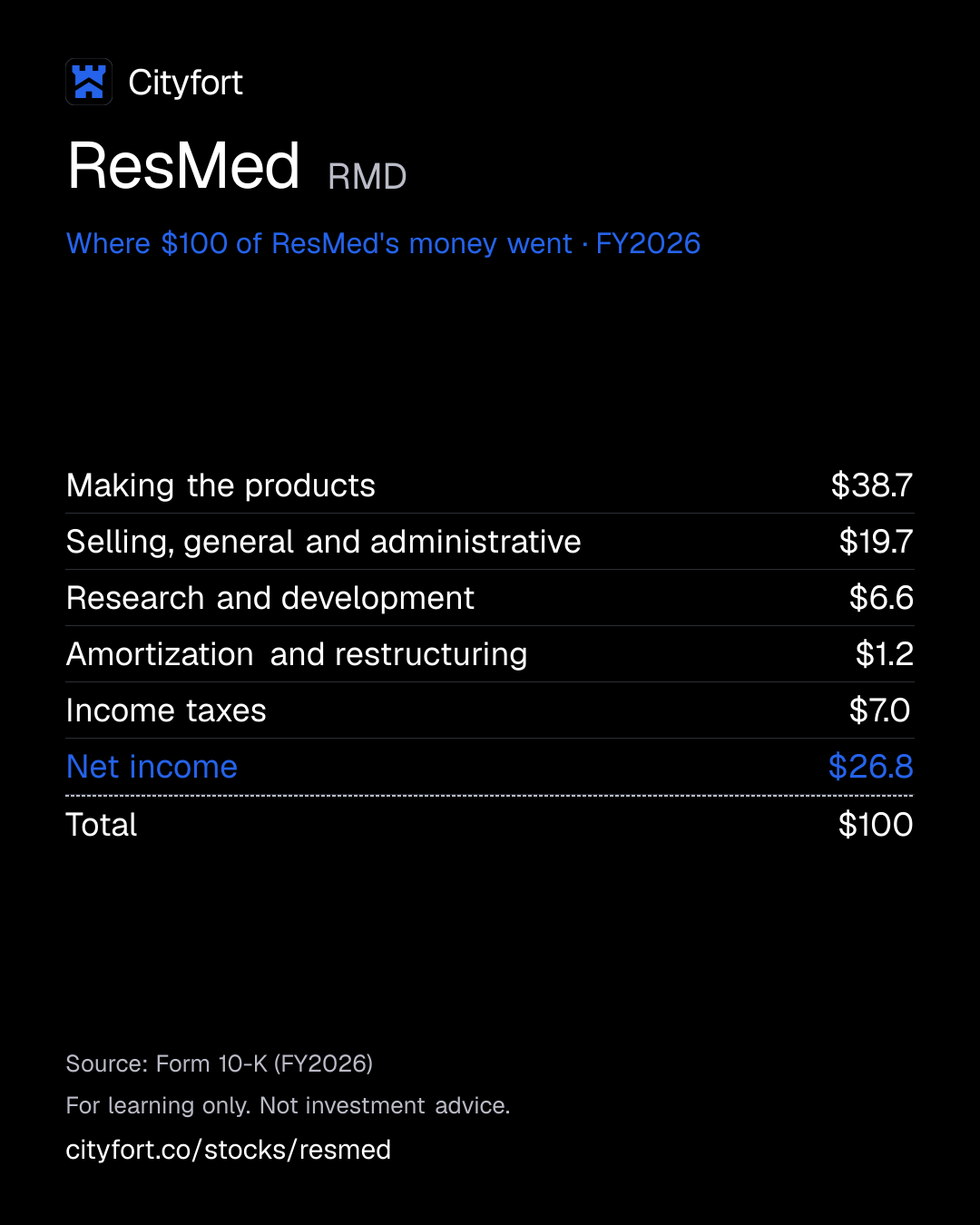
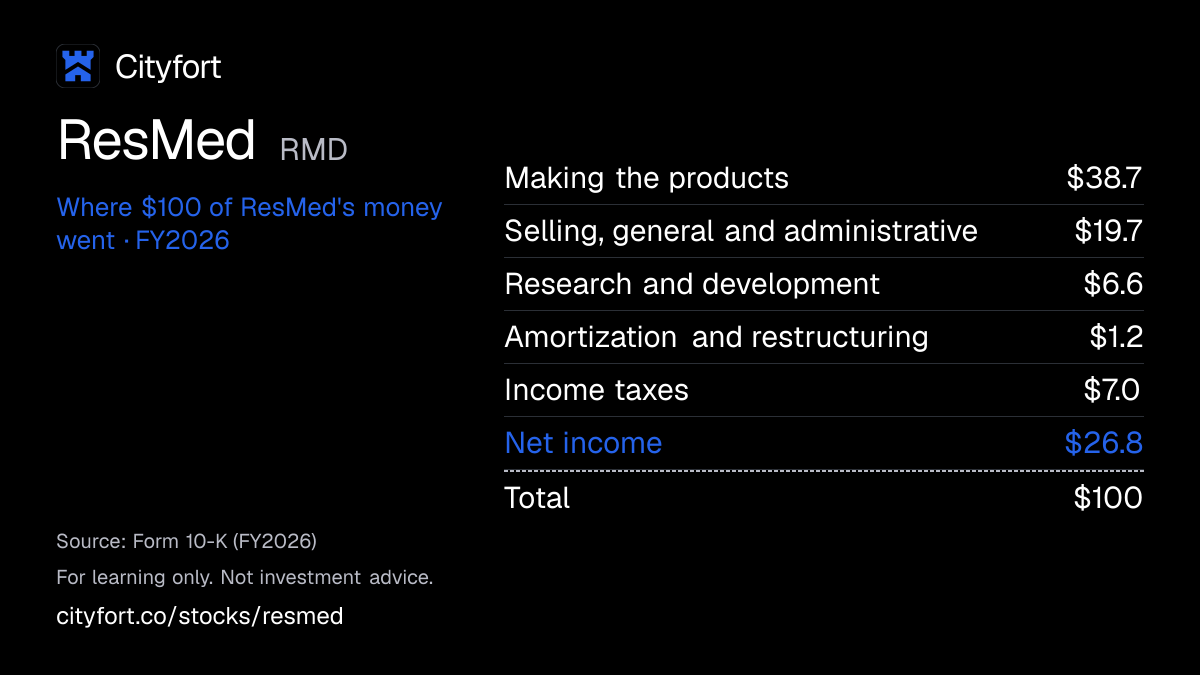
Receipt for every $100
| Making the products | $38.7 |
|---|---|
| Selling, general and administrative | $19.7 |
| Research and development | $6.6 |
| Amortization and restructuring | $1.2 |
| Income taxes | $7.0 |
| Net income | $26.8 |
| Total | $100 |
Each line = amount ÷ total money in × 100. Lines may not add to exactly $100 because of rounding.
How this is worked out
Cityfort calculation from the FY2026 10-K. Of every $100 that came in during FY2026 (net revenue of $5.65 billion plus $32.7 million of other income, net): each line = line ÷ $5.69 billion × 100.
Save this receipt as an image
Embed this receipt or the key numbers
Paste this code into a blog or website to show the card you choose, with a link back to this page.
Each week: the next company due to report earnings, explained in 5 points.
No tips. Unsubscribe anytime.
We'll send a confirmation email. See our privacy policy.
02The business in one line
What does ResMed do?
Equipment suppliers, clinics and distributors pay ResMed for sleep apnea machines, masks and software. Making the products took $38.7 of every $100 that came in during FY2026, and $26.8 was left as net income.
- In the US, suppliers set up the machines for patients and bill Medicare, Medicaid or private insurers. US customers made up 63.0% of FY2026 revenue (Cityfort calculation from the FY2026 10-K).
- Sleep and Breathing Health brought in 88% of FY2026 revenue. Masks and other products grew 13% that year, faster than devices at 9%.
03Who pays it
Who pays ResMed?
US equipment suppliers, health systems and sleep clinics
Share of revenue not disclosed
They buy the machines and masks, set them up for patients and bill Medicare, Medicaid or private insurers. Customers in the United States made up 63.0% of FY2026 revenue (Cityfort calculation from the FY2026 10-K).
Distributors and direct customers outside the US
Share of revenue not disclosed
Outside the US, ResMed sells through its own sales staff and independent distributors. The rest of the world made up 37.0% of FY2026 revenue (Cityfort calculation from the FY2026 10-K).
Software customers
12%
of revenue
Equipment suppliers, pharmacies and care providers pay for Brightree and MEDIFOX DAN software. The software segment brought in $675.8 million in FY2026.
Insurers and government payors (indirect)
Share of revenue not disclosed
Medicare, Medicaid and private health plans pay the suppliers, not ResMed. Their coverage rules decide which patients get a device.
Customer concentration
No customer reached 10% of revenue in FY2024, FY2025 or FY2026. In Q1 FY2027 one unnamed customer was 11% of total revenue, across both segments, the Q1 FY2027 10-Q says.
- Largest customer
- 11%
04How it makes money
How does ResMed make money?
Profit grew faster than revenue as gross margin widened
Revenue rose 58% from FY2022 to FY2026, while net income rose 95% (Cityfort calculation from the FY2022 and FY2026 10-Ks). GAAP gross margin rose from 59.4% in FY2025 to 61.1% in FY2026. The company credits component costs and manufacturing and logistics efficiencies.
Net income per $100 of revenue
$21.8$26.9
FY2022 to FY2026
- A patient is diagnosed with sleep apnea, often with a home test
- An equipment supplier sets up a ResMed machine and mask, and an insurer pays
- The connected device reports nightly use to clinicians on AirView
- Masks and other products grew 13% in FY2026, faster than devices at 9%
- Lower component and factory costs lifted gross margin to 61.1%
↺ Step 5 feeds back into step 1.
05Business segments · FY2026
Which businesses make up ResMed?
Sleep and Breathing Health
88%Machines, masks, ventilators, diagnostics and the apps that connect them. Segment profit, before corporate costs, was $44.3 per $100 of segment revenue (Cityfort calculation from the FY2026 10-K).
Revenue $5.0B ($4,978M) · Operating profit $2.2B ($2,205M)
Residential Care Software
12%Software for care providers outside hospitals: Brightree, MEDIFOX DAN and, until Sep 1, 2026, MatrixCare. FY2022 and FY2023 figures are from the FY2024 10-K, which used older segment names.
Revenue $676M · Operating profit $218M
How the mix changed
- Sleep and Breathing Health
- Residential Care Software
Revenue by segment, FY2022 to FY2026.
US$
See the numbers
06The numbers · Consolidated · US$
How has ResMed done?
Revenue
$5.7BFY2026
Revenue grew every year, from $3.58 billion in FY2022 to $5.65 billion in FY2026.
US$
See the numbers
Net income
$1.5BFY2026
Net income rose every year, from $779 million in FY2022 to $1.52 billion in FY2026.
US$
See the numbers
Net income for every $100 of revenue
$26.9FY2026
Net income per $100 of revenue rose from $21.8 in FY2022 to $26.9 in FY2026; it dipped to $21.3 in FY2023 and peaked at $27.2 in FY2025.
Net margin: $ of net income per $100 of revenue
See the numbers
Free cash flow
$1.6BFY2026
Free cash flow was $1.65 billion in FY2026, close to FY2025's $1.66 billion, as capital spending rose to $156 million.
US$ · cash from operations minus spending on plants and equipment
See the numbers
See all yearly numbers
EBITDA here = operating income plus depreciation and amortization (from the cash flow statement). Fiscal years are the company's own: Fiscal year ends June 30 (FY2026 = Jul 1, 2025 to Jun 30, 2026). Net income is the share belonging to the company's owners.
Learn: Fiscal years that don't end in December: Nvidia's FY2027 explained · Stock-based compensation and dilution: pay that becomes shares
Sources (16)
- Form 10-K for FY2022
- Form 10-K for FY2023
- Form 10-K for FY2024
- Form 10-K for FY2025
- Form 10-K for FY2026
- Form 10-Q for Q2 FY2024
- Form 10-Q for Q3 FY2024
- Q4 FY2025 earnings release (8-K Ex. 99.1)
- Form 10-Q for Q1 FY2025
- Form 10-Q for Q2 FY2025
- Form 10-Q for Q3 FY2025
- Form 10-Q for Q1 FY2026
- Form 10-Q for Q2 FY2026
- Form 10-Q for Q3 FY2026
- Q4 FY2026 earnings release (8-K Ex. 99.1)
- Form 10-Q for Q1 FY2027
07Who runs it
Who runs ResMed, and did they deliver?
Michael (Mick) Farrell
Chairman and Chief Executive Officer · since 2013
CEO since March 2013; also chairman since January 2023, when the board combined the roles. The 2026 proxy lists 603,905 shares, under 1%.
Aaron Bloomer
Chief Financial Officer · since 2026
Appointed May 4, 2026, after Brett Sandercock stepped down. He was CFO of Exact Sciences from May 2024 to May 2026.
Justin Leong
Chief Product Officer · since 2023
In the role since November 2023; leads product strategy, engineering and AI work.
Michael Rider
Global General Counsel and Secretary · since 2023
In the role since July 2023.
Peter Farrell
Founder and Chairman Emeritus · since 1989
Set up the company in 1989 and chaired the board until January 2023. He remains a director and a non-officer employee.
Carol Burt
Lead Independent Director · since 2026
Named lead director effective Nov 15, 2026; Ronald Taylor did not stand for re-election at the Nov 18, 2026 annual meeting.
What they said, and what happened
1 delivered · 2 too early to tell
Said on Jul 7, 2026
Expected the MatrixCare sale to Frazier Healthcare Partners to close in the first quarter of fiscal 2027.
DeliveredWhat happened
The sale closed on Sep 1, 2026, with $470 million in net cash at closing and $8 million in escrow.
Said on Oct 29, 2026
Guided to FY2027 reported revenue of $5.75 billion to $5.85 billion and non-GAAPThe company's own "adjusted" numbers, not the official (GAAP) ones. Always read them next to the official figure. Learn more diluted EPS of $12.00 to $12.25.
Too early to tellWhat happened
Q1 FY2027 revenue was $1.41 billion and non-GAAP diluted EPS $2.91. The fiscal year ends Jun 30, 2027.
Said on Aug 6, 2026
Plans to return more than $1.85 billion to shareholders through buybacks and dividends in FY2027.
Too early to tellWhat happened
In Q1 FY2027 ResMed spent $936.4 million on buybacks and paid $95.0 million in dividends.
Sources (7)
- 2026 proxy statement (DEF 14A)
- Form 10-K for FY2026
- 8-K filed Aug 17, 2026 (auditor change from KPMG to PwC; director changes)
- Q1 FY2027 earnings release (8-K Ex. 99.1)
- 8-K filed Jul 7, 2026, Ex. 99.1 (MatrixCare sale to Frazier Healthcare Partners)
- Form 10-Q for Q1 FY2027
- Q4 FY2026 earnings release (8-K Ex. 99.1)
08What could go wrong
What could go wrong for ResMed?
- Demand
Weight-loss drugs could reduce sleep apnea
The FY2026 10-K says GLP-1 weight-loss drugs may lower obesity and could reduce the severity of sleep apnea if weight loss is maintained. That could cut demand for ResMed's machines over time.
Watch Device revenue growth in each quarterly release (+9% in FY2026).
- Competition
Philips's return to the US market
Philips, a main rival, operates in the US under a consent decree after its product recall. ResMed says it cannot predict the timing or effect of a substantial Philips return.
Watch Americas device growth and any change to the Philips consent decree.
- Regulation
US insurance and Medicare payment rules
US suppliers depend on Medicare, Medicaid and private insurers to pay for devices. Medicare is preparing a 2028 nationwide competitive bidding round, and a 2022 VA proposal would cut sleep apnea disability ratings.
Watch Which product categories Medicare places in the Round 2028 competitive bidding program.
- Raw-material prices
Single-source parts, magnets and tariffs
Some components come from single-source suppliers. The 10-K warns that China's rare-earth export controls and tariffs could raise magnet costs or delay deliveries.
Watch GAAP gross margin in each release (61.5% in Q1 FY2027).
- Concentration
One customer at 11% of revenue
In Q1 FY2027 one unnamed customer was 11% of total revenue, the 10-Q says. No customer reached 10% in the same quarter a year earlier.
Watch Whether later 10-Qs and the 10-K keep reporting a customer above 10%.
- Legal
Patent lawsuits
Cleveland Medical Devices has filed suits since 2022 alleging that connected devices and AirView infringe its patents. Fractus filed a suit in October 2025 alleging AirSense and AirCurve devices infringe its antenna patents. ResMed says it cannot estimate any loss.
Watch Patent Office decisions and court rulings in the Cleveland Medical and Fractus cases.
- Execution
Product safety actions
A field safety notification is a notice to customers about a problem with a device, and it adds costs. An Astral ventilator notification cost $41.9 million in Q4 FY2026, booked in cost of sales.
Watch Field safety costs in the non-GAAP reconciliation of each release.
- Regulation
Higher tax rate
The Pillar Two global minimum tax raised ResMed's tax rate, and Singapore tax holidays expire in whole or part through Jun 30, 2030. The effective rate was 22.4% in Q1 FY2027, against 22.0% a year earlier.
Watch The effective tax rate in each 10-Q.
09Supporters vs. critics
What do supporters and critics point to?
What supporters point to
- Revenue grew every year, from $3.58 billion in FY2022 to $5.65 billion in FY2026, and net income per $100 of revenue rose from $21.8 to $26.9.
- GAAP gross margin rose from 59.4% in FY2025 to 61.1% in FY2026, which the FY2026 10-K puts down mainly to procurement, manufacturing and logistics efficiencies, partly offset by costs of a field safety notification for Astral devices.
- ResMed had $601 million more cash than debt at Sep 30, 2026 (Cityfort calculation from the Q1 FY2027 10-Q).
- More than 35 million patients use its cloud-connected devices on AirView, the FY2026 10-K says.
- The board raised the quarterly dividend 10% to $0.66 on Aug 6, 2026.
What critics point to
- The FY2026 10-K says GLP-1 weight-loss drugs could reduce the severity of sleep apnea if weight loss is maintained.
- US customers made up 63.0% of FY2026 revenue (Cityfort calculation from the FY2026 10-K), and US suppliers depend on Medicare, Medicaid and private insurers to pay.
- ResMed says it cannot predict the timing or effect of a substantial return to the US market by Philips, a main rival.
- In Q1 FY2027 one unnamed customer was 11% of total revenue, the 10-Q says; no customer reached 10% in FY2024 to FY2026.
- Cleveland Medical Devices and Fractus have filed suits alleging that ResMed devices infringe their patents; ResMed says it cannot estimate any loss.
10What to watch next
What should you watch next at ResMed?
Next event
Q2 FY2027 results
Date not announced yet.
Device growth and weight-loss drugs
Device revenue grew 9% in FY2026 and 5.9% in Q1 FY2027. The 10-K names GLP-1 drugs as a possible drag on demand.
Medicare's Round 2028 competitive bidding
Watch which product categories Medicare places in the nationwide bidding round. US customers made up 63.0% of FY2026 revenue (Cityfort calculation from the FY2026 10-K).
Share buyback settlement
The $450 million accelerated share repurchase with Citibank settles by Dec 29, 2026. ResMed spent $936.4 million on buybacks in Q1 FY2027.
Results against the company's guidance
On Oct 29, 2026, management guided to FY2027 reported revenue of $5.75 billion to $5.85 billion. Q1 FY2027 revenue was $1.41 billion.
11Key dates
What are the key dates for ResMed?
| Event | Date | Source |
|---|---|---|
| Quarterly dividend of $0.66 payableRecord date Nov 12, 2026. | Q1 FY2027 earnings release (8-K Ex. 99.1) | |
| Accelerated share repurchase final settlement (latest date) | Form 10-Q for Q1 FY2027 | |
| Revolving and term credit agreements end | Form 10-K for FY2026 | |
| Fiscal 2027 ends | Form 10-K for FY2026 | |
| $250 million 3.45% senior notes due | Form 10-K for FY2026 |
Learn: Fiscal years that don't end in December: Nvidia's FY2027 explained
12Key facts
Key facts about ResMed
- What does ResMed do?
- ResMed makes machines, masks and home ventilators that treat sleep apnea and other breathing conditions, and sells software to home care providers. Its net revenue was $5.65 billion in FY2026, the year ended Jun 30, 2026.
- How does ResMed make money?
- ResMed earns most of its money from its Sleep and Breathing Health segment, which brought in 88% of FY2026 revenue. In FY2026 ResMed's device revenue was $2.89 billion and masks and other revenue $2.09 billion.
- Who are ResMed's customers?
- ResMed sells mainly to equipment suppliers, health systems, sleep clinics and distributors, and US suppliers bill Medicare, Medicaid or private insurers. US customers made up 63.0% of ResMed's FY2026 revenue (Cityfort calculation from the FY2026 10-K), and one unnamed customer was 11% of revenue in Q1 FY2027.
- How big is ResMed?
- ResMed had net revenue of $5.65 billion and net income of $1.52 billion in FY2026, up from $3.58 billion and $779 million in FY2022. It employed about 11,370 people at Jun 30, 2026.
- Who owns ResMed?
- ResMed's directors and officers as a group held 0.58% of its shares at Sep 22, 2026, the 2026 proxy says. The proxy lists Vanguard Capital Management at 8.51% and AustralianSuper at 5.88%, from 2026 filings, and BlackRock at 9.09% from a January 2024 filing.
- When does ResMed's financial year end?
- ResMed's financial year ends on Jun 30. FY2026 is the year ended Jun 30, 2026, and Q1 FY2027 is the quarter ended Sep 30, 2026.
- Does ResMed have more cash than debt?
- ResMed had $601 million more cash than debt at Sep 30, 2026: $1.01 billion of cash against $409.6 million of borrowings (Cityfort calculation from the Q1 FY2027 10-Q).
Terms on this page
- Capital expenditures (capex)
- Customer concentration
- Debt-to-equity
- Earnings per share (EPS)
- EBITDA
- Free cash flow
- Gross margin
- Net debt
- Net margin
- Revenue vs net income
Each explains the term in plain English, with the same number from other companies on Cityfort.
Go deeper
More detail from the same filings. Open any section.
13What it sells
13What it sells
What does ResMed sell?
Sleep apnea machines
CPAP, APAP and bilevel devices such as AirSense and AirCurve push air through a mask overnight. Cloud-connected models link to AirView, which lets clinicians monitor patients remotely and change device settings.
Masks and accessories
Masks, tubing and other parts sold with the machines. Masks, diagnostics and accessories were about 37% of revenue in FY2026, the 10-K says.
Ventilators and breathing devices
Life-support and home ventilators such as Astral, and high-flow devices for lung conditions such as COPD.
Diagnostics and new therapies
Home sleep tests; VirtuOx, a testing business bought in 2025; and Noctrix Health, bought in June 2026, which sells a wearable for restless legs syndrome.
Residential Care Software
Software for care outside hospitals: Brightree for US medical equipment suppliers and MEDIFOX DAN for care providers in Germany. MatrixCare was sold on Sep 1, 2026.
AirView and myAir apps
AirView lets clinicians check patients remotely; myAir lets patients track their own therapy. More than 35 million patients use cloud-connected devices on AirView.
Think of it like this
A CPAP machine works like a gentle, steady breeze that holds the throat open, so breathing does not stop during sleep.
What it does
- Does: Designs and makes sleep apnea machines, masks and home ventilators
- Does: Sells in more than 140 countries through its own staff and distributors
- Does: Runs cloud apps that track how patients use their devices
- Does: Sells software to US medical equipment suppliers and German care providers
What it does not do
- Does not: Does not mainly sell to patients in the US: equipment suppliers, health systems and sleep clinics buy the products and bill insurers
- Does not: Does not make weight-loss drugs; its 10-K names them as a possible threat to demand
- Does not: No longer owns MatrixCare, its nursing-home and senior-living software, sold on Sep 1, 2026
14How the money flows
14How the money flows · FY2026
How does money flow through ResMed?
Money in
- Net revenue$5.7B
- Other income, net (mainly interest income)$32.7M
The company
ResMed
$5.7B came in
Money out
- Making the products (cost of sales, including amortization)$2.2B
- Selling, general and administrative$1.1B
- Research and development$378M
- Amortization of acquired intangibles and restructuring$67.2M
- Income taxes$396M
- Net income$1.5B
- Customers paid $5.65 billion for machines, masks and software in FY2026.
- Making the products cost $2.20 billion. That included $41.9 million for an Astral ventilator field safety notification.
- Selling and running the company cost $1.12 billion, and research took $378 million.
- Interest and other income added $33 million, and income taxes took $396 million.
- $1.52 billion was left as net income.
Sources (1)
15What it needs to run
15What it needs to run
What does ResMed need to run?
Factories in several countries
The FY2026 10-K lists plants in Singapore, Sydney, Johor Bahru in Malaysia, Atlanta and California, plus Suzhou in China and Lyon in France.
Chips, magnets and other parts
Devices need semiconductor chips and magnets, and some parts come from single-source suppliers. The 10-K says China's rare-earth export controls could raise magnet costs.
Research and engineering staff
R&D cost $378 million in FY2026, 6.7% of revenue. About 2,300 of its 11,370 employees work in R&D.
Therapy data from connected devices
AirView and myAir collect nightly use data. Over 12 million patients are registered on myAir, the FY2026 10-K says.
Insurance coverage
US sales depend on Medicare, Medicaid and private insurers agreeing to pay suppliers for the devices.
Sources (1)
16Where it sells
16Where it sells · FY2026
Where does ResMed sell?
- United States63%
- Rest of the world37%
Sources (1)
17Competitors and what protects it
17Competitors and what protects it
Who does ResMed compete with?
Philips
Makes sleep apnea machines and masks. The FY2026 10-K says Philips operates in the US under a consent decree after its recall, and ResMed cannot predict the timing of its full return.
Fisher & Paykel Healthcare
Named in the FY2026 10-K as a primary competitor in sleep and breathing products.
Lowenstein Medical
Named in the FY2026 10-K among its primary Sleep and Breathing Health competitors.
React Health
Named in the FY2026 10-K among its primary Sleep and Breathing Health competitors, alongside DeVilbiss Healthcare and BMC Medical.
What protects the business
Each strength is scored 1 (weak) to 5 (strong) for the business, with the reason. It is not a rating of the share.
- Connected patient base4 of 5
More than 35 million patients use cloud-connected devices on AirView, and over 12 million are registered on myAir, the FY2026 10-K says.
- Scale4 of 5
FY2026 revenue was $5.65 billion, from plants in six countries and sales in more than 140 countries.
- Research spending3 of 5
R&D was $378 million in FY2026, or 6.7% of revenue.
- Software used by its buyers3 of 5
Brightree software serves US home medical equipment suppliers, who are also the main US buyers of ResMed devices.
Weak spot
One condition, one main country
88% of FY2026 revenue came from the Sleep and Breathing Health segment (Cityfort calculation from the FY2026 10-K), and 63.0% of FY2026 revenue came from the US. There, suppliers rely on Medicare, Medicaid and private insurers to pay. The 10-K names weight-loss drugs as a possible threat to demand.
Sources (1)
18Where growth could come from
18Where growth could come from
Where could ResMed's growth come from?
In its Oct 29, 2026 release, management kept its FY2027 guidance unchanged. It expects core constant-currency revenue growth of 5% to 7% and reported revenue of $5.75 billion to $5.85 billion. It also guides to non-GAAP diluted EPS of $12.00 to $12.25.
Masks and accessories
Working+13% in FY2026
Masks and other revenue reached $2.09 billion in FY2026, growing faster than devices. It rose 10.3% in Q1 FY2027 (Cityfort calculation from the Q1 FY2027 10-Q).
Status: Working, on track against what the company said.
Sleep apnea devices
Working+9% in FY2026
Device revenue reached $2.89 billion in FY2026, up 7% in constant currency. It rose 5.9% in Q1 FY2027 (Cityfort calculation from the Q1 FY2027 10-Q).
Status: Working, on track against what the company said.
Gross margin
Working59.4% to 61.1% (GAAP, FY2025 to FY2026)
The company's own non-GAAP gross margin rose from 60.0% to 62.4%. Its releases credit component cost improvements and manufacturing and logistics efficiencies.
Status: Working, on track against what the company said.
Sales outside the Americas
Working+13% in FY2026 (+7% constant currency)
Rest of World sleep and breathing revenue reached $1.70 billion. Currency moves account for the gap between reported and constant-currency growth.
Status: Working, on track against what the company said.
New therapies
NewNoctrix bought June 2026
Noctrix sells an FDA De Novo wearable for restless legs syndrome. VirtuOx, bought in 2025, is an independent diagnostic testing business.
Status: New, recently announced.
Software after the MatrixCare sale
Mixed$155.0M in Q1 FY2027, down from $166.1M
Reported software revenue fell after the Sep 1, 2026 sale. The remaining Brightree and MEDIFOX DAN businesses grew 8%, the Q1 FY2027 release says.
Status: Mixed, partly on track.
Status compares progress with what the company itself said it would do: Working = on track against what the company said; Mixed = partly on track; Behind = behind the company's own plan; New = recently announced; Early = too early to judge.
19The company's own measures (non-GAAP)
19The company's own measures · FY2026 and Q1 FY2027
What do ResMed's own measures show?
Official (GAAP): Diluted EPS, FY2026
$10.43
Company's own measure: Non-GAAP diluted EPS, FY2026
$11.17
ResMed leaves out amortization of acquired intangibles, restructuring, $41.9 million of Astral field safety costs, acquisition and portfolio review costs, and their tax effect.
Official (GAAP): Income from operations, FY2026
$1.9B
Company's own measure: Non-GAAP income from operations, FY2026
$2.0B
Same exclusions. The company puts its non-GAAP operating margin at 36.1%, against 33.4% under GAAP.
Official (GAAP): Gross margin, FY2026
61.1%
Company's own measure: Non-GAAP gross margin, FY2026
62.4%
Leaves out amortization of acquired intangibles in cost of sales and the Astral field safety costs.
Official (GAAP): Diluted EPS, Q1 FY2027
$2.92
Company's own measure: Non-GAAP diluted EPS, Q1 FY2027
$2.91
GAAP EPS is higher because it includes the $61.8 million pre-tax gain on the MatrixCare sale, worth $0.38 a share, which the company's measure leaves out.
These are the company's own measures, defined by the company. They are not comparable across companies, and they are not added together. Each sits beside the nearest official (GAAP) figure.
Learn: Non-GAAP measures: what a company's "adjusted" numbers leave out
20Financial strength and debt
20Financial strength · Sep 30, 2026
How much debt does ResMed have?
- Total debt$410M
- Cash and investments$1.0B
- Net cash (cash minus debt)$601M
- Net worth (shareholders' money)$5.9B
- Debt to equity
- 0.07×
- $ of debt for every $1 of shareholders' money
- Net cash is $1.01 billion of cash minus $409.6 million of debt at Sep 30, 2026 (Cityfort calculation from the Q1 FY2027 10-Q). At Jun 30, 2026 it was $809.9 million (Cityfort calculation from the FY2026 10-K).
- ResMed repaid its $250 million 3.24% senior notes on Jul 10, 2026. Its $250 million 3.45% senior notes are due Jul 10, 2029.
- A $1.5 billion revolving credit agreement and a term credit agreement both end on Jun 29, 2027, the FY2026 10-K says.
- Cash fell from $1.47 billion at Jun 30, 2026 to $1.01 billion at Sep 30, 2026. In that quarter ResMed spent $936.4 million on buybacks, repaid $250 million of debt and received $450.8 million from the MatrixCare sale.
- Debt here is borrowings only; lease liabilities are not included.
- Goodwill was $2.91 billion at Jun 30, 2026, or 32.5% of total assets of $8.97 billion (Cityfort calculation from the FY2026 10-K).
21Who owns it
21Who owns it · ownership as of Sep 22, 2026
Who owns ResMed?
- Officers and directors (as a group), shares
- 0.6%
Share classes
Holders of 5% or more
From the company's proxy statement (DEF 14A), later Schedule 13G filings and the share counts on its latest annual or quarterly report. Each holder row shows the date of its own filing.
Learn: How to read a proxy statement (DEF 14A): Nvidia's 2026 proxy · Form 4 insider filings: who files, the codes and the footnotes
22What it does with profit
22What it does with profit
What does ResMed do with its profit?
Dividend per share
$2.40FY2026
Dividend paid for each share, by financial year.
$ per share
See the numbers
Buyback · Jun 30, 2024
Bought back shares for $150 million in cash during FY2024.
$150M
Buyback · Jun 30, 2025
Bought back about 1.3 million shares for $300 million during FY2025.
$300M
Buyback · Jun 30, 2026
Bought back about 2.9 million shares during FY2026: $700 million in cash, or $705.3 million including costs.
$700M
Buyback · Sep 3, 2026
Paid $450 million to Citibank under an accelerated share repurchase agreed Aug 31, 2026, receiving 1.6 million shares at first. Final settlement is due by Dec 29, 2026.
$450M
23Governance signals
23Governance signals
What do ResMed's governance filings show?
- Auditor
- PricewaterhouseCoopers LLP (from FY2027), since 2026
- Auditor changes
- Aug 13, 2026: KPMG LLP (auditor since 1994) → PricewaterhouseCoopers LLP (The audit committee chose PwC for the year ending Jun 30, 2027 after a competitive review. The 8-K reports no disagreements with KPMG, and KPMG's FY2025 and FY2026 opinions were not qualified or modified.)
- Audit qualifications
- None reported
- Related-party dealings
- The 2026 proxy says the audit committee reviews related-party transactions under a written policy. Founder Peter Farrell is both a director and a non-officer employee; in FY2026 he was paid a $300,000 salary, plus the regular board retainer and equity grant.
- Credit rating
- No public credit rating found in a search of rating agency sites on Nov 20, 2026
Flags to know about
auditor
Auditor changed from KPMG to PwC in August 2026
KPMG, auditor since 1994, was dismissed on Aug 13, 2026, and PwC was appointed for FY2027. The 8-K reports no disagreements or reportable events.
24How it got here
24How it got here
How did ResMed get here?
1989
Milestone
Founded to buy Baxter's CPAP technology
Dr. Peter Farrell set up the Australian company to acquire CPAP technology rights and a business from Baxter.
1995
Milestone
Listed on NASDAQ
ResMed Inc., formed in Delaware in March 1994, completed its IPO in June 1995.
1999
Milestone
Moved to the NYSE and added the ASX
The main listing moved to the NYSE in September 1999, with a secondary ASX listing in November.
2016
Business-model change
Bought Brightree, entering software
Brightree's software serves US home medical equipment suppliers, the main buyers of ResMed devices.
2018
Milestone
Bought MatrixCare and HEALTHCAREfirst
Added software for nursing homes, senior living, home health and hospice.
2022
Milestone
Bought MEDIFOX DAN in Germany
The November 2022 deal took the software business into Germany.
2023
Milestone
Mick Farrell became chairman
In January 2023 the board combined the chairman and CEO roles; Peter Farrell became chairman emeritus.
2025
Milestone
Bought VirtuOx
VirtuOx is an independent diagnostic testing business for sleep and breathing conditions.
2026
Milestone
Bought Noctrix Health
In June 2026 ResMed added a wearable therapy for restless legs syndrome, which the 10-K calls an adjacent area of sleep health.
2026
Business-model change
Sold MatrixCare for $490 million
The sale to Frazier Healthcare Partners closed on Sep 1, 2026, with a $61.8 million pre-tax gain.
25Sources and changes
Where every number on this page comes from
Sources (23 documents)
- S1Form 10-Q for Q1 FY2027 · SEC EDGAR · Tier 1: company or exchange filing · Oct 30, 2026
- S2Form 10-K for FY2026 · SEC EDGAR · Tier 1: company or exchange filing · Aug 13, 2026
- S3Form 10-Q for Q3 FY2026 · SEC EDGAR · Tier 1: company or exchange filing · May 1, 2026
- S4Form 10-Q for Q2 FY2026 · SEC EDGAR · Tier 1: company or exchange filing · Jan 30, 2026
- S5Form 10-Q for Q1 FY2026 · SEC EDGAR · Tier 1: company or exchange filing · Oct 31, 2025
- S6Form 10-K for FY2025 · SEC EDGAR · Tier 1: company or exchange filing · Aug 8, 2025
- S7Form 10-Q for Q3 FY2025 · SEC EDGAR · Tier 1: company or exchange filing · Apr 24, 2025
- S8Form 10-Q for Q2 FY2025 · SEC EDGAR · Tier 1: company or exchange filing · Jan 31, 2025
- S9Form 10-Q for Q1 FY2025 · SEC EDGAR · Tier 1: company or exchange filing · Oct 25, 2024
- S10Form 10-K for FY2024 · SEC EDGAR · Tier 1: company or exchange filing · Aug 9, 2024
- S11Form 10-Q for Q3 FY2024 · SEC EDGAR · Tier 1: company or exchange filing · Apr 26, 2024
- S12Form 10-Q for Q2 FY2024 · SEC EDGAR · Tier 1: company or exchange filing · Jan 25, 2024
- S13Form 10-K for FY2023 · SEC EDGAR · Tier 1: company or exchange filing · Aug 11, 2023
- S14Form 10-K for FY2022 · SEC EDGAR · Tier 1: company or exchange filing · Aug 12, 2022
- S152026 proxy statement (DEF 14A) · SEC EDGAR · Tier 1: company or exchange filing · Oct 1, 2026
- S168-K filed Aug 17, 2026 (auditor change from KPMG to PwC; director changes) · SEC EDGAR · Tier 1: company or exchange filing · Aug 17, 2026
- S178-K filed Sep 1, 2026 ($450 million accelerated share repurchase) · SEC EDGAR · Tier 1: company or exchange filing · Sep 1, 2026
- S188-K filed Jul 7, 2026, Ex. 99.1 (MatrixCare sale to Frazier Healthcare Partners) · SEC EDGAR · Tier 1: company or exchange filing · Jul 7, 2026
- S19Q1 FY2027 earnings release (8-K Ex. 99.1) · SEC EDGAR · Tier 1: company or exchange filing · Oct 29, 2026
- S20Q4 FY2026 earnings release (8-K Ex. 99.1) · SEC EDGAR · Tier 1: company or exchange filing · Aug 6, 2026
- S21Q3 FY2026 earnings release (8-K Ex. 99.1) · SEC EDGAR · Tier 1: company or exchange filing · Apr 30, 2026
- S22Q2 FY2026 earnings release (8-K Ex. 99.1) · SEC EDGAR · Tier 1: company or exchange filing · Jan 29, 2026
- S24Q4 FY2025 earnings release (8-K Ex. 99.1) · SEC EDGAR · Tier 1: company or exchange filing · Jul 31, 2025
Changes to this page (v1 · Nov 20, 2026)
- v1 · Nov 20, 2026First version. (first version)
Numbers come only from tier 1 and tier 2 sources. Read how we research.
Disclaimer
For learning only. Cityfort is not a registered investment adviser or broker-dealer and does not recommend buying or selling any security. Prices shown are dated and may be out of date.
Investing in securities involves risk, including loss of capital. Before making any investment decision, do your own research and consider consulting a registered investment adviser or other qualified professional.
Cityfort, its owners and contributors may or may not hold securities of companies covered. Cityfort is not paid by any company it covers. Content is not an offer or solicitation to buy or sell any security, including in any initial public offering.
Read the positions policyRead the full disclaimerHide the full disclaimer
Cityfort publishes general educational content that explains how listed companies work. Cityfort is not registered with the US Securities and Exchange Commission or any state securities regulator as an investment adviser, and is not a broker-dealer or a member of FINRA. Cityfort does not provide investment, tax or legal advice, recommendations, ratings, price targets or any opinion on whether to buy, sell or hold any security. Nothing on the site is tailored to any person's circumstances.
All information is taken from publicly available sources, mainly company filings with the SEC, which are listed on each page with dates. We work to keep it accurate and correct errors publicly, but we do not guarantee that it is complete, accurate or up to date. Any market price or price-based ratio shown is dated, may be out of date by the time you read it, and is included only to explain concepts.
Statements by company management, including forward-looking statements and guidance, are reported as the company's statements, with their date and source; they are not our forecasts. Adjusted (non-GAAP) figures are the company's own measures and are shown next to the official (GAAP) figures.