Consumer Discretionary · NYSE: CVNA
Carvana: how the business works
Carvana sells used cars online and delivers them to buyers, selling 596,641 cars for $20.3 billion of revenue in FY2025.
By Hardik Bhandare · Checked against filings: . Editorial policy. Corrections
Follow Carvana
Email me when Carvana's page is updated after earnings.
We'll send a confirmation email first. See our privacy policy.
Carvana Co. · Tempe, Arizona
Updated for Q3 FY2026 · checked
- Revenue, FY2025
- $20.3B
- Operating income, FY2025
- $1.88B
- Net income to Carvana Co., FY2025
- $1.41B
- Retail cars sold, FY2025
- 596,641
- Class B share of votes, Mar 10, 2026
- 83.2%
The short version
Carvana in 5 points
1 · What it sells
Carvana sells used cars online and delivers them, with 596,641 retail cars sold and $20.3 billion of revenue in FY2025.
2 · Who pays it
In FY2025, retail car buyers paid 71.5% of revenue, wholesale buyers 19.9%, and loan buyers and product partners 8.5%.
3 · What it keeps from $100
Of every $100 of FY2025 revenue, Carvana Co. kept $6.9 as net income, helped by a one-off tax change of about $685 million, while operating income was $9.26.
4 · Where the operating profit comes from
Other sales and revenues, mostly gains on selling car loans and product commissions, were 8.5% of FY2025 revenue but 41.3% of gross profit.
5 · The one thing to watch
Carvana said on Oct 28, 2026 that from 2027 it targets a 12.5% operating margin between 2030 and 2035 and will give no yearly outlook; Q3 FY2026 operating income was $8.88 per $100 of revenue.
Sources: From Carvana's FY2025 10-K, its Q3 FY2026 10-Q and its Q4 FY2025 and Q3 FY2026 shareholder letters · checked
See the full receipt and the management scorecard below
01Where the money goes · FY2025
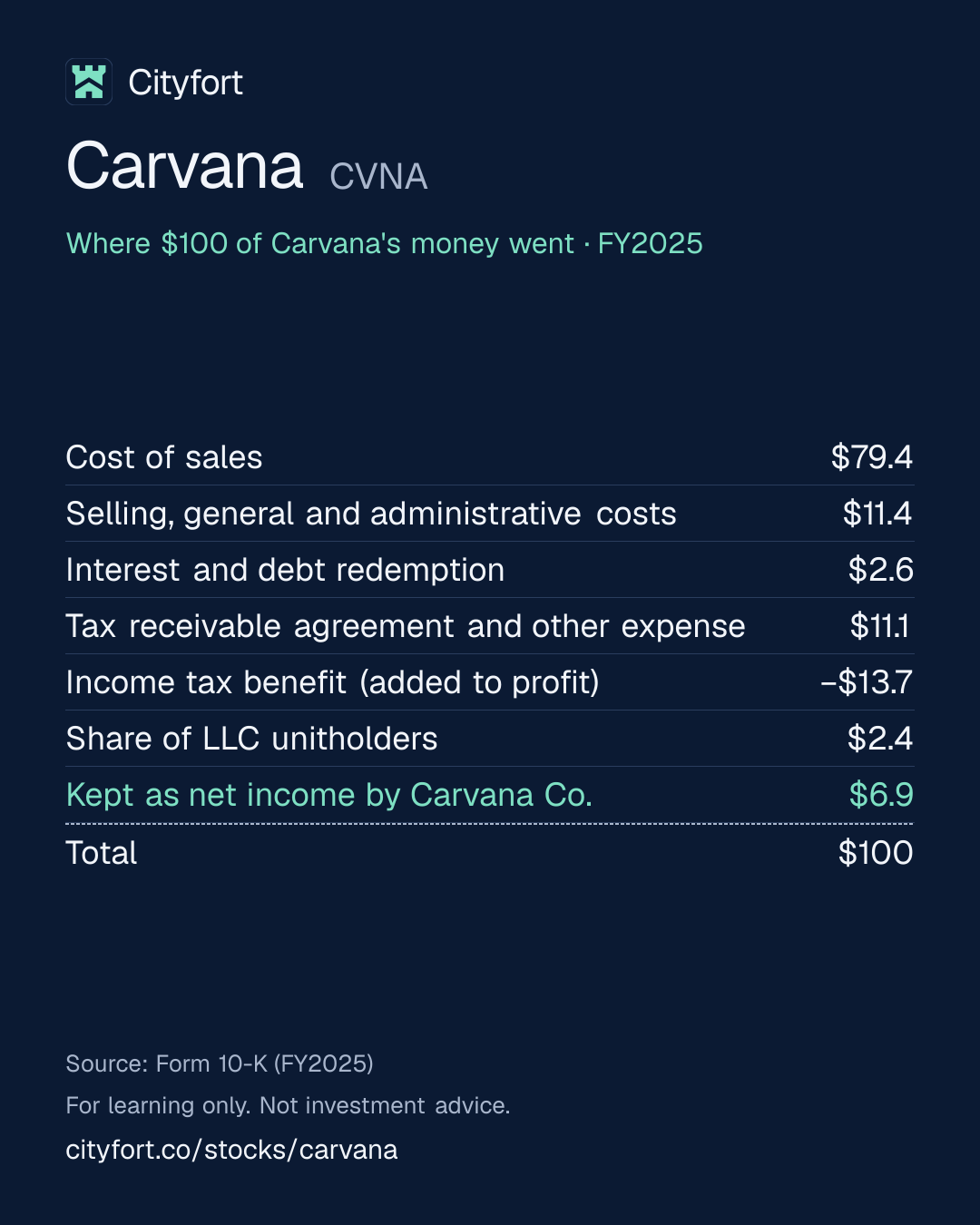
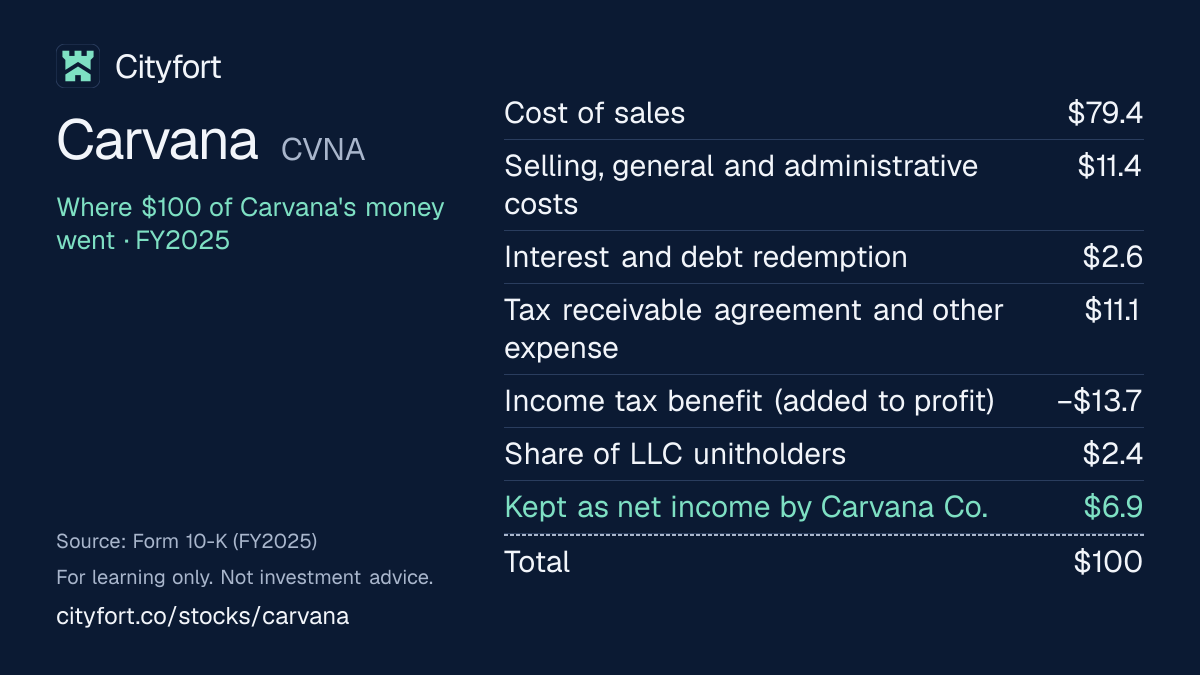
Where does $100 of Carvana's money go?
Carvana · FY2025
Receipt for every $100
| Cost of sales | $79.4 |
|---|---|
| Selling, general and administrative costs | $11.4 |
| Interest and debt redemption | $2.6 |
| Tax receivable agreement and other expense | $11.1 |
| Income tax benefit (added to profit) | −$13.7 |
| Share of LLC unitholders | $2.4 |
| Kept as net income by Carvana Co. | $6.9 |
| Total | $100 |
Each line = amount ÷ total money in × 100. Lines may not add to exactly $100 because of rounding.
How this is worked out
Cityfort calculation from the FY2025 10-K. Of every $100 of FY2025 revenue ($20,322 million): each line = line ÷ $20,322 million × 100. The tax line is negative because Carvana released a valuation allowance on its deferred tax assets; the tax receivable agreement line holds the matching $2.2 billion expense. Carvana's Q4 FY2025 shareholder letter says the two together added about $685 million to FY2025 net income. Operating income was $9.26 per $100.
Save this receipt as an image:
1080 × 1350 PNG for Instagram, LinkedIn1200 × 675 PNG for X
Embed this receipt
Paste this code into a blog or website to show the receipt, with a link back to this page:
Each week: one company explained in 5 points, picked by earnings date.
Free, no tips, unsubscribe anytime.
We'll send a confirmation email. See our privacy policy.
02The business in one line
What does Carvana do?
Car buyers pay Carvana for used cars it buys, reconditions and delivers, and investors pay it for the car loans it writes; the cars take about $79 of every $100, and $9.26 was left as operating income in FY2025.
- In FY2025, retail car sales were 71.5% of revenue, wholesale car sales 19.9% and other sales and revenues 8.5%.
- Other sales and revenues, mostly gains on selling car loans and commissions on service contracts, made 41.3% of FY2025 gross profit.
03Who pays it
Who pays Carvana?
Retail car buyers
72%
of revenue
Individuals buying a used car online: $14.54 billion of retail vehicle sales in FY2025.
Wholesale buyers
20%
of revenue
Dealers buying trade-ins and other cars Carvana does not retail, and buyers and sellers paying auction fees on its wholesale marketplace: $4.05 billion.
Loan buyers and product partners
9%
of revenue
Other sales and revenues of $1.73 billion: gains on selling car loans, commissions on service contracts and GAP waivers, and interest earned on loans before they are sold.
- Retail car buyers72%
- Wholesale buyers20%
- Loan buyers and product partners9%
How spread out the customers are
Car buyers are individuals, so no one customer is large. The loan sales are more concentrated: in FY2025 Ally bought $4.7 billion of loan principal, securitizations took $3.5 billion and fixed-pool sales $4.2 billion. Revenue from related parties, mostly DriveTime, was $386 million.
04Why it makes money
Why does Carvana make money?
Carvana earns gross profit three times on each car, and spreads its fixed costs over more cars as sales grow.
In FY2025 Carvana made $7,026 of gross profit per retail car: $3,315 on the car, $806 from wholesale and $2,905 from loans and add-ons. Selling, general and administrative cost per retail car fell from $5,741 in FY2023 to $3,868 in FY2025.
Operating income per $100 of revenue
−$17.3$9.3
FY2022 to FY2025
- Buy cars from people, auctions and suppliers; 297,643 wholesale units were resold in FY2025
- Recondition them at its own sites, built for about 1.5 million cars a year at full utilization
- Sell them online and deliver them: 596,641 retail cars in FY2025
- Write loans for buyers and sell them to investors: $1.19 billion of gains in FY2025
- Earn $7,026 of gross profit per retail car across the car, wholesale and loans
- Spread fixed costs over more cars: $3,868 of selling and admin cost per car in FY2025
↺ Step 6 feeds back into step 1.
05Business segments · FY2025
Which businesses make up Carvana?
Retail vehicles
72%Carvana has one reportable segment; these are its revenue lines. Retail sales were 71.5% of FY2025 revenue and brought $1.98 billion of gross profit, 47.2% of the total.
Revenue $14.5B
Wholesale
20%Trade-ins and auction marketplace fees: 19.9% of revenue and $481 million of gross profit, 11.5% of the total.
Revenue $4.1B
Other sales and revenues
9%Loan-sale gains and product commissions carry no cost of sales, so all $1.73 billion was gross profit: 41.3% of the total.
Revenue $1.7B
How the mix changed
- Retail vehicles
- Wholesale
- Other sales and revenues
Revenue by segment, FY2021 to FY2025.
US$
See the numbers
06The numbers · Consolidated · US$
How has Carvana done?
Revenue
$20.3BFY2025
Revenue fell 20.8% to $10.8 billion in FY2023, then rose to $20.3 billion in FY2025, and Q3 FY2026 revenue of $8.04 billion was up 42.4% from Q3 FY2025.
US$
See the numbers
Net profit
$1.4BFY2025
Net income to Carvana Co. went from a $1.59 billion loss in FY2022 to $1.41 billion in FY2025, which includes about $685 million from a one-off tax change; EPS is split-adjusted for the May 2026 5-for-1 split (reported figures ÷ 5 before it, Cityfort calculation from the 10-Ks, 10-Qs and the 8-K filed May 6, 2026).
US$
See the numbers
Profit kept per $100 of revenue
$6.9FY2025
Operating income per $100 of revenue went from a $17.28 loss in FY2022, a year with an $847 million goodwill write-down, to $9.26 in FY2025 and $8.88 in Q3 FY2026.
$ of profit per $100 of revenue (net margin)
See the numbers
Free cash flow
$889MFY2025
Free cash flow (cash from operations minus purchases of property and equipment) went from minus $3.15 billion in FY2021 to $889 million in FY2025; operating cash flow includes car loans Carvana writes and sells, so it moves with loan timing.
US$ · cash from operations minus spending on plants and equipment
See the numbers
See all yearly numbers
EBITDA here = operating income plus depreciation and amortization (from the cash flow statement). Fiscal years are the company's own (Fiscal year ends December 31 (calendar year)). Net profit is the share belonging to the company's owners. Total net income differs from net profit to the company's owners: Consolidated net income was $1,895 million; $488 million of it belonged to LLC unitholders. It includes a $2,785 million income tax benefit and about $2.2 billion of tax receivable agreement expense, which Carvana says added about $685 million net; pre-tax income was a loss of $890 million.
Download Carvana's yearly and quarterly numbers (CSV, with source ids)
Learn: Stock-based compensation and dilution: pay that becomes shares
Sources (9)
- Form 10-K, fiscal year 2023 (ended Dec 31, 2023)
- Q4 and full-year 2025 shareholder letter (8-K Exhibit 99.1, Feb 18, 2026)
- Form 10-K, fiscal year 2024 (ended Dec 31, 2024)
- Form 10-K, fiscal year 2025 (ended Dec 31, 2025)
- Q4 and full-year 2024 earnings release (8-K Exhibit 99.2, Feb 19, 2025)
- Form 10-Q, Q1 fiscal 2026 (quarter ended Mar 31, 2026)
- Form 10-Q, Q2 fiscal 2026 (quarter ended Jun 30, 2026)
- Form 10-Q, Q3 fiscal 2026 (quarter ended Sep 30, 2026)
- Q3 2026 shareholder letter (8-K Exhibit 99.1, Oct 28, 2026)
07Who runs it
Who runs Carvana, and did they deliver?
Ernest C. Garcia III
Co-founder, President, Chief Executive Officer and Chairman
2025 total pay was $8.38 million, against a median employee's $43,236. The proxy says he asked for pay set well below the market median, given his ownership.
Mark Jenkins
Chief Financial Officer
Named in the 2026 proxy as an executive officer.
Benjamin Huston
Chief Operating Officer
Named in the 2026 proxy as an executive officer.
What they said, and what happened
3 too early to tell · 2 delivered
Said on Feb 18, 2026
Carvana said in its Q4 FY2025 shareholder letter that its path to selling 3 million cars a year at a 13.5% Adjusted EBITDA marginOperating profit before wear-and-tear charges (depreciation and amortization). As a margin: per $100 of sales., a company measure, by 2030 to 2035 is clear.
Too early to tellWhat happened
On Oct 28, 2026 Carvana said it will restate the goal in 2027 as 3 million retail units a year at a 12.5% operating margin between 2030 and 2035. It sold 596,641 retail cars in FY2025.
Said on Feb 18, 2026
Carvana's Q4 FY2025 letter said it expected significant growth in retail units sold and Adjusted EBITDA in FY2026.
Too early to tellWhat happened
Retail units were 602,103 in the first nine months of FY2026, against 433,119 a year earlier (Cityfort calculation from the Q1 to Q3 FY2026 10-Qs). Adjusted EBITDA was $2,241 million in those nine months.
Said on Apr 29, 2026
Carvana's Q1 FY2026 earnings release said it expected more retail units and higher Adjusted EBITDA in Q2 than in Q1.
DeliveredWhat happened
Q2 FY2026 retail units were 197,325, up from 187,393, and Adjusted EBITDA was $769 million, up from $672 million. Operating income rose from $581 million to $680 million.
Said on Jul 29, 2026
Carvana's Q2 FY2026 shareholder letter said it expected more retail units in Q3 than in Q2.
DeliveredWhat happened
Q3 FY2026 retail units were 217,385, up from 197,325 in Q2.
Said on Jul 29, 2026
Carvana's Q2 FY2026 shareholder letter gave an FY2026 Adjusted EBITDA range of $2.7 to $3.0 billion.
Too early to tellWhat happened
Adjusted EBITDA was $2,241 million in the first nine months. On Oct 28, 2026 Carvana said it expects the higher end of the range.
Sources (9)
- Definitive proxy statement (DEF 14A), 2026 annual meeting
- Q4 and full-year 2025 shareholder letter (8-K Exhibit 99.1, Feb 18, 2026)
- Q3 2026 shareholder letter (8-K Exhibit 99.1, Oct 28, 2026)
- Form 10-K, fiscal year 2025 (ended Dec 31, 2025)
- Form 10-Q, Q3 fiscal 2026 (quarter ended Sep 30, 2026)
- Form 10-Q, Q2 fiscal 2026 (quarter ended Jun 30, 2026)
- Form 10-Q, Q1 fiscal 2026 (quarter ended Mar 31, 2026)
- Q1 2026 earnings release (8-K Exhibit 99.2, Apr 29, 2026)
- Q2 2026 shareholder letter (8-K Exhibit 99.1, Jul 29, 2026)
08What could go wrong
What could go wrong for Carvana?
- Governance
Voting control by the Garcia family
Class B shares carried 83.2% of the votes at the Mar 10, 2026 record date. The 10-K says the Garcia Parties can decide all matters that need stockholder approval.
Watch The Class B share of votes in each proxy, and Class B exchanges into Class A.
- Cash and liquidity
Dependence on selling car loans
The 10-K says selling finance receivables produces a substantial portion of gross profit. Gains on loan sales were $1.19 billion in FY2025, and Ally's purchase commitment runs through July 2027.
Watch Other sales and revenues per retail unit each quarter, and renewals of loan purchase agreements.
- Debt
Debt and interest costs
Borrowings were $5.23 billion at Sep 30, 2026, and interest expense was $505 million in FY2025. The $1.66 billion Term Loan B pays a floating rate, which Carvana swapped to a fixed 4.055% base rate until Jul 31, 2028.
Watch Interest expense and net debt in each 10-Q.
- Cash and liquidity
Tax receivable agreement payments
Carvana owes LLC unitholders 85% of certain tax benefits it realizes; the liability was $2,130 million at Sep 30, 2026. The 10-K says payments may be accelerated.
Watch The tax receivable agreement liability and payments in the cash flow statement.
- Concentration
Reliance on DriveTime
DriveTime, controlled by the CEO's father, administers Carvana's service contracts, services loans and leases it sites. The 10-K lists this related-party dependence as a risk.
Watch Related-party notes in the 10-K and the proxy.
- Demand
Car prices, rates and credit losses
The 10-K names used-car prices, interest rates, tariffs and borrower credit losses as risks to demand and loan values. Revenue fell 20.8% in FY2023.
Watch Retail units and gross profit per retail unit each quarter.
- Legal
Lawsuits and state inquiries
A securities class action alleging violations of federal securities laws is pending in Arizona, and state attorneys general inquire into titling and sales practices. The accrual for legal matters was $11 million at Sep 30, 2026.
Watch The legal proceedings note in each 10-Q.
- Competition
Competition
The 10-K lists dealers such as CarMax, online car sites, carmakers and membership buying services as competitors, in a market with tens of thousands of dealers.
Watch Retail unit growth against Carvana's stated share of about 2% of the used market.
Sources (6)
- Form 10-K, fiscal year 2025 (ended Dec 31, 2025)
- Form 8-K filed May 6, 2026 (annual meeting results, 5-for-1 stock split, Items 5.02, 5.03, 5.07)
- Form 10-Q, Q3 fiscal 2026 (quarter ended Sep 30, 2026)
- Form 8-K filed Aug 14, 2026 (Term Loan B credit agreement, Items 1.01, 2.03)
- Definitive proxy statement (DEF 14A), 2026 annual meeting
- Q3 2026 shareholder letter (8-K Exhibit 99.1, Oct 28, 2026)
09Both sides
What do supporters and critics point to?
What supporters point to
- Retail units rose from 312,847 in FY2023 to 596,641 in FY2025, and grew 39.4% in Q3 FY2026.
- Operating income went from a $2.35 billion loss in FY2022 to $1.88 billion in FY2025.
- Net debt fell from $7.88 billion at the end of 2022 to $2.18 billion at Sep 30, 2026.
- Selling, general and administrative cost per retail car fell from $5,741 in FY2023 to $3,868 in FY2025.
- Carvana says its sites can recondition about 1.5 million cars a year at full utilization, against 596,641 retail cars sold in FY2025.
What critics point to
- FY2025 net income includes about $685 million from a one-off tax change; pre-tax income was a loss of $890 million.
- Other sales and revenues, mostly loan-sale gains and commissions, made 41.3% of FY2025 gross profit, so profit depends on loan buyers.
- The Garcia family's Class B shares carried 83.2% of the votes, and DriveTime, controlled by the CEO's father, is a major business partner.
- The tax receivable agreement liability was $2,130 million at Sep 30, 2026, with $1,645 million owed to related parties.
- Gross profit per $100 of revenue fell from $22.0 in Q1 FY2025 to $18.9 in Q3 FY2026.
10What to watch next
What should you watch next at Carvana?
Next event
Q4 FY2026 results
Date not announced yet.
FY2026 Adjusted EBITDA
Carvana said on Oct 28, 2026 that it expects FY2026 Adjusted EBITDA, its own measure, in the higher end of $2.7 to $3.0 billion. It was $2,241 million in the first nine months.
The switch to GAAP reporting
From 2027 Carvana plans to report mainly GAAP figures, target a 12.5% operating margin between 2030 and 2035, and give no quarterly or annual outlook. Q3 FY2026 operating income was $8.88 per $100 of revenue.
Loan sales
Gains on loan sales were $1.19 billion in FY2025. Ally's commitment to buy up to $8 billion of Carvana loans runs through July 2027.
11Key dates
What are the key dates for Carvana?
| Event | Date | Source |
|---|---|---|
| Fiscal 2026 ends | Form 10-Q, Q3 fiscal 2026 (quarter ended Sep 30, 2026) | |
| Ally loan purchase commitment (up to $8 billion) runs toJuly 2027, per the Q3 FY2026 10-Q. | Not yet stated | Form 10-Q, Q3 fiscal 2026 (quarter ended Sep 30, 2026) |
| $1.66 billion Term Loan B matures1% a year of the loan is repaid from Q1 2027. | Form 10-Q, Q3 fiscal 2026 (quarter ended Sep 30, 2026); Form 8-K filed Aug 14, 2026 (Term Loan B credit agreement, Items 1.01, 2.03) |
12Key facts
Key facts about Carvana
- What is Carvana's business model?
- Carvana Co. sells used cars online in the US and delivers them to buyers' homes or to its car vending machines. In FY2025 Carvana sold 596,641 retail cars and had revenue of $20.3 billion.
- How does Carvana make money?
- Carvana makes money in three ways: the margin on each used car, wholesale sales of trade-ins and auction fees, and gains on selling the car loans it writes plus commissions on add-on products. In FY2025 Carvana's gross profit was $4.19 billion, or $7,026 per retail car sold.
- Is Carvana profitable?
- Yes. Carvana's operating income was $1.88 billion in FY2025, up from $990 million in FY2024, after an operating loss of $2.35 billion in FY2022. Net income to Carvana Co. was $1.41 billion in FY2025, which includes about $685 million from a one-off tax and tax-agreement accounting change.
- What is Carvana's revenue by segment?
- Carvana reports one segment. Carvana's FY2025 revenue of $20.3 billion split into retail vehicle sales ($14.54 billion, 71.5%), wholesale sales and revenues ($4.05 billion, 19.9%) and other sales and revenues ($1.73 billion, 8.5%).
- Who are Carvana's customers?
- Carvana sells mostly to individual US car buyers, with no large single customer. Carvana also sells the car loans it writes to buyers such as Ally, which bought $4.7 billion of loan principal in FY2025, and to investors in its securitizations.
- Who owns Carvana?
- The Garcia family controls Carvana through Class B shares, which carried 83.2% of the votes at the Mar 10, 2026 record date. Per the 2026 proxy, Ernest Garcia II had 50% of the votes and his son, CEO Ernest Garcia III, 33%.
- How many cars does Carvana sell?
- Carvana sold 596,641 retail cars in FY2025, up from 416,348 in FY2024 and 312,847 in FY2023. In Q3 FY2026 Carvana sold 217,385 retail cars, up 39.4% from a year earlier.
- How much does Carvana make from car loans and add-on products?
- Carvana's other sales and revenues, mainly gains on selling car loans and commissions on service contracts and GAP waivers, were $1.73 billion in FY2025. That was 8.5% of Carvana's revenue but 41.3% of its gross profit; gains on loan sales alone were $1.19 billion.
- How big is Carvana's wholesale business?
- Carvana's wholesale sales and revenues were $4.05 billion in FY2025, up from $2.84 billion in FY2024, on 297,643 wholesale units. Wholesale covers trade-ins Carvana does not retail and fees from its auction marketplace, including the ADESA sites bought in 2022.
- Does Carvana pay a dividend?
- No. Carvana Co. has not declared or paid any cash dividends, according to its FY2025 10-K. Carvana split its shares 5-for-1 in May 2026, with split-adjusted trading from May 8, 2026.
Sources (6)
- Form 10-K, fiscal year 2025 (ended Dec 31, 2025)
- Form 10-K, fiscal year 2024 (ended Dec 31, 2024)
- Q4 and full-year 2025 shareholder letter (8-K Exhibit 99.1, Feb 18, 2026)
- Definitive proxy statement (DEF 14A), 2026 annual meeting
- Form 8-K filed May 6, 2026 (annual meeting results, 5-for-1 stock split, Items 5.02, 5.03, 5.07)
- Form 10-Q, Q3 fiscal 2026 (quarter ended Sep 30, 2026)
Terms on this page
- Capital expenditures (capex)
- Debt-to-equity
- Earnings per share (EPS)
- EBITDA
- Free cash flow
- Market cap
- Net debt
- Net margin
- Operating income
- P/E ratio
Each explains the term in plain English, with the same number from other companies on Cityfort.
Go deeper
More detail from the same filings. Open any section.
13What it sells
13What it sells
What does Carvana sell?
Used cars, sold online ($14.54B in FY2025)
596,641 retail cars in FY2025, at $24,365 of revenue each. Over 75,000 cars were listed on the website at Dec 31, 2025.
Buying cars and wholesale ($4.05B)
Carvana makes online offers for people's cars. Trade-ins and other cars that miss its retail standards are sold to dealers, along with auction fees from its wholesale marketplace.
Car loans
Buyers can finance through Carvana's own loan platform. Carvana sells most of these loans to buyers such as Ally or through securitizations; gains on those sales were $1.19 billion in FY2025.
Add-on products
Vehicle service contracts (repair cover after the factory warranty), GAP waiver coverage for loans, and auto insurance through partner Root. Commissions are booked in other sales and revenues.
ADESA auction sites
Carvana bought ADESA's US physical auction business, 56 locations, in May 2022. By Q3 FY2026, 21 of them also recondition cars for retail sale.
What it does
- Does: Delivers cars to buyers' homes, or lets them collect at one of 39 car vending machines
- Does: Gives a seven-day return policy and a 100-day or 4,189-mile limited warranty
- Does: Inspects and reconditions cars at its own sites, which it says can handle about 1.5 million cars a year at full utilization
- Does: Bought five franchise dealerships in 2025 for $160 million
What it does not do
- Does not: Does not keep most of the car loans it writes: it sells them to investors
- Does not: Does not provide the auto insurance itself: partner Root does
- Does not: Does not sell outside the US: substantially all revenue and assets are in the US
- Does not: Does not report profit by business line below gross profit: it has one reportable segment
14How the money flows
14How the money flows · FY2025
How does money flow through Carvana?
Money in
- Retail vehicle sales$14.5B
- Wholesale sales and revenues$4.1B
- Other sales and revenues (loan-sale gains, commissions)$1.7B
The company
Carvana
$20.3B came in
Money out
- Cost of sales (cars, reconditioning, transport)$16.1B
- Selling, general and administrative and other operating costs$2.3B
- Interest and debt redemption costs$521M
- Tax receivable agreement and other expense$2.3B
- Income tax benefit (added to profit)−$2.8B
- Share of LLC unitholders (mainly the Garcia family)$488M
- Net income to Carvana Co.$1.4B
- Car buyers, wholesale buyers and loan buyers paid Carvana $20.3 billion of revenue in FY2025.
- The cars, their reconditioning and transport cost $16.13 billion, leaving $4.19 billion of gross profit.
- Staff, advertising, logistics and other running costs took $2.31 billion, leaving $1.88 billion of operating income.
- Interest and debt redemption costs took $521 million, and a $2.2 billion tax receivable agreement charge was more than offset by a $2.79 billion tax benefit.
- Of the $1.90 billion of net income, $488 million belonged to LLC unitholders and $1.41 billion to Carvana Co.
15What it needs to run
15What it needs to run
What does Carvana need to run?
Reconditioning sites
Inspection and reconditioning centers plus ADESA auction sites with reconditioning: 21 ADESA sites by Q3 FY2026, with three more full buildouts under construction to start in 2027.
Cars in stock
Vehicle inventory was $3.46 billion at Sep 30, 2026, up from $2.41 billion at Dec 31, 2025.
Loan buyers and credit lines
Ally's commitment to buy Carvana loans was raised to up to $8 billion through July 2027. Carvana had $5.0 billion of short-term revolving credit commitments at Dec 31, 2025.
People and delivery fleet
More than 23,100 employees at Dec 31, 2025, up from more than 13,700 two years earlier, plus an in-house fleet of car haulers.
16Competitors and what protects it
16Competitors and what protects it
Who does Carvana compete with?
CarMax
Named in Carvana's FY2025 10-K as a traditional used-vehicle dealership it competes with.
Amazon
NASDAQ: AMZN
Named in the 10-K among internet and online automotive sites competing for car buyers.
CarGurus
Named in the 10-K among online automotive sites, with AutoTrader, Cars, Carfax, eBay Motors, Edmunds, KBB and TrueCar.
Costco
NASDAQ: COST
The 10-K names the Costco Auto Program as an offline, membership-based car-buying service it competes with.
Tesla
NASDAQ: TSLA
Named in the 10-K among carmakers it competes with, alongside Ford, General Motors, Toyota, Volkswagen, Rivian and Lucid.
What protects the business
Each strength is scored 1 (weak) to 5 (strong) for the business, with the reason. It is not a rating of the share.
- Reconditioning and delivery network4 of 5
Carvana says its sites can recondition about 1.5 million cars a year at full utilization, against 596,641 retail cars sold in FY2025, and it delivers with its own hauler fleet.
- In-house car loans3 of 5
Carvana writes its own loans and sells them: other sales and revenues, mostly loan-sale gains and commissions, made 41.3% of FY2025 gross profit.
- Selection and traffic3 of 5
Over 75,000 cars were listed on the website at Dec 31, 2025, and the site averaged 23.8 million unique monthly visitors in Q3 FY2026.
Weak spot
Reliance on selling its car loans
The FY2025 10-K says selling finance receivables produces a substantial portion of gross profit, so Carvana depends on loan buyers and securitization markets staying open.
17Where growth could come from
17Where growth could come from
Where could Carvana's growth come from?
Carvana said in its Q3 FY2026 shareholder letter (Oct 28, 2026) that it expects more retail units in Q4 than in Q3, and FY2026 Adjusted EBITDA, a company measure, in the higher end of $2.7 to $3.0 billion. From 2027 it plans to report mainly GAAP figures, with a goal of 3 million retail units a year at a 12.5% operating margin between 2030 and 2035, and no quarterly or annual outlook.
Retail units
Working217,385 in Q3 FY2026, up 39.4%
Retail units rose from 312,847 in FY2023 to 596,641 in FY2025. The Q3 FY2026 letter says the run rate equals about 2% of the US used-car market.
Status: Working, on track against what the company said.
Reconditioning at ADESA sites
Working21 sites by Q3 FY2026
16 ADESA sites could recondition cars at Dec 31, 2025, 19 by Q2 FY2026 and 21 by Q3 FY2026. Three full buildouts are under construction to start in 2027.
Status: Working, on track against what the company said.
Wholesale
Working$4.05B in FY2025, up from $2.84B
Wholesale units rose from 199,780 in FY2024 to 297,643 in FY2025.
Status: Working, on track against what the company said.
Loan sales
WorkingUp to $8B Ally commitment through July 2027
Gains on loan sales rose from $434 million in FY2023 to $1.19 billion in FY2025. One other loan purchase agreement was raised by $500 million through January 2028.
Status: Working, on track against what the company said.
Franchise dealerships
New5 bought in 2025 for $160M
Carvana paid $101 million in cash and took on $59 million of floor-plan payables for five franchise dealerships in 2025.
Status: New, recently announced.
Status compares progress with what the company itself said it would do: Working = on track against what the company said; Mixed = partly on track; Behind = behind the company's own plan; New = recently announced; Early = too early to judge.
18The company's own measures (non-GAAP)
18The company's own measures · FY2025 and Q3 FY2026
What do Carvana's own measures show?
Official (GAAP): Operating income, FY2025
$1.9B
Company's own measure: Adjusted EBITDA, FY2025 (Carvana's measure)
$2.2B
Carvana starts from net income and adds back income tax, interest, the tax receivable agreement and other expense, depreciation and amortization, stock-based compensationPay given as shares instead of cash, which spreads ownership more thinly. Learn more and debt redemption losses, and removes warrant revenue.
Official (GAAP): Operating income as % of revenue, FY2025 (Cityfort calculation from the FY2025 10-K)
9.3%
Company's own measure: Adjusted EBITDA margin, FY2025 (Carvana's measure)
11.0%
Adjusted EBITDA as a share of revenue, as Carvana states it.
Official (GAAP): Operating income, Q3 FY2026
$714M
Company's own measure: Adjusted EBITDA, Q3 FY2026 (Carvana's measure)
$800M
Same measure. The first nine months of FY2026 came to $2,241 million.
Official (GAAP): Total gross profit per retail unit (GAAP gross profit ÷ retail units), FY2025
$7.0B
Company's own measure: Non-GAAP total gross profit per retail unit, FY2025 (Carvana's measure)
7,182 US$ per retail unit
Carvana adds back depreciation, amortization and stock-based compensation in cost of sales and removes $21 million of warrant revenue. It was $7,093 in Q3 FY2026, against $6,997 on a GAAP basis.
Official (GAAP): Retail vehicle sales, FY2025 (US$ million)
$14.5B
Company's own measure: Retail units sold, FY2025
596,641 cars
Used cars sold to retail customers, as Carvana counts them; 217,385 in Q3 FY2026.
Official (GAAP)
No official figure measures this; it is the company's own operating measure.
Company's own measure: Average monthly unique visitors, Q3 FY2026
23.8 million
Visitors to Carvana's website in the quarter, as Carvana counts them; 19.64 million in Q3 FY2025. The nearest GAAP line is revenue: $8.04 billion in Q3 FY2026.
These are the company's own measures, defined by the company. They are not comparable across companies, and they are not added together. Each sits beside the nearest official (GAAP) figure.
Learn: Non-GAAP measures: what a company's "adjusted" numbers leave out · Stock-based compensation and dilution: pay that becomes shares
19Financial strength and debt
19Financial strength · Sep 30, 2026
How much debt does Carvana have?
- Total debt$5.2B
- Cash and investments$3.0B
- Net debt (debt minus cash)$2.2B
- Net worth (shareholders' money)$5.7B
- Debt to equity
- 0.92×
- $ of debt for every $1 of shareholders' money
- Net debt = borrowings $5,228 million − cash and cash equivalents $3,049 million = $2,179 million (Cityfort calculation from the Q3 FY2026 10-Q). Restricted cash of $123 million is not counted; principal outstanding was $5,161 million.
- Year-end net debt (borrowings minus cash) was $5,010 million in 2021, $7,875 million in 2022, $5,743 million in 2023, $3,916 million in 2024 and $2,788 million in 2025 (Cityfort calculation from the FY2022, FY2023 and FY2025 10-Ks).
- On Aug 14, 2026 Carvana took a $1.66 billion Term Loan B at Term SOFR plus 2.25%, due Aug 14, 2033, and used it with cash to redeem all $1.66 billion of its 2030 senior secured notes for $1.71 billion.
- The tax receivable agreement liability of $2,130 million at Sep 30, 2026 is not counted as debt here; $1,645 million of it is owed to related parties.
- Total equity was negative at the end of 2022 (minus $1,053 million) and 2023 (minus $384 million), and was $5,653 million at Sep 30, 2026, of which $4,352 million belonged to Carvana Co.
- Interest expense fell from $651 million in FY2024 to $505 million in FY2025.
20Who owns it
20Who owns it · ownership as of Mar 10, 2026
Who owns Carvana?
- Officers and directors (as a group), shares
- 15.2%
- Officers and directors (as a group), votes
- 33.0%
Share classes
Holders of 5% or more
From the company's proxy statement (DEF 14A), later Schedule 13G filings and the share counts on its latest annual or quarterly report. Each holder row shows the date of its own filing.
Insider trades · Form 4 data as of Nov 6, 2026
What did Carvana's insiders report trading?
Carvana's insiders made 147 Form 4A filing an insider must make within two business days of buying or selling the company's shares. Learn more filings in the 12 months to Nov 6, 2026.
They reported 3 purchases (25,005 shares) and 333 sales (1.6 million shares) in the open market or privately (codes P and S).
315 of the 333 sales were on forms with the Rule 10b5-1 plan box checked.
The same filings report 201 other share transactions (F: 103, M: 70, A: 23, G: 2, W: 2, J: 1).
They also report 74 transactions in options, stock units or other derivatives.
Insiders are a company's officers, directors and owners of more than 10% of a class of its shares. Most changes in their holdings must be reported to the SEC on a Form 4 within two business days. Source: SEC Form 4 filings on EDGAR.
- P
- a purchase in the open market or privately
- S
- a sale in the open market or privately
- A
- a grant, award or other acquisition from the company under Rule 16b-3
- F
- shares withheld or handed over to pay an exercise price or tax when an award is received, exercised or vests
- M
- exercise or conversion of an option or other derivative, exempt under Rule 16b-3
- G
- a bona fide gift
- W
- an acquisition or disposition by will or the laws of descent and distribution
- J
- another acquisition or disposition, described in a footnote
Code meanings: General Instruction 8 of Form 4 (SEC).
The latest 25 of 537 transactions
Shares: A = acquired, D = disposed of. A price the filing gives only in a footnote shows as “See filing”. The 10b5-1 box is checked when at least one trade on the form was made under a Rule 10b5-1 plan. A Form 4/A replaces the form it amends. See all of Carvana's Form 4 filings on EDGAR.
Learn: Dual-class shares: when votes and ownership don't match · How to read a proxy statement (DEF 14A): Nvidia's 2026 proxy · Form 4 insider filings: who files, the codes and the footnotes · Rule 10b5-1 trading plans: how insiders pre-schedule their trades
Sources (9)
- Form 10-Q, Q3 fiscal 2026 (quarter ended Sep 30, 2026)
- Form 8-K filed May 6, 2026 (annual meeting results, 5-for-1 stock split, Items 5.02, 5.03, 5.07)
- Definitive proxy statement (DEF 14A), 2026 annual meeting
- Schedule 13G/A, T. Rowe Price Associates, Inc. (event Dec 31, 2025)
- Schedule 13G/A, Capital Research Global Investors (event Jun 30, 2026)
- Schedule 13G, Vanguard Capital Management (event Mar 31, 2026)
- Schedule 13G/A, The Vanguard Group (0%, event Mar 13, 2026)
- Schedule 13G/A, BlackRock, Inc. (event Jun 30, 2026)
- Schedule 13G, FMR LLC (event Mar 31, 2026)
21What it does with profit
21What it does with profit
What does Carvana do with its profit?
Money raised · Dec 31, 2024
FY2024: net cash from issuing Class A shares and LLC units.
$1.3B
Money raised · Dec 31, 2025
FY2025: net cash from issuing Class A shares and LLC units. No equity was issued in the first nine months of FY2026.
$536M
Money raised · Aug 14, 2026
$1.66 billion Term Loan B, due Aug 14, 2033, used with cash to redeem the 2030 senior secured notes.
$1.7B
22Governance signals
22Governance signals
What do Carvana's governance filings show?
- Auditor
- Grant Thornton LLP
- Auditor changes
- None in the period covered
- Audit qualifications
- None reported
- Related-party dealings
- DriveTime, controlled by Ernest Garcia II, the CEO's father, administers Carvana's vehicle service contracts, services some of its car loans, leases it reconditioning sites and buys cars at its auctions. Revenue from related parties was $386 million in FY2025 ($39 million wholesale, $347 million other). $1,645 million of the $2,130 million tax receivable agreement liability at Sep 30, 2026 was owed to related parties.
- Credit rating
- No public credit rating found in a search of rating agency sites on Nov 7, 2026
Flags to know about
other
The Garcia family controls the votes
Class B shares, held mainly by Ernest Garcia II and his son CEO Ernest Garcia III, carried 83.2% of the votes at the Mar 10, 2026 record date. Carvana is a controlled company under NYSE rules but says it does not use the exemptions.
related party
Tax receivable agreement
Carvana pays LLC unitholders 85% of the tax benefits it realizes from their unit exchanges. The liability was $2,130 million at Sep 30, 2026, and the 10-K says payments may be accelerated.
shares as collateral
A Class B holder's shares secure loans
The 2026 proxy says CVAN Holdings, holder of 8% of Class B, used all its LLC units and Class B shares as collateral for prepaid variable forward sale contracts and margin loans. Carvana's own trading policy bars hedging of its stock, and bars directors, officers and certain other employees from using company stock as loan collateral without adequate assurance of other assets to repay the loan.
other
Securities class action pending
In re Carvana Co. Securities Litigation (D. Ariz.) alleges violations of federal securities laws. Part of the claims survived a motion to dismiss on Dec 16, 2024; the court has not ruled on class certification, and Carvana says it cannot assess the likelihood of loss.
regulatory
State attorney general inquiries
The Q3 FY2026 10-Q says state attorney general offices inquire from time to time into Carvana's sales, titling, registration and lending practices, and such inquiries have resulted in claims against it.
disclosure
No outlook from 2027
Carvana said on Oct 28, 2026 that, starting with its Q4 2026 earnings call, it does not plan to give quarterly or annual financial outlooks.
auditor
Audit fees
Carvana paid Grant Thornton $2.52 million of audit fees and $1.15 million of tax fees for 2025. EDGAR shows no auditor change or restatement filing.
Sources (7)
- Form 10-K, fiscal year 2025 (ended Dec 31, 2025)
- Definitive proxy statement (DEF 14A), 2026 annual meeting
- Form 10-Q, Q3 fiscal 2026 (quarter ended Sep 30, 2026)
- Form 8-K filed Aug 14, 2026 (Term Loan B credit agreement, Items 1.01, 2.03)
- Form 8-K filed May 6, 2026 (annual meeting results, 5-for-1 stock split, Items 5.02, 5.03, 5.07)
- Q3 2026 shareholder letter (8-K Exhibit 99.1, Oct 28, 2026)
- EDGAR company filings index, Carvana Co. (CIK 0001690820)
23What the market paid
23What the market paid · price as of Nov 5, 2026
What did the market pay for Carvana on Nov 5, 2026?
Price as of Nov 5, 2026 (shown for education; prices change daily).
Price as of Nov 5, 2026: Carvana's Class A stock closed at $72.08, per Nasdaq's historical price table; the stock is listed on the NYSE. Times 722.7 million Class A shares outstanding on Oct 26, 2026, that is $52,093 million. Counting the 380.5 million Class B shares (each Class B share, with its paired LLC units, can be exchanged for one Class A share), it is $79,523 million, the figure shown here (Cityfort calculation from the Nov 5, 2026 closing price and the Q3 FY2026 10-Q cover). P/E is price ÷ earnings per share: 42.7 on split-adjusted FY2025 diluted EPS of $1.69.
- Share price
- $72.08
- Market value (market cap)
- $79.5B
- P/E
- 42.7×
More price-based ratios · as of Nov 5, 2026
Each ratio divides a number from the company's filings by the market value or share price on Nov 5, 2026. Prices change daily, so these ratios do too.
Price to sales (P/S)
2.9×
$79.5B market value ÷ $27.5B revenue (four quarters to Sep 30, 2026) = 2.9×
Cityfort calculation from the Nov 5, 2026 closing price and the Q4 FY2025 to Q3 FY2026 10-Qs and earnings releases. Source: CVNA historical prices, Oct 29 to Nov 5, 2026 (Nasdaq.com historical table; CVNA is listed on the NYSE); Form 10-Q, Q3 fiscal 2026 (quarter ended Sep 30, 2026); Form 10-K, fiscal year 2025 (ended Dec 31, 2025) and 4 more
How price ratios workFree cash flow yield
1.1%
$889M free cash flow (FY2025) ÷ $79.5B market value = 1.1%
Cityfort calculation from the FY2025 10-K and the Nov 5, 2026 closing price. Source: CVNA historical prices, Oct 29 to Nov 5, 2026 (Nasdaq.com historical table; CVNA is listed on the NYSE); Form 10-Q, Q3 fiscal 2026 (quarter ended Sep 30, 2026); Form 10-K, fiscal year 2025 (ended Dec 31, 2025) and 1 more
What free cash flow means
Shares used for the market value: 1,103.26 million ($72.08 × 1,103.26 million shares ≈ $79.5B). Source: Form 10-Q, Q3 fiscal 2026 (quarter ended Sep 30, 2026); Form 8-K filed May 6, 2026 (annual meeting results, 5-for-1 stock split, Items 5.02, 5.03, 5.07); Definitive proxy statement (DEF 14A), 2026 annual meeting
Source: CVNA historical prices, Oct 29 to Nov 5, 2026 (Nasdaq.com historical table; CVNA is listed on the NYSE); Form 10-Q, Q3 fiscal 2026 (quarter ended Sep 30, 2026); Form 10-K, fiscal year 2025 (ended Dec 31, 2025)
Sources (9)
- CVNA historical prices, Oct 29 to Nov 5, 2026 (Nasdaq.com historical table; CVNA is listed on the NYSE)
- Form 10-Q, Q3 fiscal 2026 (quarter ended Sep 30, 2026)
- Form 10-K, fiscal year 2025 (ended Dec 31, 2025)
- Q4 and full-year 2025 shareholder letter (8-K Exhibit 99.1, Feb 18, 2026)
- Form 10-Q, Q1 fiscal 2026 (quarter ended Mar 31, 2026)
- Form 10-Q, Q2 fiscal 2026 (quarter ended Jun 30, 2026)
- Q3 2026 shareholder letter (8-K Exhibit 99.1, Oct 28, 2026)
- Form 8-K filed May 6, 2026 (annual meeting results, 5-for-1 stock split, Items 5.02, 5.03, 5.07)
- Definitive proxy statement (DEF 14A), 2026 annual meeting
24How it got here
24How it got here
How did Carvana get here?
2013
Milestone
First market: Atlanta
Carvana launched to customers in Atlanta, Georgia in January 2013.
2014
Business-model change
Spun off from DriveTime
Carvana was spun off from DriveTime, the used-car dealer controlled by Ernest Garcia II, on Nov 1, 2014; the two still do business together.
2016
Milestone
Holding company formed for the IPO
Carvana Co. was formed on Nov 29, 2016 to complete its initial public offering and run Carvana Group, LLC. Its Class A shares trade on the NYSE.
2022
Crisis
ADESA purchase and a large loss
Carvana bought ADESA's US auction business, 56 sites, for about $2.2 billion in May 2022. It wrote down $847 million of goodwill, and net loss to Carvana Co. was $1.59 billion.
2023
Crisis
Debt exchange and fewer cars
Retail units fell to 312,847. An exchange of its notes produced an $878 million gain, and total equity stayed negative at year end.
2024
Business-model change
Operating profit
Operating income reached $990 million, the first operating profit in the five years on this page, on 416,348 retail units.
2025
Milestone
Revenue passes $20 billion
Revenue reached $20.3 billion. Carvana released its tax valuation allowance, recorded the full tax receivable agreement liability and bought five franchise dealerships.
2026
Milestone
Stock split and refinancing
Stockholders approved a 5-for-1 split on May 5, 2026, with split-adjusted trading from May 8. In August a $1.66 billion Term Loan B refinanced the 2030 notes.
Sources (9)
- Form 10-K, fiscal year 2025 (ended Dec 31, 2025)
- Definitive proxy statement (DEF 14A), 2026 annual meeting
- Form 10-K, fiscal year 2022 (ended Dec 31, 2022)
- Form 10-K, fiscal year 2024 (ended Dec 31, 2024)
- Form 10-K, fiscal year 2023 (ended Dec 31, 2023)
- Q4 and full-year 2025 shareholder letter (8-K Exhibit 99.1, Feb 18, 2026)
- Form 8-K filed May 6, 2026 (annual meeting results, 5-for-1 stock split, Items 5.02, 5.03, 5.07)
- Form 8-K filed Aug 14, 2026 (Term Loan B credit agreement, Items 1.01, 2.03)
- Form 10-Q, Q3 fiscal 2026 (quarter ended Sep 30, 2026)
25Sources and changes
Where every number on this page comes from
Sources (24 documents)
- S1Form 10-K, fiscal year 2025 (ended Dec 31, 2025) · Carvana Co. (SEC EDGAR) · Tier 1: company or exchange filing · Feb 18, 2026
- S2Form 10-K, fiscal year 2024 (ended Dec 31, 2024) · Carvana Co. (SEC EDGAR) · Tier 1: company or exchange filing · Feb 19, 2025
- S3Form 10-K, fiscal year 2023 (ended Dec 31, 2023) · Carvana Co. (SEC EDGAR) · Tier 1: company or exchange filing · Feb 22, 2024
- S4Form 10-K, fiscal year 2022 (ended Dec 31, 2022) · Carvana Co. (SEC EDGAR) · Tier 1: company or exchange filing · Feb 23, 2023
- S5Form 10-Q, Q3 fiscal 2026 (quarter ended Sep 30, 2026) · Carvana Co. (SEC EDGAR) · Tier 1: company or exchange filing · Oct 28, 2026
- S6Form 10-Q, Q2 fiscal 2026 (quarter ended Jun 30, 2026) · Carvana Co. (SEC EDGAR) · Tier 1: company or exchange filing · Jul 29, 2026
- S7Form 10-Q, Q1 fiscal 2026 (quarter ended Mar 31, 2026) · Carvana Co. (SEC EDGAR) · Tier 1: company or exchange filing · Apr 29, 2026
- S8Q3 2026 shareholder letter (8-K Exhibit 99.1, Oct 28, 2026) · Carvana Co. (SEC EDGAR) · Tier 1: company or exchange filing · Oct 28, 2026
- S9Q3 2026 earnings release (8-K Exhibit 99.2, Oct 28, 2026) · Carvana Co. (SEC EDGAR) · Tier 1: company or exchange filing · Oct 28, 2026
- S10Q2 2026 shareholder letter (8-K Exhibit 99.1, Jul 29, 2026) · Carvana Co. (SEC EDGAR) · Tier 1: company or exchange filing · Jul 29, 2026
- S12Q1 2026 earnings release (8-K Exhibit 99.2, Apr 29, 2026) · Carvana Co. (SEC EDGAR) · Tier 1: company or exchange filing · Apr 29, 2026
- S13Q4 and full-year 2025 shareholder letter (8-K Exhibit 99.1, Feb 18, 2026) · Carvana Co. (SEC EDGAR) · Tier 1: company or exchange filing · Feb 18, 2026
- S18Q4 and full-year 2024 earnings release (8-K Exhibit 99.2, Feb 19, 2025) · Carvana Co. (SEC EDGAR) · Tier 1: company or exchange filing · Feb 19, 2025
- S19Definitive proxy statement (DEF 14A), 2026 annual meeting · Carvana Co. (SEC EDGAR) · Tier 1: company or exchange filing · Mar 25, 2026
- S20Form 8-K filed May 6, 2026 (annual meeting results, 5-for-1 stock split, Items 5.02, 5.03, 5.07) · Carvana Co. (SEC EDGAR) · Tier 1: company or exchange filing · May 6, 2026
- S21Form 8-K filed Aug 14, 2026 (Term Loan B credit agreement, Items 1.01, 2.03) · Carvana Co. (SEC EDGAR) · Tier 1: company or exchange filing · Aug 14, 2026
- S22Schedule 13G/A, T. Rowe Price Associates, Inc. (event Dec 31, 2025) · Carvana Co. (SEC EDGAR) · Tier 1: company or exchange filing · Feb 17, 2026
- S23Schedule 13G/A, The Vanguard Group (0%, event Mar 13, 2026) · Carvana Co. (SEC EDGAR) · Tier 1: company or exchange filing · Mar 26, 2026
- S24Schedule 13G, Vanguard Capital Management (event Mar 31, 2026) · Carvana Co. (SEC EDGAR) · Tier 1: company or exchange filing · Apr 29, 2026
- S25Schedule 13G, FMR LLC (event Mar 31, 2026) · Carvana Co. (SEC EDGAR) · Tier 1: company or exchange filing · May 6, 2026
- S27Schedule 13G/A, Capital Research Global Investors (event Jun 30, 2026) · Carvana Co. (SEC EDGAR) · Tier 1: company or exchange filing · Aug 12, 2026
- S28Schedule 13G/A, BlackRock, Inc. (event Jun 30, 2026) · Carvana Co. (SEC EDGAR) · Tier 1: company or exchange filing · Jul 29, 2026
- S29CVNA historical prices, Oct 29 to Nov 5, 2026 (Nasdaq.com historical table; CVNA is listed on the NYSE) · Nasdaq, Inc. · Tier 1: company or exchange filing · Nov 6, 2026
- S30EDGAR company filings index, Carvana Co. (CIK 0001690820) · SEC EDGAR · Tier 1: company or exchange filing · Nov 7, 2026
Changes to this page (v1 · Nov 6, 2026)
- v1 · Nov 6, 2026First version, through Q3 FY2026 (quarter ended Sep 30, 2026). (first version)
Numbers come only from tier 1 and tier 2 sources. Read how we research.
Disclaimer
For learning only. Cityfort is not a registered investment adviser or broker-dealer and does not recommend buying or selling any security. Prices shown are dated and may be out of date.
Investing in securities involves risk, including loss of capital. Before making any investment decision, do your own research and consider consulting a registered investment adviser or other qualified professional.
Cityfort, its owners and contributors may or may not hold securities of companies covered. Cityfort is not paid by any company it covers. Content is not an offer or solicitation to buy or sell any security, including in any initial public offering.
Read the positions policyRead the full disclaimerHide the full disclaimer
Cityfort publishes general educational content that explains how listed companies work. Cityfort is not registered with the US Securities and Exchange Commission or any state securities regulator as an investment adviser, and is not a broker-dealer or a member of FINRA. Cityfort does not provide investment, tax or legal advice, recommendations, ratings, price targets or any opinion on whether to buy, sell or hold any security. Nothing on the site is tailored to any person's circumstances.
All information is taken from publicly available sources, mainly company filings with the SEC, which are listed on each page with dates. We work to keep it accurate and correct errors publicly, but we do not guarantee that it is complete, accurate or up to date. Any market price or price-based ratio shown is dated, may be out of date by the time you read it, and is included only to explain concepts.
Statements by company management, including forward-looking statements and guidance, are reported as the company's statements, with their date and source; they are not our forecasts. Adjusted (non-GAAP) figures are the company's own measures and are shown next to the official (GAAP) figures.