Health Care · NYSE: CAH
Cardinal Health: how the business works
Cardinal Health buys medicines from drug makers and delivers them to US pharmacies, hospitals and clinics, with revenue of $254.2 billion in FY2026, the year to Jun 30, 2026.
By Hardik Bhandare · Checked against filings: . Editorial policy. Corrections
Follow Cardinal Health
Email me when Cardinal Health's page is updated after earnings.
We'll send a confirmation email first. See our privacy policy.
Cardinal Health, Inc. · Dublin, Ohio · Founded 1979
Updated for Q1 FY2027 · checked
- Revenue, FY2026
- $254.2B
- Net income, FY2026
- $1,714M
- Largest customer, FY2026
- CVS Health, 28%
- Employees, Jun 30, 2026
- About 63,900
- Incorporated in Ohio
- 1979
The short version
Cardinal Health in 5 points
1 · What it sells
Cardinal Health distributes branded, generic and specialty medicines to US pharmacies, hospitals and clinics, and makes its own medical products such as gloves and syringes, with revenue of $254.2 billion in FY2026.
2 · Who pays it
CVS Health paid 28% of Cardinal Health's FY2026 revenue, the next four largest customers 15% together and all other pharmacies, hospitals, clinics and patients 57% (Cityfort calculation from FY2026 10-K).
3 · What it keeps from $100
Of every $100 that came in during FY2026, Cardinal Health kept $0.7 as net income, after a $122 million write-down of its Outcomes stake and including a one-time $100 million tariff refund benefit; operating earnings were $2,613 million.
4 · Where the operating profit comes from
In FY2026, Pharmaceutical and Specialty Solutions earned $2,783 million of segment profit, the other businesses (nuclear, at-home and logistics) $707 million and Global Medical Products and Distribution $258 million.
5 · The one thing to watch
CVS Health was 28% of Cardinal Health's FY2026 revenue, and on Nov 5, 2026 the company said it had signed a binding letter of intent to renew its drug distribution agreements with CVS Health.
Sources: From Cardinal Health's FY2026 10-K, the Q1 FY2027 10-Q and the earnings releases of Aug 11 and Nov 5, 2026 · checked
01Where the money goes · FY2026
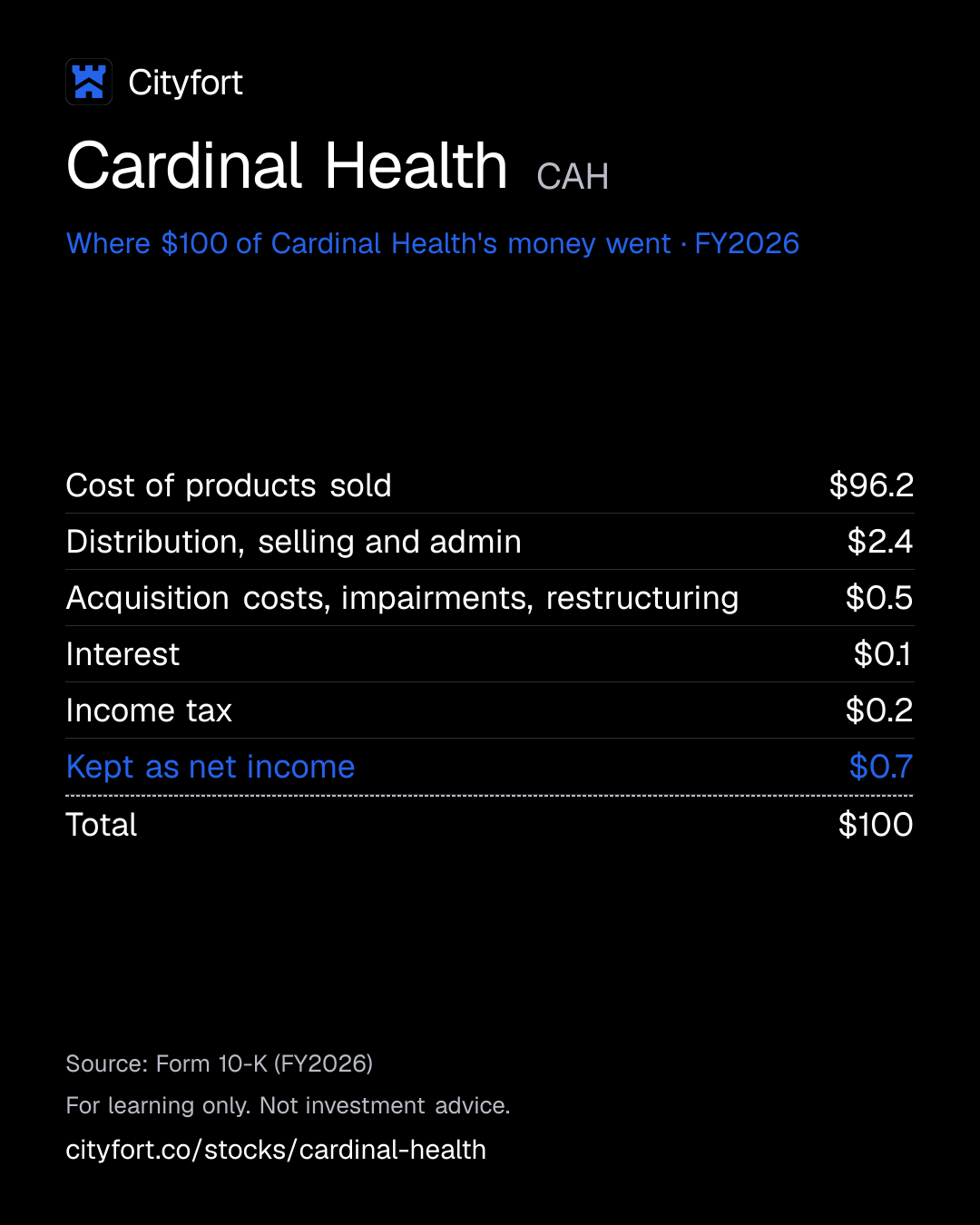
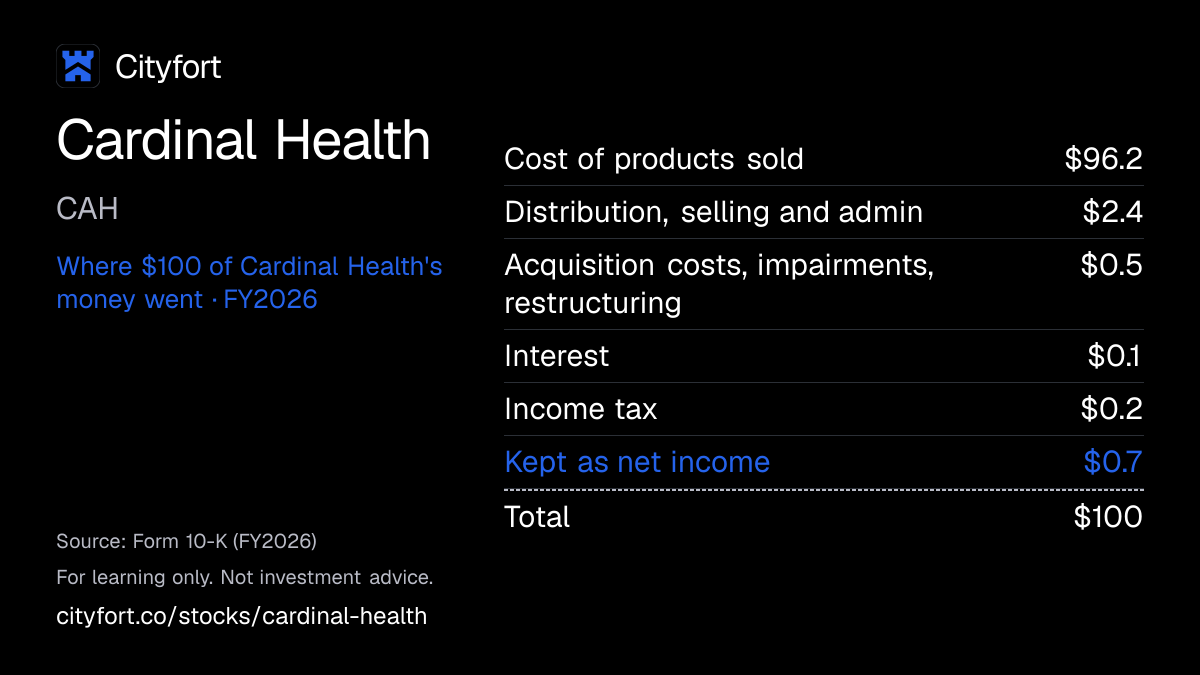
Where does $100 of Cardinal Health's money go?
Cardinal Health · FY2026
Receipt for every $100
| Cost of products sold | $96.2 |
|---|---|
| Distribution, selling and admin | $2.4 |
| Acquisition costs, impairments, restructuring | $0.5 |
| Interest | $0.1 |
| Income tax | $0.2 |
| Kept as net income | $0.7 |
| Total | $100 |
Each line = amount ÷ total money in × 100. Lines may not add to exactly $100 because of rounding.
How this is worked out
Cityfort calculation from FY2026 10-K. Of every $100 that came in during FY2026 (revenue plus $31 million of other income and $9 million of losses taken by minority owners): each line = line ÷ $254.3 billion × 100.
Save this receipt as an image
Embed this receipt or the key numbers
Paste this code into a blog or website to show the card you choose, with a link back to this page.
Each week: the next company due to report earnings, explained in 5 points.
No tips. Unsubscribe anytime.
We'll send a confirmation email. See our privacy policy.
02The business in one line
What does Cardinal Health do?
Pharmacies, hospitals and clinics pay Cardinal Health for the medicines and supplies it delivers. Of every $100, about $96 goes on buying those products, and about 67 cents is left as net income.
- Drug makers also pay it fees for distribution, data and launch services, usually a percentage of the list price they set.
- In FY2026, warehouses, delivery, staff and offices took $6.1 billion, and net income was $1,714 million.
03Who pays it
Who pays Cardinal Health?
CVS Health
28%
of revenue
The drugstore and pharmacy-benefit group is the largest customer. The two companies also run Red Oak Sourcing, which buys generic drugs for both through June 2029.
Pharmacies
Share of revenue not disclosed
Drugstore chains, independent pharmacies and the pharmacy counters of supermarkets and mass merchandisers buy medicines.
Hospitals and health systems
Share of revenue not disclosed
Many buy through group purchasing organizations. Members of the two largest, Vizient and Premier, made up 29% of FY2026 revenue.
Doctors, clinics and labs
Share of revenue not disclosed
Physician offices, surgery centers and clinical labs buy specialty drugs, medical products and practice management services.
Patients at home
Share of revenue not disclosed
People with diabetes and other chronic conditions get supplies shipped to their homes.
Drug manufacturers
Share of revenue not disclosed
Pay fees for distribution, inventory, data and product-launch services, usually a percentage of the list price they set.
Customer concentration
CVS Health was 28% of FY2026 revenue and the five largest customers were 43%, per the FY2026 10-K. OptumRx, 17% of FY2024 revenue, stopped buying when its contracts ended in June 2024.
- Largest customer
- 28%
- Top 5 customers
- 43%
04How it makes money
How does Cardinal Health make money?
It earns a few dollars on every $100 of medicine it moves, so volume and higher-margin services decide profit.
Gross margin was $3.84 per $100 of revenue in FY2026, up from $3.27 in FY2024 (Cityfort calculation from FY2026 10-K and FY2024 10-K). Branded drug makers pay it a fee, usually a percentage of the list price they set. Generic drugs earn the most soon after launch, while their prices are highest.
Gross margin per $100 of revenue
$3.3$3.8
FY2024 to FY2026
- Drug makers ship medicines to its warehouses
- Pharmacies and hospitals order and get frequent deliveries
- Makers pay fees and discounts; generics earn sourcing margins
- Thin margins on large volume cover warehouse and delivery costs
- Profit and borrowing fund acquisitions in specialty practices, nuclear and at-home supplies
↺ Step 5 feeds back into step 1.
05Business segments · FY2026
Which businesses make up Cardinal Health?
Pharmaceutical and Specialty Solutions
92.3%Drug distribution, specialty drugs and physician-practice platforms. Segment profit rose 23% in FY2026.
Revenue $234.8B ($234,833M) · Operating profit $2.8B ($2,783M)
Global Medical Products and Distribution
5%Cardinal Health brand medical products and distribution of other brands to hospitals. It lost $147 million in FY2023.
Revenue $12.7B ($12,719M) · Operating profit $258M
Other
2.7%Nuclear pharmacies ($1,851 million revenue), at-home supplies ($4,536 million) and OptiFreight Logistics ($405 million).
Revenue $6.8B ($6,792M) · Operating profit $707M
How the mix changed
- Pharmaceutical and Specialty Solutions
- Global Medical Products and Distribution
- Other
Revenue by segment, FY2022 to FY2026.
US$
See the numbers
06The numbers · Consolidated · US$
How has Cardinal Health done?
Revenue
$254.2BFY2026
Revenue grew from $181.4 billion in FY2022 to $254.2 billion in FY2026, with one dip in FY2025 after the OptumRx drug contracts ended in June 2024.
US$
See the numbers
Net income
$1.7BFY2026
Net income went from a $938 million loss in FY2022 to $1,714 million in FY2026.
US$
See the numbers
Net income for every $100 of revenue
$0.7FY2026
Cardinal Health kept about 67 cents of net income per $100 of revenue in FY2026, because almost all of each sale pays for the products it resells.
Net margin: $ of net income per $100 of revenue
See the numbers
Free cash flow
$4.5BFY2026
Free cash flow was $4,525 million in FY2026, up from $1,850 million in FY2025; the 10-K says money owed to suppliers rose $3,463 million in FY2026.
US$ · cash from operations minus spending on plants and equipment
See the numbers
See all yearly numbers
EBITDA here = operating income plus depreciation and amortization (from the cash flow statement). Fiscal years are the company's own: Fiscal year ends June 30 (FY2026 ran from July 2025 to June 2026). Net income is the share belonging to the company's owners.
Learn: Fiscal years that don't end in December: Nvidia's FY2027 explained · Stock-based compensation and dilution: pay that becomes shares
Sources (18)
- Form 10-K for FY2022
- Form 10-K for FY2024
- Form 10-K for FY2023
- Form 10-K for FY2025
- Form 10-K for FY2026
- Form 10-Q for Q2 FY2024
- Form 10-Q for Q2 FY2025
- Form 10-Q for Q1 FY2025
- Form 10-Q for Q3 FY2024
- Form 10-Q for Q3 FY2025
- Q4 FY2025 earnings release (8-K Ex. 99.1, filed Aug 12, 2025)
- Form 10-Q for Q1 FY2026
- Form 10-Q for Q2 FY2026
- Q3 FY2026 earnings release (8-K Ex. 99.1, filed Apr 30, 2026)
- Form 10-Q for Q3 FY2026
- Q4 FY2026 earnings release (8-K Ex. 99.1, filed Aug 11, 2026)
- Form 10-Q for Q1 FY2027
- Q1 FY2027 earnings release (8-K Ex. 99.1, filed Nov 5, 2026)
07Who runs it
Who runs Cardinal Health, and did they deliver?
Jason M. Hollar
Chief Executive Officer · since 2022
CEO since September 2022; CFO from May 2020 to August 2022.
Aaron E. Alt
Chief Financial Officer · since 2023
CFO since February 2023; earlier CFO of Sysco.
Deborah L. Weitzman
CEO, Pharmaceutical and Specialty Solutions
Runs the largest segment.
Stephen M. Mason
CEO, Global Medical Products and Distribution
Runs the medical products segment.
Patricia A. Hemingway Hall
Independent Board Chair · since 2026
Director since 2013; became Chair in March 2026 when Gregory B. Kenny retired.
What they said, and what happened
1 delivered · 2 too early to tell
Said on Aug 12, 2025
Expected FY2026 non-GAAPThe company's own "adjusted" numbers, not the official (GAAP) ones. Always read them next to the official figure. Learn more diluted EPS of $9.30 to $9.50.
DeliveredWhat happened
Reported $11.26 after raising the range three times. The company says it was $10.95 without the one-time tariff refund benefit.
Said on Aug 11, 2026
Expected FY2027 non-GAAP diluted EPS of $12.40 to $12.60.
Too early to tellWhat happened
Raised to $12.80 to $13.00 on Nov 5, 2026; Q1 FY2027 non-GAAP EPS was $3.26.
Said on Nov 5, 2026
Expected the AdaptHealth Diabetes Health purchase to close in Q3 FY2027.
Too early to tellWhat happened
Q3 FY2027 ends Mar 31, 2027.
Sources (6)
08What could go wrong
What could go wrong for Cardinal Health?
- Concentration
Reliance on CVS Health
CVS Health was 28% of FY2026 revenue and 22% of trade receivables at Jun 30, 2026. A binding letter of intent to renew its contracts was signed in November 2026.
Watch Whether final CVS Health agreements are signed, and their term.
- Legal
Opioid litigation
About 56 private-plaintiff suits, including about 9 purported class actions, were pending at Sep 30, 2026. Settlement payments run mostly through 2038, against $3.9 billion accrued.
Watch The opioid accrual and payments in each 10-Q.
- Pricing
Thin margins
It kept about 67 cents of net income per $100 of revenue in FY2026. Generic drug prices tend to fall after launch, and small price changes move profit.
Watch Gross margin per $100 of revenue in the FY2027 10-K.
- Regulation
Tariffs on generic drugs
The 10-K quotes a presidential statement that generic drugs will face 100% tariffs from 2028 and 200% from 2029. The company says there is significant uncertainty about how it will be implemented.
Watch Any tariff rule on generic drugs and what the company says about cost pass-through.
- Execution
Large acquisitions
ION, GI Alliance, ADSA certificate a US bank (the depositary) issues for shares of a foreign company that it holds. It trades in US dollars on a US exchange, and one may stand for more than one share. Learn more, Urology America and Solaris Health cost about $7.2 billion from December 2024 to November 2025 (Cityfort calculation from FY2026 10-K). In Q3 FY2026 it took a $184 million goodwill impairment on Navista and ION.
Watch Further goodwill impairments and Pharma segment profit growth.
- Cash and liquidity
Supplier and payables timing
It owed suppliers $38.3 billion at Jun 30, 2026. The 10-K says FY2026 operating cash flow reflected the timing of payments to vendors, so cash flow can swing.
Watch Operating cash flow and accounts payable in each 10-Q.
09Supporters vs. critics
What do supporters and critics point to?
What supporters point to
- Revenue grew from $181.4 billion in FY2022 to $254.2 billion in FY2026, and net income went from a $938 million loss to $1,714 million.
- Pharma segment profit rose 23% in FY2026, and the other businesses (nuclear, at-home and logistics) earned $707 million, up 37%.
- Global Medical Products and Distribution went from a $147 million loss in FY2023 to $258 million of profit in FY2026.
- On Nov 5, 2026, the company said it signed a binding letter of intent to renew its drug distribution agreements with CVS Health, its largest customer.
- It spent $1,358 million on buybacks and $491 million on dividends in FY2026, and the board approved a new $5.0 billion buyback program on Aug 4, 2026.
What critics point to
- It kept about 67 cents of net income per $100 of revenue in FY2026, so small price changes move profit.
- CVS Health was 28% of FY2026 revenue and the five largest customers 43%. OptumRx, 17% of FY2024 revenue, stopped buying when its contracts ended in June 2024.
- According to the Q1 FY2027 10-Q, about 56 private-plaintiff opioid suits are pending, and $3.9 billion was accrued at Sep 30, 2026 for settlement payments, mostly through 2038.
- Shareholders' equity was a deficit of $3.0 billion at Sep 30, 2026, and goodwill and other intangibles reached $13.7 billion after its acquisitions.
- FY2026 medical-products profit included a one-time $100 million tariff refund benefit, and Q1 FY2027 segment profit fell to $33 million from $46 million.
10What to watch next
What should you watch next at Cardinal Health?
Next event
Q2 FY2027 results
Date not announced yet.
Final CVS Health agreements
The binding letter of intent was signed in November 2026; CVS Health was 28% of FY2026 revenue, and Red Oak Sourcing runs through June 2029.
The FY2027 outlook
On Nov 5, 2026, management raised its FY2027 non-GAAP EPS outlook to $12.80 to $13.00; Q1 FY2027 non-GAAP EPS was $3.26.
Medical products profit
Global Medical Products and Distribution (GMPD) earned $258 million in FY2026, including a one-time $100 million tariff refund benefit, and $33 million in Q1 FY2027, down from $46 million.
Tariffs on generic drugs
The FY2026 10-K quotes a presidential statement of 100% tariffs on generic drugs from 2028 and 200% from 2029; the company says there is significant uncertainty about how they will be implemented.
11Key facts
Key facts about Cardinal Health
- What does Cardinal Health do?
- Cardinal Health, Inc., based in Dublin, Ohio, buys medicines from drug makers and delivers them to US pharmacies, hospitals and clinics. It also makes its own medical products such as gloves and syringes. Cardinal Health had revenue of $254.2 billion in FY2026, the year to Jun 30, 2026, and about 63,900 employees.
- How does Cardinal Health make money?
- Cardinal Health earns a small margin on each medicine it resells, plus fees from drug makers for distribution and other services. In FY2026, Cardinal Health's gross margin was $3.84 per $100 of revenue (Cityfort calculation from FY2026 10-K), its operating earnings were $2,613 million and its net income was $1,714 million.
- Who are Cardinal Health's customers?
- Cardinal Health sells to drugstore chains, independent pharmacies, hospitals, doctors' offices, clinics, labs and patients at home. CVS Health was 28% of Cardinal Health's FY2026 revenue, the next four largest customers 15% together and all other customers 57% (Cityfort calculation from FY2026 10-K).
- How big is Cardinal Health?
- Cardinal Health's FY2026 revenue was $254.2 billion, up from $222.6 billion in FY2025, and net income was $1,714 million, up from $1,561 million. In Q1 FY2027, the quarter to Sep 30, 2026, Cardinal Health's revenue was $67,513 million and net income $554 million.
- What are Cardinal Health's business segments?
- In FY2026, Cardinal Health's Pharmaceutical and Specialty Solutions segment had revenue of $234,833 million, Global Medical Products and Distribution $12,719 million, and its other businesses (nuclear pharmacies, at-home supplies and OptiFreight Logistics) $6,792 million.
- Who owns Cardinal Health?
- Cardinal Health has one class of common shares and no controlling holder. The 2026 proxy statementThe yearly filing about shareholder votes, the board and executive pay. Learn more lists Vanguard Capital Management with 7.6%, Wellington Management Group 6.4%, State Street 6.3% and Vanguard Portfolio Management 6.0%. Cardinal Health's directors and executive officers held about 0.12% (Cityfort calculation from 2026 proxy statement).
- How much debt does Cardinal Health have?
- At Sep 30, 2026, Cardinal Health had debt of $8.8 billion and cash of $5.3 billion. Cardinal Health's shareholders' equity was a deficit of $3.0 billion on that date.
- Does Cardinal Health pay dividends or buy back shares?
- Cardinal Health paid dividends of $2.04 a share for FY2026, $491 million in total, and spent $1,358 million buying back its own shares in FY2026.
Terms on this page
- Capital expenditures (capex)
- Customer concentration
- Earnings per share (EPS)
- EBITDA
- Free cash flow
- Net debt
- Net margin
- Revenue vs net income
- Stock buyback
Each explains the term in plain English, with the same number from other companies on Cityfort.
Go deeper
More detail from the same filings. Open any section.
12What it sells
12What it sells
What does Cardinal Health sell?
Drug distribution
Delivers branded, generic and over-the-counter medicines to drugstore chains, independent pharmacies, supermarket pharmacies and hospitals in the US.
Specialty drugs and doctor networks
Distributes cancer, gastroenterology, urology and other specialty drugs, and runs management services for physician practices through The Specialty Alliance and Navista.
Cardinal Health brand medical products
Makes or sources its own exam and surgical gloves, needles and syringes, wound-care and incontinence products, and surgical drapes and gowns. It also distributes other brands to hospitals.
Nuclear pharmacies
Prepares and delivers radioactive drugs used in nuclear imaging and cancer treatment for hospitals and doctors.
At-home supplies
Ships diabetes and other medical supplies straight to patients with chronic conditions, through Edgepark and ADS.
OptiFreight Logistics
Manages shipping for hospitals, pharmacies, labs and surgery centers.
Think of it like this
Think of a giant wholesale warehouse that sits between drug makers and the pharmacy counter, earning a small cut on each box it moves.
What it does
- Does: Distributes medicines from many manufacturers to US pharmacies and hospitals
- Does: Provides distribution, data and launch services to drug makers for a fee
- Does: Makes its own branded medical and surgical products
- Does: Manages physician practices in specialties such as gastroenterology and urology
What it does not do
- Does not: Does not set the list price of branded drugs; manufacturers set it
- Does not: Does not run a drugstore chain; it operates only a limited number of pharmacies
- Does not: Earns little outside the US: international revenue was $1,705 million of $254,344 million of segment revenue in FY2026
Sources (1)
13How the money flows
13How the money flows · FY2026
How does money flow through Cardinal Health?
Money in
- Revenue$254.2B
- Other income, plus losses taken by minority owners$40M
The company
Cardinal Health
$254.3B came in
Money out
- Cost of products sold$244.5B
- Distribution, selling, general and administrative$6.1B
- Acquisition costs, impairments, restructuring and litigation$1.2B
- Interest (net)$348M
- Income tax$469M
- Net income attributable to Cardinal Health$1.7B
- Pharmacies, hospitals, clinics and patients paid Cardinal Health $254.2 billion in FY2026, the year to Jun 30, 2026.
- Buying the drugs and products it resold or made took $244.5 billion. That left a gross margin of $9.8 billion.
- Warehouses, delivery, staff and offices took $6.1 billion. Deal costs, write-downs and restructuring took $1.2 billion more.
- Interest took $348 million and income tax took $469 million. Other income and minority owners added $40 million.
- Net income for Cardinal Health shareholders was $1,714 million, up from $1,561 million in FY2025.
Sources (1)
14What it needs to run
14What it needs to run
What does Cardinal Health need to run?
Distribution centers
A national logistics center and a network of pharmaceutical and specialty distribution facilities in the US, plus medical-products plants and distribution sites.
Drug makers’ products
Products from its five largest suppliers made up 39% of FY2026 revenue. The largest supplier alone was about 13%.
Supplier credit
At Jun 30, 2026, it owed suppliers $38.3 billion, more than its $17.3 billion of inventory and $13.8 billion of receivables.
Workforce
63,900 employees at Jun 30, 2026, up from 57,700 a year earlier. About 37,000 work in distribution centers, plants, pharmacies or practice operations.
Sources (2)
15Where it sells
15Where it sells · FY2026
Where does Cardinal Health sell?
- United States99.3%
- International0.7%
Sources (1)
16Competitors and what protects it
16Competitors and what protects it
Who does Cardinal Health compete with?
McKesson Corporation
NYSE: MCK
A national drug wholesaler that competes with the Pharma segment for pharmacy and hospital customers, per the FY2026 10-K.
Cencora, Inc.
NYSE: COR
Another national drug wholesaler named in the FY2026 10-K as a Pharma segment competitor.
Medline Industries, Inc.
A national medical-products distributor and maker that competes with the medical-products (GMPD) segment, per the FY2026 10-K.
Owens & Minor, Inc.
A national medical-products distributor named in the FY2026 10-K as a competitor of the medical-products (GMPD) segment.
What protects the business
Each strength is scored 1 (weak) to 5 (strong) for the business, with the reason. It is not a rating of the share.
- Scale4 of 5
It moved $254.2 billion of products in FY2026 through a national network of distribution centers.
- Generic drug buying3 of 5
Red Oak Sourcing negotiates generic drug supply contracts for both Cardinal Health and CVS Health, through June 2029.
- Customer relationships3 of 5
It signed a binding letter of intent in November 2026 to renew its drug distribution agreements with CVS Health, its largest customer.
Weak spot
A few large buyers
CVS Health was 28% of FY2026 revenue and the five largest customers 43%. When OptumRx (17% of FY2024 revenue) left in June 2024, FY2025 revenue fell to $222.6 billion from $226.8 billion.
17Where growth could come from
17Where growth could come from
Where could Cardinal Health's growth come from?
On Nov 5, 2026, management raised its FY2027 outlook for non-GAAP diluted EPS to $12.80 to $13.00, from $12.40 to $12.60 given on Aug 11, 2026. It gave no GAAP EPS outlook.
Specialty drugs and doctor networks
WorkingPharma segment profit +23% in FY2026
Since December 2024 it bought ION, GI Alliance, Urology America and Solaris Health, which manage oncology, gastroenterology and urology practices.
Status: Working, on track against what the company said.
Nuclear, at-home and logistics businesses
WorkingOther segment profit $707M in FY2026, up 37%
At-home revenue rose to $4,536 million in FY2026 from $3,480 million, after the ADS purchase in April 2025.
Status: Working, on track against what the company said.
Medical products turnaround
MixedGMPD profit $258M in FY2026; $33M in Q1 FY2027
The medical-products segment (GMPD) went from a $147 million loss in FY2023 to profit. FY2026 included a one-time $100 million tariff refund benefit, and Q1 FY2027 profit fell from $46 million.
Status: Mixed, partly on track.
CVS Health renewal
NewBinding letter of intent, Nov 5, 2026
The company said it agreed to renew its drug distribution agreements with CVS Health, 28% of FY2026 revenue.
Status: New, recently announced.
AdaptHealth diabetes business
EarlyCompany expects closing in Q3 FY2027 (Nov 5, 2026)
The company has agreed to buy AdaptHealth’s Diabetes Health business, adding to its at-home supplies. It completed the Strive Medical purchase in July 2026.
Status: Early, too early to judge.
Status compares progress with what the company itself said it would do: Working = on track against what the company said; Mixed = partly on track; Behind = behind the company's own plan; New = recently announced; Early = too early to judge.
18The company's own measures (non-GAAP)
18The company's own measures · FY2026
What do Cardinal Health's own measures show?
Official (GAAP): Operating earnings (GAAP), FY2026
$2.6B
Company's own measure: Non-GAAP operating earnings, FY2026
$3.6B
Leaves out amortization and other acquisition costs ($469 million), deal-related pay ($287 million), impairments ($177 million) and restructuring ($106 million), among others.
Official (GAAP): Diluted EPS (GAAP), FY2026
$7.23
Company's own measure: Non-GAAP diluted EPS, FY2026
$11.26
The company says it was $10.95 without the one-time tariff refund benefit recorded in Q4 FY2026.
Official (GAAP): Net income attributable to Cardinal Health (GAAP), FY2026
$1.7B
Company's own measure: Non-GAAP net earnings, FY2026
$2.7B
Also leaves out a $122 million write-down of its 16% stake in Outcomes.
Official (GAAP): Operating earnings (GAAP), Q1 FY2027
$753M
Company's own measure: Non-GAAP operating earnings, Q1 FY2027
$1.0B
Up from $857 million in Q1 FY2026, by the company’s measure.
Official (GAAP): Diluted EPS (GAAP), Q1 FY2027
$2.38
Company's own measure: Non-GAAP diluted EPS, Q1 FY2027
$3.26
Up from $2.55 in Q1 FY2026, by the company’s measure.
These are the company's own measures, defined by the company. They are not comparable across companies, and they are not added together. Each sits beside the nearest official (GAAP) figure.
Learn: Non-GAAP measures: what a company's "adjusted" numbers leave out
19Financial strength and debt
19Financial strength · Sep 30, 2026
How much debt does Cardinal Health have?
- Total debt$8.8B
- Cash and investments$5.3B
- Net debt (debt minus cash)$3.6B
- Net worth (shareholders' money)−$2.9B
- Debt is mostly notes and debentures (types of bonds) plus a term loan; current debt was $1,886 million and long-term debt $6,929 million at Sep 30, 2026.
- On Aug 7, 2026, a $4.0 billion revolving credit line running to August 2031 replaced its earlier bank lines and receivables facility. It limits net leverage to 4.00 times.
- It also had $4.3 billion accrued for opioid settlements at Jun 30, 2026, mostly paid out through 2038. That liability is not counted as debt here.
- Goodwill and other intangibles were $13.6 billion at Jun 30, 2026, up from $6.5 billion two years earlier, after its acquisitions.
20Who owns it
20Who owns it · ownership as of Sep 14, 2026
Who owns Cardinal Health?
- Officers and directors (as a group), shares
- 0.1%
Share classes
Holders of 5% or more
From the company's proxy statement (DEF 14A), later Schedule 13G filings and the share counts on its latest annual or quarterly report. Each holder row shows the date of its own filing.
Learn: How to read a proxy statement (DEF 14A): Nvidia's 2026 proxy · Form 4 insider filings: who files, the codes and the footnotes
21What it does with profit
21What it does with profit
What does Cardinal Health do with its profit?
Dividend per share
$2.04FY2026
Dividend paid for each share, by financial year.
$ per share
See the numbers
Buyback · Jun 30, 2024
FY2024: paid $750 million for its own shares.
$750M
Buyback · Jun 30, 2025
FY2025: paid $765 million for its own shares.
$765M
Buyback · Jun 30, 2026
FY2026: paid $1,358 million for its own shares, through four accelerated repurchase deals.
$1.4B
Buyback · Sep 30, 2026
Q1 FY2027: a $500 million accelerated repurchase.
$500M
22Governance signals
22Governance signals
What do Cardinal Health's governance filings show?
- Auditor
- Ernst & Young LLP, since 2002
- Auditor changes
- None in the period covered
- Audit qualifications
- None reported
- Related-party dealings
- The 2026 proxy lists one related person transaction since Jul 1, 2025: the brother of Chief Human Resources Officer Valerie Pitteroff, a Pharma segment manager, received about $158,000 in FY2026 pay.
- Credit rating
- Not checked for this page
Flags to know about
regulatory
Opioid lawsuits and settlement
It was named in lawsuits over the distribution of opioid pain medicines. The national settlement resolved claims of all 50 states, DC and over 99% of local governments without admitting liability. About 56 private-plaintiff suits remain, with $3.9 billion accrued at Sep 30, 2026.
other
Chair change
Gregory B. Kenny retired as Board Chair effective Mar 20, 2026, after more than 18 years on the board. Independent director Patricia A. Hemingway Hall became Chair.
disclosure
Outlook only on an adjusted basis
Its earnings outlook for FY2027 is given for non-GAAP EPS only; the Nov 5, 2026 release gives no GAAP EPS outlook.
23How it got here
23How it got here
How did Cardinal Health get here?
1979
Milestone
Ohio company formed
Cardinal Health, Inc. was incorporated in Ohio; it is based in Dublin, Ohio.
2014
Business-model change
Red Oak Sourcing with CVS Health
A joint venture to buy generic drugs for both companies, now running through June 2029.
2020
Crisis
$5.6 billion opioid charges
It recorded $5.6 billion of pre-tax charges in fiscal 2020 for opioid lawsuits, later settled with states and local governments.
2022
Milestone
Jason Hollar becomes CEO
The former CFO took over as CEO in September 2022.
2024
Crisis
OptumRx contracts end
Drug distribution contracts with OptumRx, 17% of FY2024 revenue, expired at the end of June 2024.
2025
Business-model change
Buying doctor-practice platforms
It bought ION (December 2024), 73% of GI Alliance (January 2025) and Solaris Health (November 2025).
2026
Milestone
Tariff refunds
After the US Supreme Court ruled IEEPA tariffs unlawful in February 2026, it booked a one-time $100 million net benefit in Q4 FY2026.
2026
Milestone
CVS Health renewal agreed
In November 2026 it signed a binding letter of intent to renew its drug distribution agreements with CVS Health.
24Sources and changes
Where every number on this page comes from
Sources (22 documents)
- S1Form 10-Q for Q1 FY2027 · SEC EDGAR · Tier 1: company or exchange filing · Nov 5, 2026
- S2Form 10-K for FY2026 · SEC EDGAR · Tier 1: company or exchange filing · Aug 11, 2026
- S3Form 10-Q for Q2 FY2026 · SEC EDGAR · Tier 1: company or exchange filing · Feb 5, 2026
- S4Form 10-Q for Q1 FY2026 · SEC EDGAR · Tier 1: company or exchange filing · Oct 30, 2025
- S5Form 10-K for FY2025 · SEC EDGAR · Tier 1: company or exchange filing · Aug 12, 2025
- S6Form 10-Q for Q3 FY2025 · SEC EDGAR · Tier 1: company or exchange filing · May 1, 2025
- S7Form 10-Q for Q2 FY2025 · SEC EDGAR · Tier 1: company or exchange filing · Jan 30, 2025
- S8Form 10-Q for Q1 FY2025 · SEC EDGAR · Tier 1: company or exchange filing · Nov 1, 2024
- S9Form 10-K for FY2024 · SEC EDGAR · Tier 1: company or exchange filing · Aug 14, 2024
- S10Form 10-Q for Q3 FY2024 · SEC EDGAR · Tier 1: company or exchange filing · May 2, 2024
- S11Form 10-Q for Q2 FY2024 · SEC EDGAR · Tier 1: company or exchange filing · Feb 1, 2024
- S12Form 10-K for FY2023 · SEC EDGAR · Tier 1: company or exchange filing · Aug 15, 2023
- S13Form 10-K for FY2022 · SEC EDGAR · Tier 1: company or exchange filing · Aug 11, 2022
- S14Q1 FY2027 earnings release (8-K Ex. 99.1, filed Nov 5, 2026) · SEC EDGAR · Tier 1: company or exchange filing · Nov 5, 2026
- S15Q4 FY2026 earnings release (8-K Ex. 99.1, filed Aug 11, 2026) · SEC EDGAR · Tier 1: company or exchange filing · Aug 11, 2026
- S16Q3 FY2026 earnings release (8-K Ex. 99.1, filed Apr 30, 2026) · SEC EDGAR · Tier 1: company or exchange filing · Apr 30, 2026
- S18Q1 FY2026 earnings release (8-K Ex. 99.1, filed Oct 30, 2025) · SEC EDGAR · Tier 1: company or exchange filing · Oct 30, 2025
- S19Q4 FY2025 earnings release (8-K Ex. 99.1, filed Aug 12, 2025) · SEC EDGAR · Tier 1: company or exchange filing · Aug 12, 2025
- S202026 proxy statement (DEF 14A, filed Sep 21, 2026) · SEC EDGAR · Tier 1: company or exchange filing · Sep 21, 2026
- S218-K filed Aug 11, 2026: $4.0 billion revolving credit agreement · SEC EDGAR · Tier 1: company or exchange filing · Aug 11, 2026
- S228-K filed Mar 23, 2026: Board Chair change · SEC EDGAR · Tier 1: company or exchange filing · Mar 23, 2026
- S23Form 10-Q for Q3 FY2026 · SEC EDGAR · Tier 1: company or exchange filing · Apr 30, 2026
Changes to this page (v1 · Nov 20, 2026)
- v1 · Nov 20, 2026First version. (first version)
Numbers come only from tier 1 and tier 2 sources. Read how we research.
Disclaimer
For learning only. Cityfort is not a registered investment adviser or broker-dealer and does not recommend buying or selling any security. Prices shown are dated and may be out of date.
Investing in securities involves risk, including loss of capital. Before making any investment decision, do your own research and consider consulting a registered investment adviser or other qualified professional.
Cityfort, its owners and contributors may or may not hold securities of companies covered. Cityfort is not paid by any company it covers. Content is not an offer or solicitation to buy or sell any security, including in any initial public offering.
Read the positions policyRead the full disclaimerHide the full disclaimer
Cityfort publishes general educational content that explains how listed companies work. Cityfort is not registered with the US Securities and Exchange Commission or any state securities regulator as an investment adviser, and is not a broker-dealer or a member of FINRA. Cityfort does not provide investment, tax or legal advice, recommendations, ratings, price targets or any opinion on whether to buy, sell or hold any security. Nothing on the site is tailored to any person's circumstances.
All information is taken from publicly available sources, mainly company filings with the SEC, which are listed on each page with dates. We work to keep it accurate and correct errors publicly, but we do not guarantee that it is complete, accurate or up to date. Any market price or price-based ratio shown is dated, may be out of date by the time you read it, and is included only to explain concepts.
Statements by company management, including forward-looking statements and guidance, are reported as the company's statements, with their date and source; they are not our forecasts. Adjusted (non-GAAP) figures are the company's own measures and are shown next to the official (GAAP) figures.