Industrials · NASDAQ: PAYX
Paychex: how the business works
Paychex runs payroll, HR software and benefits for about 840,000 customers, mostly small and mid-sized US businesses, with revenue of $6.5 billion in FY2026.
By Hardik Bhandare · Checked against filings: . Editorial policy. Corrections
Follow Paychex
Email me when Paychex's page is updated after earnings.
We'll send a confirmation email first. See our privacy policy.
Paychex, Inc. · Rochester, New York and Cincinnati, Ohio
Updated for Q1 FY2027 · checked
- Revenue, FY2026
- $6.5B
- Net income, FY2026
- $1.76B
- Payroll clients, May 31, 2026
- About 800,000
- Interest on client money, FY2026
- $210.9M
- Employees, May 31, 2026
- About 17,600
The short version
Paychex in 5 points
1 · What it sells
Paychex runs payroll, HR software, HR outsourcing, retirement plans and insurance for about 840,000 customers, mostly small and mid-sized US businesses, as of May 31, 2026.
2 · Who pays it
In FY2026, Management Solutions brought in 74.8% of Paychex's revenue, PEO and Insurance Solutions 22% and interest on client money 3.2%.
3 · What it keeps from $100
Of every $100 that came in during FY2026, Paychex kept $26.7 as net income, which includes $69.9 million of other income; its operating margin was 38.6%.
4 · Where the operating profit comes from
Paychex reports one operating segment, so it gives no profit by revenue line; operating income was $2,510.5 million in FY2026, after $304.2 million of acquisition-related costs.
5 · The one thing to watch
Paychex's yearly interest expense rose from $37.3 million in FY2024 to $269.5 million in FY2026, while net income per $100 of revenue fell from $32.0 to $27.0.
Sources: From Paychex's FY2022 to FY2026 10-Ks, Q1 FY2027 10-Q, 2026 proxy and earnings releases · checked
01Where the money goes · FY2026
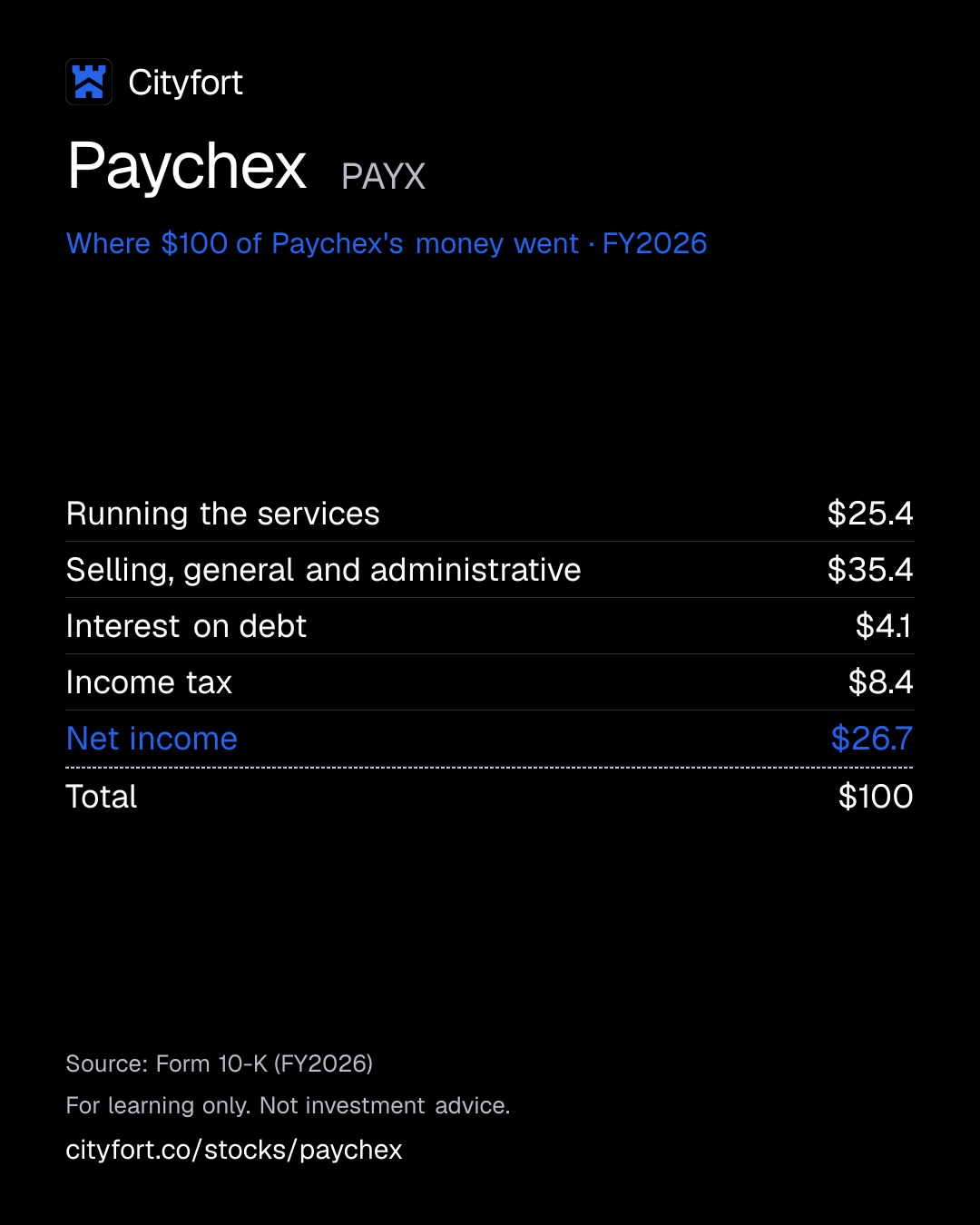
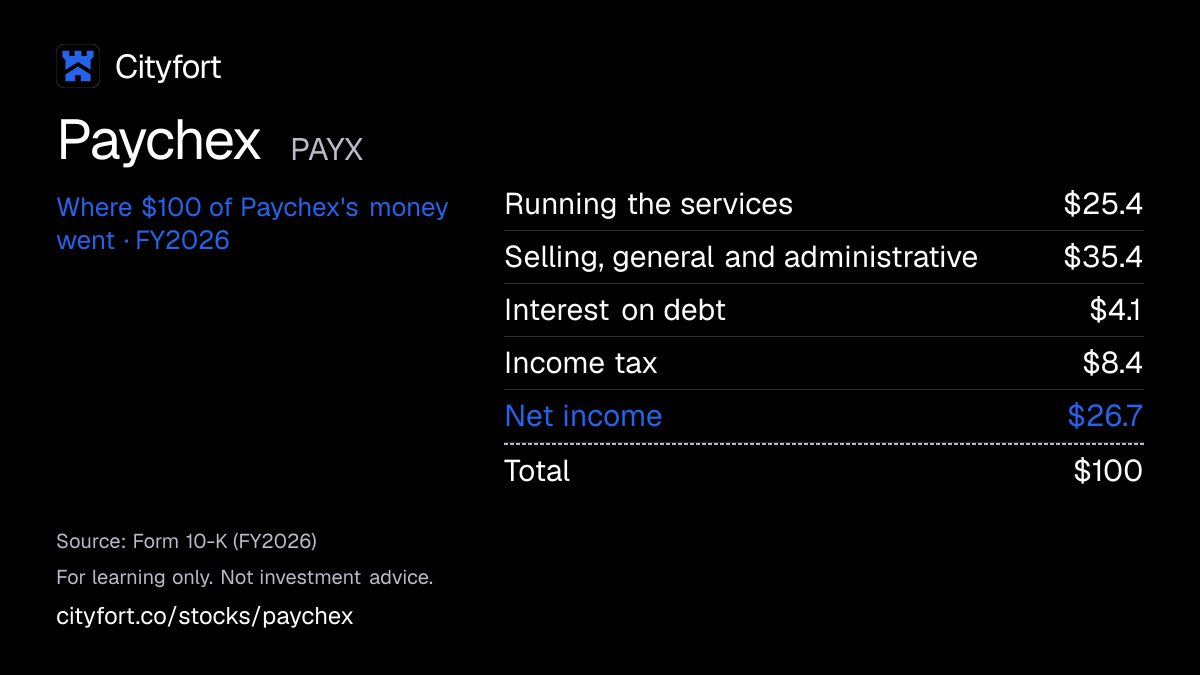
Where does $100 of Paychex's money go?
Paychex · FY2026
Receipt for every $100
| Running the services | $25.4 |
|---|---|
| Selling, general and administrative | $35.4 |
| Interest on debt | $4.1 |
| Income tax | $8.4 |
| Net income | $26.7 |
| Total | $100 |
Each line = amount ÷ total money in × 100. Lines may not add to exactly $100 because of rounding.
How this is worked out
Cityfort calculation from the FY2026 10-K: each line divided by total money in (revenue of $6,512.0 million plus other income of $69.9 million), times 100.
Save this receipt as an image
Embed this receipt or the key numbers
Paste this code into a blog or website to show the card you choose, with a link back to this page.
Each week: the next company due to report earnings, explained in 5 points.
No tips. Unsubscribe anytime.
We'll send a confirmation email. See our privacy policy.
02The business in one line
What does Paychex do?
Businesses pay Paychex a fee each pay period to run payroll and HR. Sales and administration are its biggest cost, and $26.7 of every $100 was left as net income in FY2026.
- In FY2026, payroll, HR software, outsourcing and retirement services brought in 74.8% of revenue, acting as co-employer and insurance agent 22%, and interest on client money 3.2%.
- Of every $100 that came in, selling, general and administrative costs took $35.4, running the services $25.4 and income tax $8.4.
03Who pays it
Who pays Paychex?
Businesses using payroll, HR software and outsourcing
74.8%
of revenue
Management Solutions revenue of $4,867.9 million in FY2026, from a customer base of about 840,000 in the US and parts of Europe.
Businesses using Paychex as co-employer or insurance agent
22%
of revenue
PEO and Insurance Solutions revenue of $1,433.2 million in FY2026.
Interest on client money held
3.2%
of revenue
$210.9 million in FY2026 from investing payroll and tax money collected from clients but not yet paid out.
- Businesses using payroll, HR software and outsourcing74.8%
- Businesses using Paychex as co-employer or insurance agent22%
- Interest on client money held3.2%
How spread out the customers are
Paychex does not report revenue by customer. Its 10-Q says no single client is material to its receivables, service revenue or results.
04How it makes money
How does Paychex make money?
Small, repeating fees from hundreds of thousands of employers, plus interest on their money
A client pays Paychex to process payroll and file taxes every pay period. Paychex then sells the same client more services, and earns interest on the payroll money it holds in between.
Net income per $100 of revenue
$30.2$27.0
FY2022 to FY2026
- A business signs up, often through its accountant, broker or bank.
- It pays a fee every pay period for payroll and tax filing.
- Paychex adds HR software, outsourcing, retirement plans or insurance.
- The client's payroll money passes through Paychex and earns interest on the way.
- The same platforms serve more clients, and the cycle repeats.
↺ Step 5 feeds back into step 1.
05Business segments · FY2026
Which businesses make up Paychex?
Management Solutions
74.8%Payroll, HR software, HR outsourcing (ASO), retirement and funding services. Paychex reports one operating segment, so it gives no profit by revenue line.
Revenue $4.9B ($4,868M)
PEO and Insurance Solutions
22%Co-employment of clients' workers with benefits and insurance, plus its insurance agency.
Revenue $1.4B ($1,433M)
Interest on funds held for clients
3.2%Interest earned on client payroll and tax money before it is paid out.
Revenue $211M
How the mix changed
- Management Solutions
- PEO and Insurance Solutions
- Interest on funds held for clients
Revenue by segment, FY2022 to FY2026.
US$
See the numbers
06The numbers · Consolidated · US$
How has Paychex done?
Revenue
$6.5BFY2026
Revenue rose every year, from $4,611.7 million in FY2022 to $6,512.0 million in FY2026, the first full year that includes Paycor, bought in April 2025.
US$
See the numbers
Net income
$1.8BFY2026
Net income rose from $1,392.8 million in FY2022 to $1,690.4 million in FY2024, dipped to $1,657.3 million in FY2025 and reached $1,760.1 million in FY2026.
US$
See the numbers
Net income for every $100 of revenue
$27.0FY2026
Net income per $100 of revenue was $32.0 in FY2024 and $27.0 in FY2026, a period in which yearly interest expense rose from $37.3 million to $269.5 million.
Net margin: $ of net income per $100 of revenue
See the numbers
Free cash flow
$2.3BFY2026
Free cash flow (cash from operations minus spending on property and equipment) was $2,321.8 million in FY2026, up from $1,709.1 million in FY2025.
US$ · cash from operations minus spending on plants and equipment
See the numbers
See all yearly numbers
EBITDA here = operating income plus depreciation and amortization (from the cash flow statement). Fiscal years are the company's own: Fiscal year ends May 31 (FY2026 = Jun 1, 2025 to May 31, 2026). Net income is the share belonging to the company's owners.
Learn: Fiscal years that don't end in December: Nvidia's FY2027 explained · Stock-based compensation and dilution: pay that becomes shares
Sources (20)
- Paychex, Inc. FY2022 Form 10-K
- Paychex, Inc. FY2024 Form 10-K
- Paychex, Inc. FY2023 Form 10-K
- Paychex, Inc. FY2025 Form 10-K
- Paychex, Inc. FY2026 Form 10-K (FYE May 31, 2026)
- Paychex, Inc. Q4 FY2025 earnings release (8-K Ex. 99.1)
- Paychex, Inc. Form 10-Q, Q1 FY2025
- Paychex, Inc. Q1 FY2026 Form 10-Q (Aug 31, 2025)
- Paychex, Inc. Q1 FY2026 earnings release (8-K Ex. 99.1)
- Paychex, Inc. Form 10-Q, Q2 FY2025
- Paychex, Inc. Q2 FY2026 Form 10-Q (Nov 30, 2025)
- Paychex, Inc. Q2 FY2025 earnings release (8-K Ex. 99.1)
- Paychex, Inc. Form 10-Q, Q3 FY2025
- Paychex, Inc. Q3 FY2026 Form 10-Q (Feb 28, 2026)
- Paychex, Inc. Q3 FY2025 earnings release (8-K Ex. 99.1)
- Paychex, Inc. Q2 FY2026 earnings release (8-K Ex. 99.1)
- Paychex, Inc. Q3 FY2026 earnings release (8-K Ex. 99.1)
- Paychex, Inc. Q4 FY2026 earnings release (8-K Ex. 99.1)
- Paychex, Inc. Q1 FY2027 Form 10-Q (Aug 31, 2026)
- Paychex, Inc. Q1 FY2027 earnings release (8-K Ex. 99.1)
07Who runs it
Who runs Paychex, and did they deliver?
John B. Gibson
President and Chief Executive Officer · since 2022
CEO since October 2022; joined Paychex in 2013 and was chief operating officer from December 2021.
Robert L. Schrader
Chief Financial Officer · since 2023
CFO since October 2023; joined Paychex in 2014.
Martin Mucci
Chairman of the Board · since 2010
Director since 2010 and former chairman and CEO; he handed the CEO role to John Gibson in October 2022.
Sipi Bhandari
Chief Legal Officer · since 2024
In the role since May 2024.
J. Michael Hansen
Independent director · since 2026
Former CFO of Cintas; joined the board and its audit committee on Jan 16, 2026. The Jan 20, 2026 8-K says he served on the Paycor board from 2008 to 2018.
What they said, and what happened
3 delivered · 2 too early to tell
Said on Jun 25, 2025
Total revenue for FY2026 would grow 16.5% to 18.5%.
DeliveredWhat happened
Total revenue rose 17% to $6.5 billion in FY2026, Paychex reported.
Said on Jun 25, 2025
Adjusted operating margin for FY2026 would be about 43%.
DeliveredWhat happened
Adjusted operating margin was 43.2% in FY2026.
Said on Jun 25, 2025
Adjusted diluted EPS for FY2026 would grow 8.5% to 10.5%.
DeliveredWhat happened
Adjusted diluted EPS rose 11% to $5.51, slightly above the range.
Said on Jun 24, 2026
Total revenue for FY2027 would grow 5% to 6%; repeated on Sep 23, 2026.
Too early to tellWhat happened
Not yet reported.
Said on Sep 23, 2026
PEO and Insurance Solutions revenue for FY2027 would grow 7% to 8%, raised from 6% to 7%.
Too early to tellWhat happened
Not yet reported.
Sources (6)
- Paychex, Inc. FY2026 Form 10-K (FYE May 31, 2026)
- Paychex, Inc. 2026 Proxy Statement (DEF 14A)
- Paychex, Inc. 8-K filed Jan 20, 2026 (Items 5.02, 8.01)
- Paychex, Inc. Q4 FY2025 earnings release (8-K Ex. 99.1)
- Paychex, Inc. Q4 FY2026 earnings release (8-K Ex. 99.1)
- Paychex, Inc. Q1 FY2027 earnings release (8-K Ex. 99.1)
08What could go wrong
What could go wrong for Paychex?
- Debt
Debt taken on to buy Paycor
Paychex issued $4.2 billion of bonds in April 2025 to pay for Paycor. Interest expense was $269.5 million in FY2026, against $37.3 million in FY2024. The 10-K says covenants cap leverage at 3.5 times and future deals could bring it closer to those limits.
Watch Interest expense and net debt in each 10-Q.
- Pricing
PEO insurance costs depend on claims
In its PEO business Paychex keeps health and workers' compensation insurance for worksite employees. The 10-K says a rise in claims, or cost increases not passed into fees, could hurt results.
Watch PEO and Insurance Solutions revenue and PEO direct insurance costs ($563.2 million in FY2026).
- Regulation
Interest on client money moves with rates and rules
Interest on funds held for clients was $210.9 million in FY2026. The 10-K says a rule cutting tax withheld, or giving less time before taxes are remitted, could lower this income; it also depends on interest rates.
Watch Interest on funds held for clients, which Paychex said in its Q1 FY2027 earnings release (Sep 23, 2026) it expects to be $200 million to $210 million in FY2027.
- Technology
Cyberattacks on payroll and personal data
Paychex holds pay, tax and bank details for its clients and their workers. The 10-K says cyberattacks or security flaws could reduce revenue, raise costs and bring liability claims.
Watch Cybersecurity incidents disclosed in 8-K or 10-Q filings.
- Competition
Clients can leave on 30 days' notice
The 10-K describes a fragmented market with one primary national competitor plus regional, online and in-house options. Most contracts can be ended with 30 days' notice, and payroll client retention was 82% to 83% in FY2026.
Watch Payroll client retention in the FY2027 10-K.
- Execution
Fitting Paycor into Paychex
The 10-K says acquisitions bring risks such as unforeseen liabilities, loss of key staff and higher costs if expected savings are not achieved. Acquisition-related costs were $304.2 million in FY2026.
Watch Acquisition-related costs and Management Solutions growth in each earnings release.
- Legal
Liability as a co-employer
As a PEO, Paychex is co-employer of its clients' workers. The 10-K says it could be held liable for clients' breaches of employment or discrimination laws, and that co-employment rules keep changing.
Watch Legal matters in the 10-K contingencies note.
09Supporters vs. critics
What do supporters and critics point to?
What supporters point to
- Revenue rose every year, from $4,611.7 million in FY2022 to $6,512.0 million in FY2026.
- Free cash flow was $2,321.8 million in FY2026, up from $1,709.1 million in FY2025.
- Worksite employees in HR outsourcing rose 6% to 2.6 million at May 31, 2026, and retirement plans rose 4% to 130,000.
- Payroll client retention was 82% to 83% of the beginning client base in FY2026.
- Dividends rose every year, from $2.77 a share for FY2022 to $4.43 for FY2026.
What critics point to
- Net income per $100 of revenue fell from $32.0 in FY2024 to $27.0 in FY2026, as interest expense rose to $269.5 million.
- Goodwill and intangible assets, mostly from Paycor, add up to more than stockholders' equity of $3,735.1 million at May 31, 2026.
- Dividends paid were 90.3% of FY2026 net income (Cityfort calculation from the FY2026 10-K).
- Most service agreements can be ended by either side with 30 days' notice.
- Paycor contributed about 15% to the 20% Management Solutions revenue growth in FY2026, the 10-K says; on Sep 23, 2026 Paychex said it expects FY2027 total revenue to grow 5% to 6%.
10What to watch next
What should you watch next at Paychex?
Next event
Q2 FY2027 results
Date not announced yet.
Revenue against the FY2027 outlook
Paychex said on Sep 23, 2026 that it expects FY2027 total revenue to grow 5% to 6% and adjusted diluted EPS 7% to 9%. Q1 FY2027 revenue was $1,630.5 million.
PEO and insurance
On Sep 23, 2026 Paychex raised its FY2027 growth outlook for PEO and Insurance Solutions to 7% to 8%, from 6% to 7%.
Interest on client money
The average rate Paychex earned on client funds was 3.6% in Q1 FY2027, against 3.7% a year earlier.
Buybacks and debt
Paychex paid $160.1 million for buybacks in Q1 FY2027, under a $1.0 billion program approved on Jan 16, 2026; its next notes, $400.0 million, are due Mar 13, 2029.
11Key dates
What are the key dates for Paychex?
| Event | Date | Source |
|---|---|---|
| Fiscal 2027 endsPaychex's fiscal year ends on May 31. | Paychex, Inc. FY2026 Form 10-K (FYE May 31, 2026) | |
| AICPA partnership agreement runs throughSeptember 2027, according to the FY2026 10-K. | Not yet stated | Paychex, Inc. FY2026 Form 10-K (FYE May 31, 2026) |
| Series B senior notes due$400.0 million at 4.25%. | Paychex, Inc. FY2026 Form 10-K (FYE May 31, 2026) | |
| 5-year bonds due$1,500.0 million at 5.10%. | Paychex, Inc. FY2026 Form 10-K (FYE May 31, 2026) | |
| 2017 credit facility matures$1.0 billion unsecured revolving facility, extended in January 2026. | Paychex, Inc. 8-K filed Jan 26, 2026 (Items 1.01, 1.02, 2.03: debt agreements) |
Learn: Fiscal years that don't end in December: Nvidia's FY2027 explained
12Key facts
Key facts about Paychex
- What does Paychex do?
- Paychex, Inc. runs payroll for US businesses, mostly small and mid-sized ones: it works out each worker's pay, pays them and files the payroll taxes. Paychex also sells HR software, HR outsourcing, retirement plans and insurance, and had about 840,000 customers at May 31, 2026.
- How does Paychex make money?
- Paychex had revenue of $6,512.0 million in FY2026, the year ended May 31, 2026. Management Solutions (payroll, HR software, outsourcing and retirement) brought in $4,867.9 million, PEO and Insurance Solutions $1,433.2 million, and interest earned on client payroll money it held $210.9 million.
- Who are Paychex's customers?
- Paychex's customers are mostly small and mid-sized US businesses, and Paycor serves larger ones. It had about 800,000 payroll clients at May 31, 2026. About 1% of Paychex's FY2026 revenue came from Europe, and its 10-Q says no single client is material to its results.
- How big is Paychex?
- Paychex had revenue of $6,512.0 million and net income of $1,760.1 million in FY2026, up from $5,571.7 million and $1,657.3 million in FY2025. Paychex employed about 17,600 people at May 31, 2026.
- How did buying Paycor change Paychex?
- Paychex completed its purchase of Paycor HCM on Apr 14, 2025, for a total price of $4,085.7 million. Paychex's FY2026 10-K says Paycor contributed about 15% to Management Solutions revenue growth of 20% in FY2026.
- How much debt does Paychex have?
- Paychex had $4,600.0 million of unsecured notes at May 31, 2026, carried at $4,556.1 million, most of it from $4.2 billion of bonds issued in April 2025 to pay for Paycor. Paychex's interest expense was $269.5 million in FY2026.
- Does Paychex pay a dividend?
- Paychex paid dividends of $4.43 a share for FY2026, up from $2.77 for FY2022. Dividends paid in FY2026 were $1,589.6 million, or 90.3% of net income (Cityfort calculation from the FY2026 10-K).
- Who owns Paychex?
- Paychex has one class of common stock with one vote per share. Paychex's 2026 proxy lists B. Thomas Golisano with 10.1%, Capital International Investors with 8.6%, BlackRock with 7.8% (as of Dec 31, 2023) and Vanguard Capital Management with 6.8%; its directors and executive officers held under 1%.
Sources (6)
Terms on this page
- Capital expenditures (capex)
- Debt-to-equity
- Dividend payout ratio
- Earnings per share (EPS)
- EBITDA
- Free cash flow
- Interest coverage
- Net debt
- Net margin
- Operating margin
Each explains the term in plain English, with the same number from other companies on Cityfort.
Go deeper
More detail from the same filings. Open any section.
13What it sells
13What it sells
What does Paychex sell?
Payroll
Works out pay, delivers paychecks and files federal, state and local payroll taxes for about 800,000 payroll clients (May 31, 2026). Paychex says it pays 1 in 11 US private-sector workers.
HR software (SurePayroll, Paychex Flex, Paycor)
Three online platforms: SurePayroll for small do-it-yourself businesses, Paychex Flex for small and mid-sized firms, and Paycor for larger businesses. They cover hiring, time tracking, benefits and staff records.
HR outsourcing (ASO)
A business hands its HR paperwork and compliance to Paychex, with HR staff available online or on site. Paychex supports about 2.6 million worksite employees across its HR outsourcing services.
Professional employer organization (PEO)
Paychex becomes the co-employer of a client's workers. It handles payroll, benefits and insurance, and takes on some of the insurance risk.
Retirement plans
Runs 401(k) and similar retirement plans for over 130,000 employers, with $66 billion of plan assets (May 31, 2026).
Insurance agency and funding
Paychex Insurance Agency sells workers' compensation, business and health coverage from other insurers. Two units buy unpaid invoices from staffing firms and small businesses to give them cash sooner.
Think of it like this
Like an outsourced payroll and HR department that a small business uses instead of hiring its own.
What it does
- Does: Pays 1 in 11 US private-sector workers, according to the FY2026 10-K.
- Does: Collects payroll money and taxes from clients and pays them out to workers and tax agencies.
- Does: Earns interest on that client money while it holds it ($210.9 million in FY2026).
- Does: Acts as co-employer of clients' workers in its PEO business.
What it does not do
- Does not: Does not earn most of its revenue from payroll processing alone: over 60% comes from other services.
- Does not: Does not lock clients into long contracts: most agreements can be ended by either side with 30 days' notice.
- Does not: Does not sell much outside the US: about 1% of FY2026 revenue came from Europe.
- Does not: Is not a bank, though it holds client money for a short time before paying it out.
14How the money flows
14How the money flows · FY2026
How does money flow through Paychex?
Money in
- Management Solutions (payroll, HR software, outsourcing, retirement)$4.9B
- PEO and Insurance Solutions$1.4B
- Interest on funds held for clients$211M
- Other income, net$69.9M
The company
Paychex
$6.6B came in
Money out
- Cost of service revenue (running payroll and services, PEO insurance costs)$1.7B
- Selling, general and administrative (sales, offices, amortization of acquired intangibles)$2.3B
- Interest expense on debt$270M
- Income tax$551M
- Net income$1.8B
- Clients paid Paychex $6,301.1 million for services in FY2026, and client money it held earned another $210.9 million of interest.
- Running the services cost $1,674.5 million, and selling, general and administrative costs took $2,327.0 million, leaving operating income of $2,510.5 million.
- Interest expense on debt was $269.5 million, and other income added $69.9 million.
- After $550.8 million of income tax, net income was $1,760.1 million.
15What it needs to run
15What it needs to run
What does Paychex need to run?
Software platforms and data
Three HR platforms and WISE, its AI engine, which powered about 600 AI features and agents at May 31, 2026 and draws on more than 26 trillion data points.
People who know payroll rules
About 17,600 employees at May 31, 2026, including about 250 compliance experts and over 650 HR professionals who advise clients.
Referral partners
More than 50% of payroll clients come from referrals by existing customers, accountants, benefit brokers and banks. Its deal as the preferred payroll provider of the AICPA, the US accountants' body, runs through September 2027.
Insurers behind the PEO
Paychex keeps health and workers' compensation insurance for PEO worksite employees; the 10-K says these insurance costs are a significant portion of PEO costs.
Client money and its investment
Funds held for clients were $4,832.2 million at May 31, 2026; Paychex invests this money until it is paid out.
16Where it sells
16Where it sells · FY2026
Where does Paychex sell?
- United States99%
- Europe1%
17Where growth could come from
17Where growth could come from
Where could Paychex's growth come from?
In its Q1 FY2027 earnings release on Sep 23, 2026, Paychex said it expects FY2027 total revenue to grow 5% to 6% and adjusted diluted EPS to grow 7% to 9%. It raised its PEO and Insurance Solutions growth outlook to 7% to 8%, from 6% to 7% given on Jun 24, 2026.
Paycor and larger businesses
WorkingManagement Solutions +20% in FY2026
Paycor, bought in April 2025, serves larger businesses. The 10-K says it added about 15 percentage points of the 20% Management Solutions revenue growth in FY2026.
Status: Working, on track against what the company said.
PEO and insurance
Working+12% to $367.6M in Q1 FY2027
The Q1 FY2027 release links the rise to more average PEO worksite employees and higher PEO insurance volume.
Status: Working, on track against what the company said.
HR outsourcing
Working2.6M worksite employees
Worksite employees in HR outsourcing (ASO and PEO) rose 6% to 2.6 million at May 31, 2026, from 2.46 million a year earlier.
Status: Working, on track against what the company said.
Retirement plans
Working130,000 plans, $66.0B assets
Retirement plans rose 4% to 130,000 and participant assets rose to $66.0 billion from $55.7 billion in FY2026.
Status: Working, on track against what the company said.
AI features (WISE)
NewAbout 600 AI features and agents
Paychex launched WISE, its AI engine, and in Q1 FY2027 introduced WISE Hire, an AI recruiting tool, according to the Sep 23, 2026 release.
Status: New, recently announced.
Interest on client funds
Mixed+30% to $210.9M in FY2026
The 10-K links the FY2026 rise to higher average balances after Paycor and gains from repositioning the portfolio. The average rate earned was 3.6% in Q1 FY2027, against 3.7% a year earlier.
Status: Mixed, partly on track.
Status compares progress with what the company itself said it would do: Working = on track against what the company said; Mixed = partly on track; Behind = behind the company's own plan; New = recently announced; Early = too early to judge.
Sources (5)
18The company's own measures (non-GAAP)
18The company's own measures · FY2026
What do Paychex's own measures show?
Official (GAAP): Operating income, FY2026
$2.5B
Company's own measure: Adjusted operating income, FY2026
$2.8B
Paychex leaves out acquisition-related costs ($304.2 million in FY2026), mostly linked to buying Paycor.
Official (GAAP): Operating margin, FY2026
38.6%
Company's own measure: Adjusted operating margin, FY2026
43.2%
Adjusted operating income as a share of total revenue; it was 42.5% in FY2025.
Official (GAAP): Net income, FY2026
$1.8B
Company's own measure: Adjusted net income, FY2026
$2.0B
Leaves out acquisition-related costs and their tax effect, among other items, as Paychex defines it.
Official (GAAP): Diluted EPS, FY2026
$4.89
Company's own measure: Adjusted diluted EPS, FY2026
$5.51
Adjusted net income per diluted share; up 11% from $4.98 in FY2025, Paychex says.
Official (GAAP): Net income, FY2026
$1.8B
Company's own measure: EBITDA as Paychex defines it, FY2026
$3.0B
Net income plus interest expense, income taxes and depreciation and amortization, less interest on corporate investments. The EBITDAOperating profit before wear-and-tear charges (depreciation and amortization). As a margin: per $100 of sales. column in the numbers tables is operating income plus depreciation and amortization ($2,953.1 million), a slightly different basis.
Official (GAAP): Net income, Q1 FY2027
$430M
Company's own measure: Adjusted EBITDA, Q1 FY2027
$738M
Company EBITDA ($729.7 million) plus $8.6 million of acquisition-related costs.
Official (GAAP): PEO and Insurance Solutions revenue, FY2026
$1.4B
Company's own measure: HR outsourcing worksite employees, May 31, 2026
2.6 million
Workers at clients using its ASO and PEO services; up 6% from 2.46 million a year earlier.
These are the company's own measures, defined by the company. They are not comparable across companies, and they are not added together. Each sits beside the nearest official (GAAP) figure.
Learn: Non-GAAP measures: what a company's "adjusted" numbers leave out
19Financial strength and debt
19Financial strength · May 31, 2026
How much debt does Paychex have?
- Total debt$4.6B
- Cash and investments$1.1B
- Net debt (debt minus cash)$3.4B
- Net worth (shareholders' money)$3.7B
- Debt to equity
- 1.22×
- $ of debt for every $1 of shareholders' money
- Interest cover
- 9.3×
- how many times operating profit covers interest
- Net debt is a Cityfort calculation from the FY2026 10-K: long-term debt ($4,556.1 million, net of discounts and issuance costs) minus cash and cash equivalents ($1,088.2 million) and corporate investments ($36.3 million). Interest coverage (operating income divided by interest expense, 9.3 times) and debt to equity are Cityfort calculations from the same 10-K.
- The debt is $4,600.0 million of unsecured notes: $1,500.0 million due Apr 15, 2030, $1,500.0 million due Apr 15, 2032, $1,200.0 million due Apr 15, 2035 and $400.0 million due Mar 13, 2029. The $4.2 billion of bonds issued in April 2025 paid for Paycor; $400.0 million of older notes were repaid in March 2026.
- The note agreement and credit facilities cap leverage at 3.5 times and the note agreement requires interest coverage of at least 2.0 times; Paychex says it complied at May 31, 2026 and Aug 31, 2026.
- Unused credit facilities totaled $2.0 billion at May 31, 2026. One facility was raised to $1.0 billion and extended to Jan 23, 2031 in January 2026.
- Funds held for clients ($4,832.2 million) are matched by client fund obligations ($4,884.6 million): client money in transit, left out of net debt.
- Goodwill ($4,527.4 million) and intangible assets ($1,684.0 million), mostly from Paycor, add up to more than stockholders' equity ($3,735.1 million).
- At Aug 31, 2026 (Q1 FY2027 10-Q), cash and cash equivalents were $600.9 million, corporate investments $333.3 million and stockholders' equity $3,705.5 million.
- The FY2026 10-K says the major rating agencies have given Paychex an investment-grade long-term debt rating; it does not name the ratings.
20Who owns it
20Who owns it · ownership as of Aug 17, 2026
Who owns Paychex?
- Officers and directors (as a group), shares
- 0.2%
Share classes
Holders of 5% or more
From the company's proxy statement (DEF 14A), later Schedule 13G filings and the share counts on its latest annual or quarterly report. Each holder row shows the date of its own filing.
Learn: How to read a proxy statement (DEF 14A): Nvidia's 2026 proxy · Form 4 insider filings: who files, the codes and the footnotes
Sources (1)
21What it does with profit
21What it does with profit
What does Paychex do with its profit?
Dividend per share
$4.43FY2026
Dividend paid for each share, by financial year.
$ per share
See the numbers
Buyback · May 31, 2024
Paid $169.2 million for share buybacks in FY2024.
$169M
Buyback · May 31, 2025
Paid $104.5 million for share buybacks in FY2025.
$105M
Buyback · May 31, 2026
Bought back 5.6 million shares for $611.0 million in FY2026; the shares were retired. On Jan 16, 2026 the board approved a new program of up to $1.0 billion with no expiry date.
$611M
Buyback · Aug 31, 2026
Paid $160.1 million for share buybacks in Q1 FY2027.
$160M
22Governance signals
22Governance signals
What do Paychex's governance filings show?
- Auditor
- PricewaterhouseCoopers LLP, since 2013
- Auditor changes
- None in the period covered
- Audit qualifications
- None reported
- Related-party dealings
- The 2026 proxy says Paychex generally avoids transactions with related persons, which include directors, executive officers and holders of more than 5% of its shares. The Jan 20, 2026 8-K says new director J. Michael Hansen had no reportable related-person transaction.
- Credit rating
- No public credit rating found in a search of rating agency sites on Nov 20, 2026
23How it got here
23How it got here
How did Paychex get here?
1979
Milestone
Incorporated in Delaware
Paychex, Inc. was incorporated in Delaware in 1979; it keeps dual headquarters in Rochester, New York and Cincinnati, Ohio.
2022
Milestone
New CEO
John Gibson, chief operating officer since December 2021, became CEO in October 2022; Martin Mucci stayed as chairman.
2025
Milestone
$4.2 billion of bonds
In April 2025 Paychex issued $4.2 billion of fixed-rate bonds due 2030 to 2035 to pay for Paycor.
2025
Business-model change
Bought Paycor
Paychex completed its purchase of Paycor HCM on Apr 14, 2025, for a total price of $4,085.7 million, adding a software platform for larger businesses.
2026
Milestone
Buyback, new director and bank lines
In January 2026 the board approved a buyback of up to $1.0 billion and added J. Michael Hansen as a director; credit facilities were amended and extended.
2026
Milestone
Older notes repaid
Paychex repaid its $400.0 million Series A senior notes when they matured in March 2026.
2026
Milestone
AI recruiting tool
Paychex introduced WISE Hire, an AI tool for recruiting, according to its Sep 23, 2026 earnings release.
Sources (7)
- Paychex, Inc. FY2026 Form 10-K (FYE May 31, 2026)
- Paychex, Inc. 2026 Proxy Statement (DEF 14A)
- Paychex, Inc. 8-K filed Apr 14, 2025 (Paycor acquisition completed, Items 2.01, 8.01)
- Paychex, Inc. 8-K filed Jan 20, 2026 (Items 5.02, 8.01)
- Paychex, Inc. 8-K filed Jan 26, 2026 (Items 1.01, 1.02, 2.03: debt agreements)
- Paychex, Inc. Q4 FY2026 earnings release (8-K Ex. 99.1)
- Paychex, Inc. Q1 FY2027 earnings release (8-K Ex. 99.1)
24Sources and changes
Where every number on this page comes from
Sources (24 documents)
- S1Paychex, Inc. FY2026 Form 10-K (FYE May 31, 2026) · SEC EDGAR (Paychex, Inc.) · Tier 1: company or exchange filing · Jul 17, 2026
- S2Paychex, Inc. FY2025 Form 10-K · SEC EDGAR (Paychex, Inc.) · Tier 1: company or exchange filing · Jul 11, 2025
- S3Paychex, Inc. FY2024 Form 10-K · SEC EDGAR (Paychex, Inc.) · Tier 1: company or exchange filing · Jul 11, 2024
- S4Paychex, Inc. FY2023 Form 10-K · SEC EDGAR (Paychex, Inc.) · Tier 1: company or exchange filing · Jul 14, 2023
- S5Paychex, Inc. FY2022 Form 10-K · SEC EDGAR (Paychex, Inc.) · Tier 1: company or exchange filing · Jul 15, 2022
- S6Paychex, Inc. Q1 FY2027 Form 10-Q (Aug 31, 2026) · SEC EDGAR (Paychex, Inc.) · Tier 1: company or exchange filing · Sep 24, 2026
- S7Paychex, Inc. Q3 FY2026 Form 10-Q (Feb 28, 2026) · SEC EDGAR (Paychex, Inc.) · Tier 1: company or exchange filing · Mar 26, 2026
- S8Paychex, Inc. Q2 FY2026 Form 10-Q (Nov 30, 2025) · SEC EDGAR (Paychex, Inc.) · Tier 1: company or exchange filing · Dec 22, 2025
- S9Paychex, Inc. Q1 FY2026 Form 10-Q (Aug 31, 2025) · SEC EDGAR (Paychex, Inc.) · Tier 1: company or exchange filing · Sep 30, 2025
- S10Paychex, Inc. 2026 Proxy Statement (DEF 14A) · SEC EDGAR (Paychex, Inc.) · Tier 1: company or exchange filing · Sep 4, 2026
- S11Paychex, Inc. Q1 FY2027 earnings release (8-K Ex. 99.1) · SEC EDGAR (Paychex, Inc.) · Tier 1: company or exchange filing · Sep 23, 2026
- S12Paychex, Inc. Q4 FY2026 earnings release (8-K Ex. 99.1) · SEC EDGAR (Paychex, Inc.) · Tier 1: company or exchange filing · Jun 24, 2026
- S13Paychex, Inc. Q3 FY2026 earnings release (8-K Ex. 99.1) · SEC EDGAR (Paychex, Inc.) · Tier 1: company or exchange filing · Mar 25, 2026
- S14Paychex, Inc. Q2 FY2026 earnings release (8-K Ex. 99.1) · SEC EDGAR (Paychex, Inc.) · Tier 1: company or exchange filing · Dec 19, 2025
- S15Paychex, Inc. Q1 FY2026 earnings release (8-K Ex. 99.1) · SEC EDGAR (Paychex, Inc.) · Tier 1: company or exchange filing · Sep 30, 2025
- S16Paychex, Inc. Q4 FY2025 earnings release (8-K Ex. 99.1) · SEC EDGAR (Paychex, Inc.) · Tier 1: company or exchange filing · Jun 25, 2025
- S17Paychex, Inc. Q3 FY2025 earnings release (8-K Ex. 99.1) · SEC EDGAR (Paychex, Inc.) · Tier 1: company or exchange filing · Mar 26, 2025
- S18Paychex, Inc. Q2 FY2025 earnings release (8-K Ex. 99.1) · SEC EDGAR (Paychex, Inc.) · Tier 1: company or exchange filing · Dec 19, 2024
- S19Paychex, Inc. 8-K filed Apr 14, 2025 (Paycor acquisition completed, Items 2.01, 8.01) · SEC EDGAR (Paychex, Inc.) · Tier 1: company or exchange filing · Apr 14, 2025
- S20Paychex, Inc. 8-K filed Jan 26, 2026 (Items 1.01, 1.02, 2.03: debt agreements) · SEC EDGAR (Paychex, Inc.) · Tier 1: company or exchange filing · Jan 26, 2026
- S21Paychex, Inc. 8-K filed Jan 20, 2026 (Items 5.02, 8.01) · SEC EDGAR (Paychex, Inc.) · Tier 1: company or exchange filing · Jan 20, 2026
- S23Paychex, Inc. Form 10-Q, Q3 FY2025 · SEC EDGAR · Tier 1: company or exchange filing · Mar 26, 2025
- S24Paychex, Inc. Form 10-Q, Q2 FY2025 · SEC EDGAR · Tier 1: company or exchange filing · Dec 19, 2024
- S25Paychex, Inc. Form 10-Q, Q1 FY2025 · SEC EDGAR · Tier 1: company or exchange filing · Oct 1, 2024
Changes to this page (v1 · Nov 20, 2026)
- v1 · Nov 20, 2026First version. (first version)
Numbers come only from tier 1 and tier 2 sources. Read how we research.
Disclaimer
For learning only. Cityfort is not a registered investment adviser or broker-dealer and does not recommend buying or selling any security. Prices shown are dated and may be out of date.
Investing in securities involves risk, including loss of capital. Before making any investment decision, do your own research and consider consulting a registered investment adviser or other qualified professional.
Cityfort, its owners and contributors may or may not hold securities of companies covered. Cityfort is not paid by any company it covers. Content is not an offer or solicitation to buy or sell any security, including in any initial public offering.
Read the positions policyRead the full disclaimerHide the full disclaimer
Cityfort publishes general educational content that explains how listed companies work. Cityfort is not registered with the US Securities and Exchange Commission or any state securities regulator as an investment adviser, and is not a broker-dealer or a member of FINRA. Cityfort does not provide investment, tax or legal advice, recommendations, ratings, price targets or any opinion on whether to buy, sell or hold any security. Nothing on the site is tailored to any person's circumstances.
All information is taken from publicly available sources, mainly company filings with the SEC, which are listed on each page with dates. We work to keep it accurate and correct errors publicly, but we do not guarantee that it is complete, accurate or up to date. Any market price or price-based ratio shown is dated, may be out of date by the time you read it, and is included only to explain concepts.
Statements by company management, including forward-looking statements and guidance, are reported as the company's statements, with their date and source; they are not our forecasts. Adjusted (non-GAAP) figures are the company's own measures and are shown next to the official (GAAP) figures.