Consumer Discretionary · NYSE: LVS
Las Vegas Sands: how the business works
Las Vegas Sands runs five casino resorts in Macao and one in Singapore, and none in Las Vegas; its revenue was $13.0 billion in FY2025.
By Hardik Bhandare · Checked against filings: . Editorial policy. Corrections
Follow Las Vegas Sands
Email me when Las Vegas Sands's page is updated after earnings.
We'll send a confirmation email first. See our privacy policy.
Las Vegas Sands Corp. · Las Vegas, Nevada · Founded 2004
Updated for Q3 FY2026 · checked
- Revenue, FY2025
- $13.0B
- Net income, FY2025
- $1.63B
- Resorts, FY2025
- 6 (5 Macao, 1 Singapore)
- Employees, FY2025 10-K
- About 41,500
- Adelson family group, Mar 16, 2026
- 58.2%
The short version
Las Vegas Sands in 5 points
1 · What it sells
Las Vegas Sands runs five integrated resorts in Macao and Marina Bay Sands in Singapore, and its casinos brought in $9.8 billion of its $13.0 billion FY2025 revenue.
2 · Who pays it
In FY2025, casino players paid 75.2% of Las Vegas Sands' revenue, hotel guests 10.9%, mall tenants 6.2%, diners 4.9% and convention, retail and other customers 2.8%.
3 · What it keeps from $100
Of every $100 that came in during FY2025, including $161 million of interest income, Las Vegas Sands kept $12.3 as net income after $247 million of write-offs and disposal losses; operating income was $2,818 million.
4 · Where the operating profit comes from
Marina Bay Sands made $2,922 million of the company's $5.2 billion FY2025 adjusted property EBITDAOperating profit before wear-and-tear charges (depreciation and amortization). As a margin: per $100 of sales. (a company measure), and the Macao resorts and ferries made $2,310 million.
5 · The one thing to watch
In Q3 FY2026, the company's adjusted property EBITDA was $1,119 million against $1,344 million a year earlier, and Marina Bay Sands won 18.7% of non-rolling chip drop against 24.5%.
Sources: From Las Vegas Sands' FY2025 10-K and the Q3 FY2026 earnings release · checked
01Where the money goes · FY2025
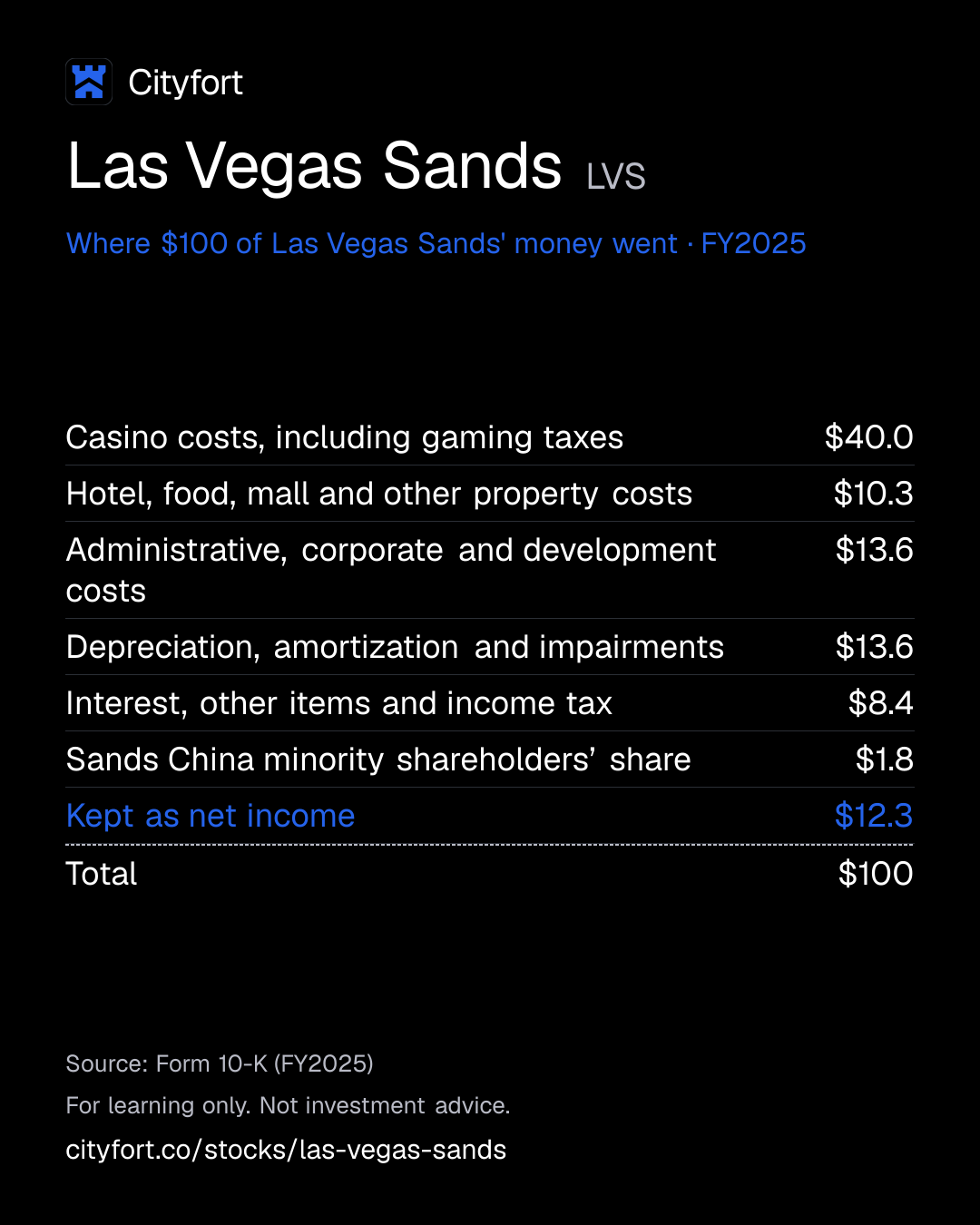
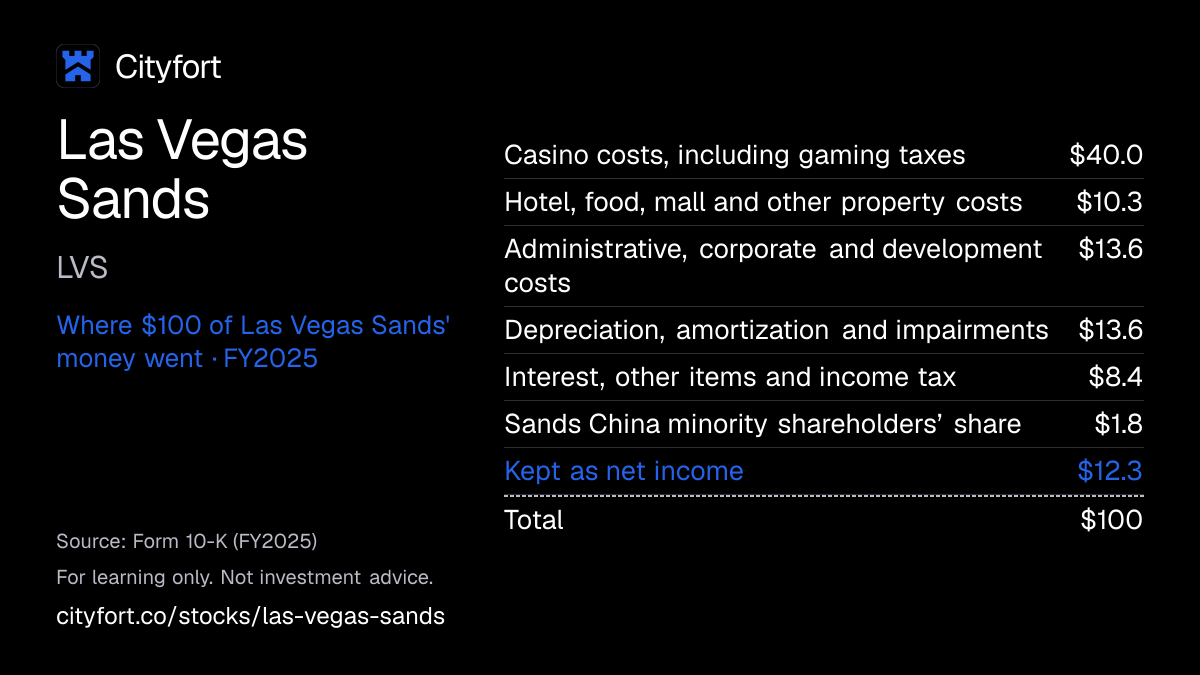
Where does $100 of Las Vegas Sands' money go?
Las Vegas Sands · FY2025
Receipt for every $100
| Casino costs, including gaming taxes | $40.0 |
|---|---|
| Hotel, food, mall and other property costs | $10.3 |
| Administrative, corporate and development costs | $13.6 |
| Depreciation, amortization and impairments | $13.6 |
| Interest, other items and income tax | $8.4 |
| Sands China minority shareholders’ share | $1.8 |
| Kept as net income | $12.3 |
| Total | $100 |
Each line = amount ÷ total money in × 100. Lines may not add to exactly $100 because of rounding.
How this is worked out
Cityfort calculation from FY2025 10-K. Of every $100 that came in during FY2025 (revenue plus $161 million of interest income): each line = line ÷ $13,178 million × 100.
Save this receipt as an image
Embed this receipt or the key numbers
Paste this code into a blog or website to show the card you choose, with a link back to this page.
Each week: the next company due to report earnings, explained in 5 points.
No tips. Unsubscribe anytime.
We'll send a confirmation email. See our privacy policy.
02The business in one line
What does Las Vegas Sands do?
Gamblers in Macao and Singapore pay Las Vegas Sands to play at its resort casinos. Casino costs and gaming taxes take the biggest share; what is left once upkeep, interest and tax are paid is profit.
- Casino players paid 75.2% of FY2025 revenue; hotel guests, mall tenants, diners and event organizers paid the rest.
- Of every $100 that came in during FY2025, casino costs including gaming taxes took $40 and $12.3 was left as net income.
03Who pays it
Who pays Las Vegas Sands?
Casino players
75.2%
of revenue
People betting at the tables and slots in Macao and Singapore.
Hotel guests
10.9%
of revenue
Room nights at the six resorts.
Mall tenants
6.2%
of revenue
Retailers paying rent for shop space.
Diners
4.9%
of revenue
Food and drink at the resorts.
Convention, retail and other
2.8%
of revenue
Event organizers, shop sales, shows and other services.
- Casino players75.2%
- Hotel guests10.9%
- Mall tenants6.2%
- Diners4.9%
- Convention, retail and other2.8%
How spread out the customers are
The FY2025 10-K names no customer that makes up a large share of revenue; concentration is by place: Macao 57.1% and Singapore 42.9% of FY2025 revenue. About 9.4% of Macao table play and 12.3% of Marina Bay Sands table play was on credit in FY2025.
Sources (1)
04How it makes money
How does Las Vegas Sands make money?
Big fixed-cost resorts keep more of each extra dollar once enough players come through.
Buildings, staff and land cost much the same whether a resort is busy or quiet; gaming taxes rise with revenue. At Marina Bay Sands, revenue rose $1.4 billion from FY2024 to FY2025 and the company’s adjusted property EBITDA there rose $870 million.
Marina Bay Sands adjusted property EBITDA per $100 of its revenue (company measure; Cityfort calculation from FY2025 10-K)
$48.4$52.3
FY2023 to FY2025
- Visitors fly or ferry in to Macao and Singapore
- Hotels, malls and shows keep them on site
- They bet at tables and slots
- The casino keeps its win, less gaming tax
- Cash goes to debt, buybacks, dividends and new building
↺ Step 5 feeds back into step 1.
Sources (1)
05Business segments · FY2025
Which businesses make up Las Vegas Sands?
Venetian Macao
21%The largest Macao resort, with about 659 gaming tables.
Revenue $2.7B ($2,736M)
Londoner Macao
19.6%A rebuilt Macao resort; its Londoner Grand hotel conversion finished in Q2 2025.
Revenue $2.6B ($2,556M)
Parisian Macao
6.7%A Paris-themed Macao resort with 2,541 rooms.
Revenue $872M
Plaza and Four Seasons Macao
6.7%A smaller Macao resort with 360 rooms and a mall.
Revenue $872M
Sands Macao
2.3%The smallest Macao casino resort, with about 160 tables.
Revenue $294M
Ferry and other
0.8%Ferries and other Macao operations.
Revenue $103M
Marina Bay Sands
42.9%The Singapore resort: casino, three hotel towers, mall and SkyPark.
Revenue $5.6B ($5,584M)
How the mix changed
- Venetian Macao
- Londoner Macao
- Parisian Macao
- Plaza and Four Seasons Macao
- Sands Macao
- Ferry and other
- Marina Bay Sands
Revenue by segment, FY2023 to FY2025.
US$
See the numbers
06The numbers · Consolidated · US$
How has Las Vegas Sands done?
Revenue
$13.0BFY2025
Revenue was $4.2 billion in FY2021 and $4.1 billion in FY2022, then rose each year to $13.0 billion in FY2025.
US$
See the numbers
Net income
$1.6BFY2025
FY2022 net income of $1.8 billion includes the Las Vegas business, sold in Feb 2022 and shown as discontinued operations; FY2025 net income was $1.6 billion.
US$
See the numbers
Net income for every $100 of revenue
$12.5FY2025
Las Vegas Sands kept $12.50 of net income per $100 of revenue in FY2025, against $11.80 in FY2023.
Net margin: $ of net income per $100 of revenue
See the numbers
Free cash flow
$1.9BFY2025
Free cash flow was $1.9 billion in FY2025, after negative cash from operations in FY2021 and FY2022.
US$ · cash from operations minus spending on plants and equipment
See the numbers
See all yearly numbers
EBITDA here = operating income plus depreciation and amortization (from the cash flow statement). Fiscal years are the company's own: Fiscal year ends Dec 31 (the calendar year). Net income is the share belonging to the company's owners.
Learn: Fiscal years that don't end in December: Nvidia's FY2027 explained · Stock-based compensation and dilution: pay that becomes shares
Sources (16)
- Form 10-K for FY2021
- Form 10-K for FY2022
- Form 10-K for FY2023
- Form 10-K for FY2024
- Form 10-K for FY2025
- Form 10-Q for Q1 FY2024
- Form 10-Q for Q2 FY2024
- Form 10-Q for Q3 FY2024
- Q4 FY2024 earnings release (8-K Ex. 99.1)
- Form 10-Q for Q1 FY2025
- Form 10-Q for Q2 FY2025
- Form 10-Q for Q3 FY2025
- Q4 FY2025 earnings release (8-K Ex. 99.1)
- Form 10-Q for Q1 FY2026
- Form 10-Q for Q2 FY2026
- Form 10-Q for Q3 FY2026
07Who runs it
Who runs Las Vegas Sands, and did they deliver?
Patrick Dumont
Chairman, Chief Executive Officer, President and Treasurer · since 2026
Chairman and CEO from Mar 1, 2026; also Chairman of Sands China. Total 2025 pay was $18.3 million, per the 2026 proxy.
Robert G. Goldstein
Senior Advisor (Chairman and CEO until Mar 1, 2026) · since 2026
Total 2025 pay was $31.1 million, per the 2026 proxy.
Randy Hyzak
Executive Vice President and Chief Financial Officer
New employment agreement effective Mar 2, 2026.
D. Zachary Hudson
Executive Vice President, Global General Counsel and Secretary
New employment agreement effective Mar 2, 2026.
What they said, and what happened
3 too early to tell
Said on Feb 6, 2026
The FY2025 10-K said the company expected to pay a dividend of $0.30 a share each quarter in 2026.
Too early to tellWhat happened
$0.30 was paid in each of the first three quarters, and the next $0.30 was payable Nov 10, 2026.
Said on Feb 6, 2026
The company estimated the Marina Bay Sands expansion would be completed in June 2030 and open in January 2031.
Too early to tellWhat happened
The Q3 FY2026 10-Q gives the same dates; the contract completion date is Jul 8, 2029, and going past it needs Singapore government approval.
Said on Oct 23, 2026
Under the Macao concession, the Macao subsidiary committed to invest at least 35.84 billion patacas (about $4.43 billion) by Dec 31, 2032.
Too early to tellWhat happened
The filings Cityfort reviewed do not state how much has been spent so far.
08What could go wrong
What could go wrong for Las Vegas Sands?
- Concentration
All revenue comes from two places
Macao made 57.1% and Singapore 42.9% of FY2025 revenue. Travel limits or a slowdown in either city would affect the whole company.
Watch Macao and Marina Bay Sands revenue each quarter.
- Regulation
Licenses with end dates
The Macao concession ends Dec 31, 2032. The company states the Macao concession and Singapore agreements can be terminated or redeemed in some cases without compensation.
Watch Macao concession news before 2032 and Singapore’s two-license limit after Jan 1, 2031.
- Demand
Luck at the tables
Profit moves with how much the casino wins. Marina Bay Sands won 18.7% of non-rolling chip drop (the chips its non-VIP table players bought) in Q3 FY2026 against 24.5% a year earlier.
Watch Win percentages against the company’s expected figures in each earnings release.
- Debt
Large debt across three borrowers
Debt was $15.4 billion at Sep 30, 2026. Sands China’s leverage ratio was 3.38x at Dec 31, 2025 against a 4.00x limit.
Watch Sands China’s leverage ratio and refinancing of notes due in 2027 and 2028.
- Execution
An $8 billion building project
The Marina Bay Sands expansion is estimated at about $8.0 billion. The company estimates completion in June 2030, after the Jul 8, 2029 contract date; going past that date needs government approval.
Watch Spending to date and any extension approval from Singapore.
- Other
Credit to gamblers
About 9.4% of Macao and 12.3% of Marina Bay Sands table play was on credit in FY2025. The provision for credit losses rose to $85 million from $19 million.
Watch Provision for credit losses in the 10-K and 10-Qs.
- Cash and liquidity
Cash must travel up from subsidiaries
The parent relies on payments from Sands China and Marina Bay Sands, and loan terms limit dividends. The Macao dividend tax agreement covered 2023 to 2025; an extension to 2027 was requested in Jan 2026.
Watch Whether the Macao dividend tax agreement is extended.
- Currency
Currency moves
Results are reported in US dollars, while the company names the Singapore dollar, Macao pataca and Hong Kong dollar among its currency exposures.
Watch Exchange-rate effects noted in each 10-Q.
09Supporters vs. critics
What do supporters and critics point to?
What supporters point to
- Revenue rose each year from $4.1 billion in FY2022 to $13.0 billion in FY2025.
- Marina Bay Sands made $2,922 million of adjusted property EBITDA on $5,584 million of revenue in FY2025, up from $2,052 million in FY2024.
- The company holds one of six Macao gaming concessions, running to Dec 31, 2032, and Singapore may have no more than two casino licenses until Jan 1, 2031.
- It bought back $2,269 million of shares in 2025 and $2.48 billion in the first nine months of 2026; on Oct 21, 2026 the board announced a 2027 dividend of $1.44 a share.
- Free cash flow was $1.9 billion in FY2025.
What critics point to
- All FY2025 revenue came from two places, Macao (57.1%) and Singapore (42.9%), and the Macao concession ends Dec 31, 2032.
- Debt was $15.4 billion at Sep 30, 2026, and Las Vegas Sands stockholders' equity was a deficit of $344 million.
- Q3 FY2026 adjusted property EBITDA was $1,119 million against $1,344 million a year earlier, and the Macao margin was 27.3% against 31.5%.
- The Adelson family group held 58.2% of the shares on Mar 16, 2026, and the company has service and aircraft agreements with Adelson family companies, per the 2026 proxy.
- In its Q3 FY2026 10-Q (Oct 23, 2026) the company estimated the about $8.0 billion Marina Bay Sands expansion would be completed in June 2030, after the Jul 8, 2029 contract date.
10What to watch next
What should you watch next at Las Vegas Sands?
Next event
Q4 FY2026 results (expected, based on last year's Jan 28 release)
Jan 27, 2027
Expected, based on last year's date
Macao margins and the Venetian rooms
The Macao adjusted property EBITDA margin was 27.3% in Q3 FY2026 against 31.5% a year earlier. In its Q3 FY2026 earnings release, the company said about 500 Venetian Macao rooms would be out of service on average through Q4 2027.
Marina Bay Sands expansion
In its Q3 FY2026 10-Q (Oct 23, 2026), the company estimated the project, at about $8.0 billion, would be completed in June 2030. That is after the Jul 8, 2029 contract date, and going past that date needs Singapore government approval.
Sands China borrowing
Sands China's leverage ratio was 3.38x at Dec 31, 2025 against a 4.00x limit. It completed $1.0 billion of new notes on Nov 3, 2026.
Macao dividend tax agreement
The Macao dividend tax agreement covered 2023 to 2025; the company requested an extension to 2027 in Jan 2026, according to its FY2025 10-K.
11Key facts
Key facts about Las Vegas Sands
- What does Las Vegas Sands do?
- Las Vegas Sands Corp. runs six integrated resorts, each with a casino, hotels, shops, restaurants and convention space: five in Macao through Sands China, in which it owns about 75%, and Marina Bay Sands in Singapore.
- Does Las Vegas Sands run casinos in Las Vegas?
- No. Las Vegas Sands sold The Venetian Resort Las Vegas and the Sands Expo on Feb 23, 2022. In FY2025, Macao made 57.1% and Singapore 42.9% of Las Vegas Sands' revenue.
- How does Las Vegas Sands make money?
- Las Vegas Sands makes most of its money from casino gaming, which brought in $9,789 million, or 75.2%, of its FY2025 revenue of $13,017 million. Hotel rooms, mall rents, food and events made up the rest.
- Who are Las Vegas Sands' customers?
- Las Vegas Sands' customers are casino players, hotel guests, mall tenants and diners at its resorts in Macao and Singapore. Its FY2025 10-K names no single large customer; about 9.4% of Macao table play and 12.3% of Marina Bay Sands table play was on credit in FY2025.
- How big is Las Vegas Sands?
- Las Vegas Sands had FY2025 revenue of $13,017 million and net income attributable to the company of $1,627 million, against $11,298 million and $1,446 million in FY2024. Its FY2025 10-K lists about 41,500 employees.
- Which Las Vegas Sands resort earns the most?
- Marina Bay Sands in Singapore was Las Vegas Sands' largest property in FY2025, with $5,584 million of revenue (42.9% of the total) and $2,922 million of adjusted property EBITDA, a company measure.
- Who owns Las Vegas Sands?
- The Adelson family group held 58.2% of Las Vegas Sands' shares on Mar 16, 2026, according to the 2026 proxy statementThe yearly filing about shareholder votes, the board and executive pay. Learn more. The Vanguard Group held 6.4%, and the executive officers and directors as a group held under 1%.
- How much debt does Las Vegas Sands have?
- At Sep 30, 2026, Las Vegas Sands had $15.4 billion of debt and $2.9 billion of cash. Its stockholders' equity was a deficit of $344 million, and the shares it has bought back and holds (treasury stock) cost $11.5 billion.
- How much does Las Vegas Sands return to shareholders?
- Las Vegas Sands declared dividends of $1.00 a share for FY2025 and bought back 47.6 million shares for $2,269 million in 2025, according to its FY2025 10-K.
- Who runs Las Vegas Sands?
- Patrick Dumont has been Chairman and Chief Executive Officer of Las Vegas Sands since Mar 1, 2026. Robert G. Goldstein, Chairman and CEO until then, became a senior advisor.
Terms on this page
- Capital expenditures (capex)
- Dividend payout ratio
- Earnings per share (EPS)
- EBITDA
- Free cash flow
- Interest coverage
- Net debt
- Net margin
- Revenue vs net income
- Stock buyback
Each explains the term in plain English, with the same number from other companies on Cityfort.
Go deeper
More detail from the same filings. Open any section.
12What it sells
12What it sells
What does Las Vegas Sands sell?
Casino gaming
Table games and slot machines for mass-market and VIP players; the casinos brought in $9.8 billion in FY2025.
Hotel rooms
Rooms and suites at each resort; Marina Bay Sands has 1,844 rooms, and its average room rate was $944 a night in FY2025.
Shopping malls
About 2.9 million square feet of shops rented to retailers, which brought in $801 million of mall revenue in FY2025.
Meetings and events
About 2.8 million square feet of convention and exhibition space, plus restaurants, shows and attractions such as the SkyPark.
Think of it like this
Think of a resort as a small city: the casino is the main shop, and hotels, malls and shows bring people through the door.
What it does
- Does: Runs five resorts in Macao through Sands China, a Hong Kong-listed company in which it owns about 75%
- Does: Owns and runs Marina Bay Sands in Singapore
- Does: Rents mall space to retailers
What it does not do
- Does not: Run any casino in Las Vegas: it sold its Las Vegas resorts on Feb 23, 2022, despite the name
- Does not: Run an online gaming business: in 2025 it dropped certain digital gaming activities; development costs for its remaining digital gaming efforts were $100 million in the nine months to Sep 30, 2026
- Does not: Hold a New York casino license: it announced in Apr 2025 that it would stop pursuing one, and the state granted all available licenses in Dec 2025
Sources (1)
13How the money flows
13How the money flows · FY2025
How does money flow through Las Vegas Sands?
Money in
- Casino revenue$9.8B
- Rooms, malls, food and other revenue$3.2B
- Interest income$161M
The company
Las Vegas Sands
$13.2B came in
Money out
- Casino costs, including gaming taxes$5.3B
- Hotel, food, mall and other property costs$1.4B
- Administrative, corporate and development costs$1.8B
- Depreciation, amortization and impairments$1.8B
- Interest, other items and income tax$1.1B
- Sands China minority shareholders’ share$239M
- Net income attributable to Las Vegas Sands$1.6B
- Casinos in Macao and Singapore brought in $9.8 billion in FY2025; hotels, malls, food and events added $3.2 billion.
- Running the casinos cost $5.3 billion, including taxes paid to the two governments on gaming revenue.
- Hotels, restaurants, malls, offices and development work cost another $3.1 billion.
- Wear and tear on the buildings, plus $247 million of write-offs and losses on disposals, took $1.8 billion.
- After interest, tax and the minority owners’ share of Sands China, $1.6 billion was left for Las Vegas Sands shareholders.
Sources (1)
14What it needs to run
14What it needs to run
What does Las Vegas Sands need to run?
Government gaming rights
A 10-year Macao gaming concession to Dec 31, 2032 (one of six), and one of the two Singapore casino licenses.
Land and buildings
Property and equipment of $11.5 billion on the books at Sep 30, 2026, plus $3.0 billion of leasehold interests in land.
People
About 41,500 employees at the end of FY2025, none under collective bargaining agreements.
Visitors
Macao had about 40 million visitors in 2025 and Singapore 16.9 million.
Sources (2)
15Where it sells
15Where it sells · FY2025
Where does Las Vegas Sands sell?
- Macao57.1%
- Singapore42.9%
Sources (1)
16Competitors and what protects it
16Competitors and what protects it
Who does Las Vegas Sands compete with?
Galaxy Casino, S.A.
Holds one of the other five Macao gaming concessions, as listed in the FY2025 10-K.
Wynn Resorts (Macau), S.A.
A Macao concession holder competing for the same Macao visitors.
MGM Grand Paradise, S.A.
A Macao concession holder competing for the same Macao visitors.
Melco Resorts (Macau), S.A.
A Macao concession holder competing for the same Macao visitors.
Resorts World Sentosa
The only other Singapore casino license holder, 100% owned by Genting Singapore.
What protects the business
Each strength is scored 1 (weak) to 5 (strong) for the business, with the reason. It is not a rating of the share.
- Government licenses5 of 5
Macao has six concession holders, to Dec 31, 2032; Singapore may have no more than two casino licenses until Jan 1, 2031.
- Scale of resorts4 of 5
About 2.8 million square feet of convention space and 2.9 million square feet of shops across six resorts, as the FY2025 10-K states.
- Non-gaming draw3 of 5
Rooms, malls, food and events were 24.8% of FY2025 revenue; Marina Bay Sands rooms were 95.3% full in FY2025.
Weak spot
Two places, two governments
All revenue comes from Macao and Singapore. The company states the Macao concession and Singapore agreements can be terminated or redeemed in some cases without compensation.
Sources (2)
17Where growth could come from
17Where growth could come from
Where could Las Vegas Sands' growth come from?
In its Q3 FY2026 10-Q (Oct 23, 2026), the company said it estimates the Marina Bay Sands expansion will be completed in June 2030 and open in January 2031. The filings reviewed give no revenue or profit forecast.
Marina Bay Sands expansion
EarlyAbout $8.0B estimated cost; about $2.5B incurred by Dec 31, 2025
A fourth hotel tower, an arena of about 15,000 seats and premium gaming space. Construction began in May 2025.
Status: Early, too early to judge.
Londoner Macao rebuild
WorkingRevenue $1,984M in FY2024, $2,556M in FY2025
The Londoner Grand hotel conversion, with 2,405 rooms, was completed in Q2 2025.
Status: Working, on track against what the company said.
Marina Bay Sands volumes
MixedRevenue $4,225M in FY2024, $5,584M in FY2025; Q3 FY2026 $1,294M vs $1,436M
Revenue rose 32% in FY2025 (Cityfort calculation from FY2025 10-K) but was lower in Q3 FY2026 than a year earlier.
Status: Mixed, partly on track.
Macao market
MixedMacao gaming revenue +9.1% in 2025; company Macao margin 27.3% in Q3 FY2026 vs 31.5%
Macao visitors rose 14.7% in 2025, while the company’s Macao adjusted property EBITDA margin was lower in Q3 FY2026 than a year earlier.
Status: Mixed, partly on track.
Venetian Macao room renovation
EarlyAbout 500 rooms out of service on average through Q4 2027
The company is renovating rooms and adding premium suites at the Venetian Macao.
Status: Early, too early to judge.
Status compares progress with what the company itself said it would do: Working = on track against what the company said; Mixed = partly on track; Behind = behind the company's own plan; New = recently announced; Early = too early to judge.
18The company's own measures (non-GAAP)
18The company's own measures · FY2025 and Q3 FY2026
What do Las Vegas Sands' own measures show?
Official (GAAP): Operating income, FY2025
$2.8B
Company's own measure: Adjusted property EBITDA, FY2025 (company measure)
$5.2B
The measure the company uses for each resort. It leaves out depreciation, stock-based payPay given as shares instead of cash, which spreads ownership more thinly. Learn more, corporate costs, pre-opening and development spending.
Official (GAAP): Operating income, Q3 FY2026
$618M
Company's own measure: Adjusted property EBITDA, Q3 FY2026 (company measure)
$1.1B
Same definition; it was $1,344 million in Q3 FY2025.
Official (GAAP): Marina Bay Sands net revenue, FY2025
$5.6B
Company's own measure: Marina Bay Sands adjusted property EBITDA, FY2025 (company measure)
$2.9B
Up from $2,052 million in FY2024. The Macao resorts and ferries together made $2,310 million on $7,433 million of revenue.
These are the company's own measures, defined by the company. They are not comparable across companies, and they are not added together. Each sits beside the nearest official (GAAP) figure.
Learn: Non-GAAP measures: what a company's "adjusted" numbers leave out · Stock-based compensation and dilution: pay that becomes shares
19Financial strength and debt
19Financial strength · Sep 30, 2026
How much debt does Las Vegas Sands have?
- Total debt$15.4B
- Cash and investments$2.9B
- Net debt (debt minus cash)$12.6B
- Net worth (shareholders' money)−$344M
- Interest cover
- 3.8×
- how many times operating profit covers interest
- Total debt is the carrying amount in the Q3 FY2026 10-Q ($15,579 million of principal). By borrower: the U.S. parent $5.0 billion of notes, Sands China $6.3 billion, Marina Bay Sands $4.1 billion, plus $147 million of finance leases.
- Net debt (debt minus cash and cash equivalents) is a Cityfort calculation from the Q3 FY2026 10-Q. The 4.2 times figure also uses FY2025 cash from operations from the FY2025 10-K (Cityfort calculation).
- Las Vegas Sands stockholders’ equity was a deficit of $344 million at Sep 30, 2026, against $1,590 million at Dec 31, 2025. Shares bought back and held as treasury stock cost $11.5 billion. Debt-to-equity is therefore not shown.
- Interest coverage (FY2025 operating income of $2,818 million ÷ interest expense of $746 million) is a Cityfort calculation from the FY2025 10-K.
- At Dec 31, 2025 the leverage ratios under the loan agreements were 1.34x for the U.S. parent (limit 4.00x), 3.38x for Sands China (limit 4.00x) and 1.37x for Singapore (limit 4.50x).
- After the quarter, Sands China completed $1.0 billion of notes on Nov 3, 2026: $700 million at 6.400% due 2032 and $300 million at 6.700% due 2033.
20Who owns it
20Who owns it · ownership as of Mar 16, 2026
Who owns Las Vegas Sands?
- Officers and directors (as a group), shares
- 0.6%
Share classes
Holders of 5% or more
From the company's proxy statement (DEF 14A), later Schedule 13G filings and the share counts on its latest annual or quarterly report. Each holder row shows the date of its own filing.
Learn: How to read a proxy statement (DEF 14A): Nvidia's 2026 proxy · Form 4 insider filings: who files, the codes and the footnotes
21What it does with profit
21What it does with profit
What does Las Vegas Sands do with its profit?
Dividend per share
$1.00FY2025
Dividend paid for each share, by financial year.
$ per share
See the numbers
Buyback · Dec 31, 2023
Bought back 11.1 million shares in 2023 for $510 million.
$510M
Buyback · Dec 31, 2024
Bought back 37.6 million shares in 2024 for $1,768 million.
$1.8B
Buyback · Dec 31, 2025
Bought back 47.6 million shares in 2025 for $2,269 million.
$2.3B
Buyback · Sep 30, 2026
Bought back $2.48 billion of shares in the first nine months of 2026, including about 21 million shares for $950 million in Q3 at an average $45.31.
$2.5B
22Governance signals
22Governance signals
What do Las Vegas Sands' governance filings show?
- Auditor
- Deloitte & Touche LLP, since 2013
- Auditor changes
- None in the period covered
- Audit qualifications
- None reported
- Related-party dealings
- Las Vegas Sands charged Interface Operations, a company controlled by the Adelson family, $4.8 million for services in 2025, and its Sands Aviation unit charged Interface Operations $39.6 million for aviation staff and costs. Citadel Completions, owned by an Adelson family trust, charged $2.2 million for aircraft work.
- Credit rating
- No public credit rating found in a search of rating agency sites on Nov 20, 2026
Flags to know about
other
Family-controlled company
The Adelson family group held 58.2% of the shares on Mar 16, 2026. Five of the eight directors are independent, according to the 2026 proxy.
related party
Dealings with Adelson family companies
Service, aircraft time-sharing and aircraft maintenance agreements with Interface Operations and Citadel Completions, which the Audit Committee approves, as described in the 2026 proxy.
other
Macao lawsuit decided for the defendants
According to the Q3 FY2026 10-Q, Asian American Entertainment Corp. brought a claim in Macao against Venetian Macau Ltd and others, later amended to 96.45 billion patacas (about $11.93 billion). Judgment for the defendants became final on Mar 4, 2026.
other
Nassau Coliseum land lease case
The FY2025 10-K states there is litigation over the company’s right to lease the land under the Nassau Coliseum in New York, bought in June 2023.
other
Audit fees
Deloitte’s audit fees were $6.25 million for 2025 and $6.17 million for 2024, according to the 2026 proxy.
23How it got here
23How it got here
How did Las Vegas Sands get here?
2004
Milestone
Las Vegas Sands Corp. incorporated
Incorporated in Nevada in August 2004; its shares trade on the NYSE as LVS.
2006
Milestone
Singapore deal signed
The August 2006 development agreement gave a 30-year casino concession for Marina Bay Sands.
2010
Milestone
Marina Bay Sands opens
The Singapore resort opened in 2010; it made 42.9% of revenue in FY2025.
2022
Business-model change
Las Vegas resorts sold
On Feb 23, 2022 it sold The Venetian Resort Las Vegas and the Sands Expo, with a $2.85 billion gain on the sale.
2023
Milestone
New Macao concession
A 10-year Macao gaming concession began, running to Dec 31, 2032, with an investment commitment of 35.84 billion patacas.
2025
Milestone
Singapore expansion starts
Construction of the Marina Bay Sands expansion began in May 2025, after a SGD 1.13 billion land payment in April.
2025
Crisis
New York plan dropped
In Apr 2025 the company announced it would stop pursuing a New York casino license; the state granted all available licenses in Dec 2025. FY2025 impairments of $191 million included this and other items (digital gaming, Texas).
2026
Milestone
Leadership change
Patrick Dumont became Chairman and CEO on Mar 1, 2026; Robert G. Goldstein became senior advisor.
2026
Milestone
Las Vegas sale loan repaid
In May 2026 the company received $1.26 billion from the early repayment in full of the seller loan from the Las Vegas sale.
24Sources and changes
Where every number on this page comes from
Sources (20 documents)
- S1Form 10-Q for Q3 FY2026 · SEC EDGAR · Tier 1: company or exchange filing · Oct 23, 2026
- S2Form 10-Q for Q2 FY2026 · SEC EDGAR · Tier 1: company or exchange filing · Jul 24, 2026
- S3Form 10-Q for Q1 FY2026 · SEC EDGAR · Tier 1: company or exchange filing · Apr 24, 2026
- S4Form 10-K for FY2025 · SEC EDGAR · Tier 1: company or exchange filing · Feb 6, 2026
- S5Form 10-Q for Q3 FY2025 · SEC EDGAR · Tier 1: company or exchange filing · Oct 24, 2025
- S6Form 10-Q for Q2 FY2025 · SEC EDGAR · Tier 1: company or exchange filing · Jul 25, 2025
- S7Form 10-Q for Q1 FY2025 · SEC EDGAR · Tier 1: company or exchange filing · Apr 25, 2025
- S8Form 10-K for FY2024 · SEC EDGAR · Tier 1: company or exchange filing · Feb 7, 2025
- S9Form 10-Q for Q3 FY2024 · SEC EDGAR · Tier 1: company or exchange filing · Oct 25, 2024
- S10Form 10-Q for Q2 FY2024 · SEC EDGAR · Tier 1: company or exchange filing · Jul 26, 2024
- S11Form 10-Q for Q1 FY2024 · SEC EDGAR · Tier 1: company or exchange filing · Apr 19, 2024
- S12Form 10-K for FY2023 · SEC EDGAR · Tier 1: company or exchange filing · Feb 7, 2024
- S13Form 10-K for FY2022 · SEC EDGAR · Tier 1: company or exchange filing · Feb 3, 2023
- S14Form 10-K for FY2021 · SEC EDGAR · Tier 1: company or exchange filing · Feb 4, 2022
- S152026 proxy statement (DEF 14A) · SEC EDGAR · Tier 1: company or exchange filing · Apr 1, 2026
- S16Q3 FY2026 earnings release (8-K Ex. 99.1) · SEC EDGAR · Tier 1: company or exchange filing · Oct 21, 2026
- S19Q4 FY2025 earnings release (8-K Ex. 99.1) · SEC EDGAR · Tier 1: company or exchange filing · Jan 28, 2026
- S23Q4 FY2024 earnings release (8-K Ex. 99.1) · SEC EDGAR · Tier 1: company or exchange filing · Jan 29, 2025
- S248-K Nov 3, 2026: Sands China $1.0B senior notes completed (Items 1.01, 2.03) · SEC EDGAR · Tier 1: company or exchange filing · Nov 3, 2026
- S278-K Feb 13, 2026: leadership change, Dumont Chairman (Items 5.02, 8.01) · SEC EDGAR · Tier 1: company or exchange filing · Feb 13, 2026
Changes to this page (v1 · Nov 20, 2026)
- v1 · Nov 20, 2026First version. (first version)
Numbers come only from tier 1 and tier 2 sources. Read how we research.
Disclaimer
For learning only. Cityfort is not a registered investment adviser or broker-dealer and does not recommend buying or selling any security. Prices shown are dated and may be out of date.
Investing in securities involves risk, including loss of capital. Before making any investment decision, do your own research and consider consulting a registered investment adviser or other qualified professional.
Cityfort, its owners and contributors may or may not hold securities of companies covered. Cityfort is not paid by any company it covers. Content is not an offer or solicitation to buy or sell any security, including in any initial public offering.
Read the positions policyRead the full disclaimerHide the full disclaimer
Cityfort publishes general educational content that explains how listed companies work. Cityfort is not registered with the US Securities and Exchange Commission or any state securities regulator as an investment adviser, and is not a broker-dealer or a member of FINRA. Cityfort does not provide investment, tax or legal advice, recommendations, ratings, price targets or any opinion on whether to buy, sell or hold any security. Nothing on the site is tailored to any person's circumstances.
All information is taken from publicly available sources, mainly company filings with the SEC, which are listed on each page with dates. We work to keep it accurate and correct errors publicly, but we do not guarantee that it is complete, accurate or up to date. Any market price or price-based ratio shown is dated, may be out of date by the time you read it, and is included only to explain concepts.
Statements by company management, including forward-looking statements and guidance, are reported as the company's statements, with their date and source; they are not our forecasts. Adjusted (non-GAAP) figures are the company's own measures and are shown next to the official (GAAP) figures.