Health Care · NYSE: BMY
Bristol Myers Squibb: how the business works
Bristol Myers Squibb sells prescription medicines for cancer, blood clots and other diseases, with $48.2 billion of revenue in FY2025, 30% of it from one blood thinner, Eliquis.
By Hardik Bhandare · Checked against filings: . Editorial policy. Corrections
Follow Bristol Myers Squibb
Email me when Bristol Myers Squibb's page is updated after earnings.
We'll send a confirmation email first. See our privacy policy.
Bristol-Myers Squibb Company · Princeton, New Jersey
Updated for Q3 FY2026 · checked
- Revenue, FY2025
- $48.2B
- Net income, FY2025
- $7.1B
- Revenue, Q3 FY2026
- $13.1B
- Eliquis's share of FY2025 revenue (Cityfort calculation from the FY2025 10-K)
- 30.0%
- Employees, end of 2025
- About 32,500
The short version
Bristol Myers Squibb in 5 points
1 · What it sells
Bristol Myers Squibb sells prescription medicines, and the blood thinner Eliquis brought in $14.4 billion and the cancer medicine Opdivo $10.0 billion of its $48.2 billion of FY2025 revenue.
2 · Who pays it
BMS reports no net revenue by customer or final payer; by location, in FY2025 US customers paid 69.1% of revenue, customers elsewhere 28.7% and partners and royalty payers 2.3%.
3 · What it keeps from $100
Of every $100 of FY2025 revenue, BMS kept $14.6 as net income after $7.7 of charges for bought research, and operating income, a Cityfort calculation from the FY2025 10-K, was $20.8.
4 · Where the operating profit comes from
BMS reports one segment and no profit by product, so profit comes from the whole portfolio, where the Growth Portfolio of newer medicines was 54.8% of FY2025 revenue.
5 · The one thing to watch
Eliquis and Opdivo were 30.0% and 20.9% of BMS's FY2025 revenue, and BMS estimates US exclusivity for both ends in 2028.
Sources: From Bristol Myers Squibb's FY2025 10-K, Q3 FY2026 10-Q and earnings releases · checked
See the full receipt and the management scorecard below
01Where the money goes · FY2025
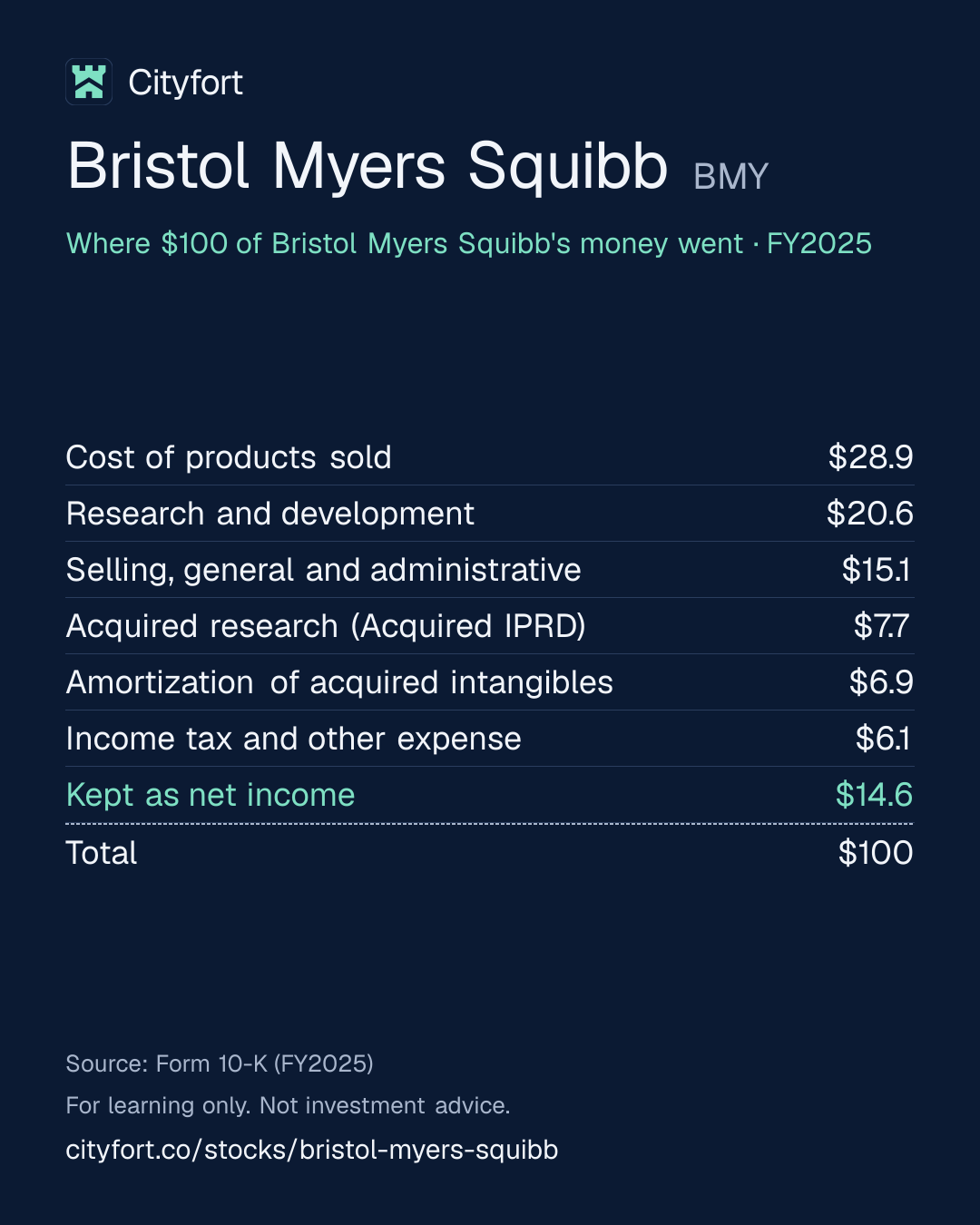
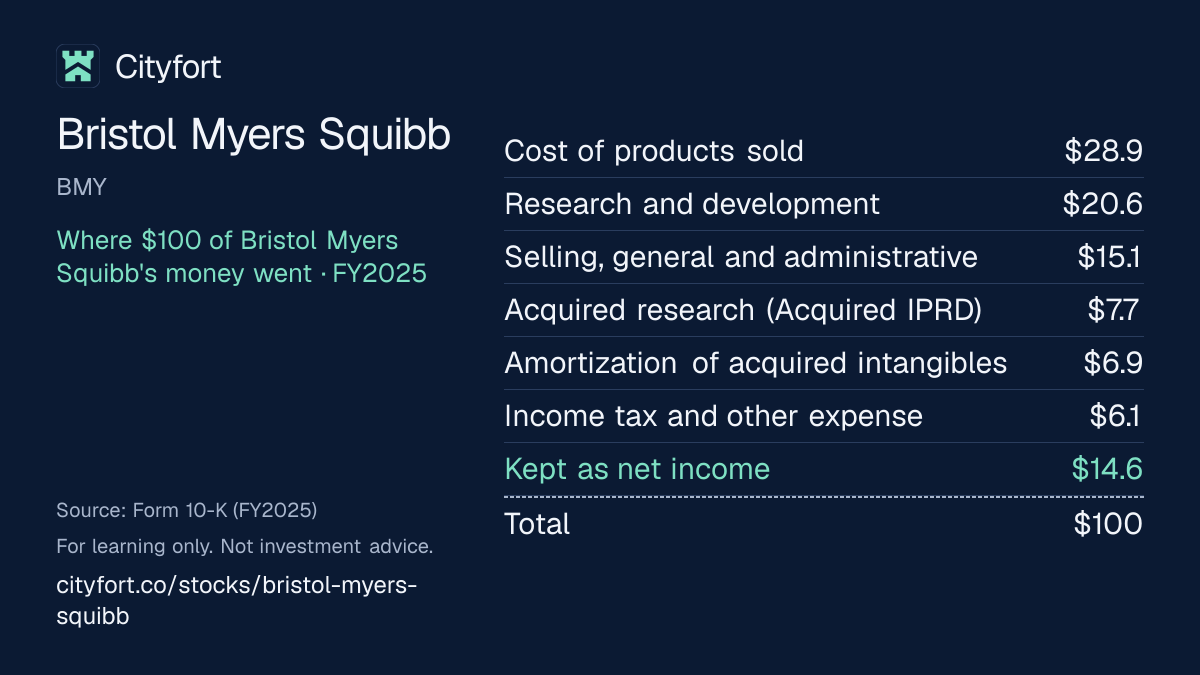
Where does $100 of Bristol Myers Squibb's money go?
Bristol Myers Squibb · FY2025
Receipt for every $100
| Cost of products sold | $28.9 |
|---|---|
| Research and development | $20.6 |
| Selling, general and administrative | $15.1 |
| Acquired research (Acquired IPRD) | $7.7 |
| Amortization of acquired intangibles | $6.9 |
| Income tax and other expense | $6.1 |
| Kept as net income | $14.6 |
| Total | $100 |
Each line = amount ÷ total money in × 100. Lines may not add to exactly $100 because of rounding.
How this is worked out
Cityfort calculation from the FY2025 10-K. Of every $100 of revenue in FY2025: each line = line ÷ $48.2 billion × 100. Other items were a net cost, so no other income is added. Lines are rounded.
Save this receipt as an image:
1080 × 1350 PNG for Instagram, LinkedIn1200 × 675 PNG for X
Embed this receipt
Paste this code into a blog or website to show the receipt, with a link back to this page:
Each week: one company explained in 5 points, picked by earnings date.
Free, no tips, unsubscribe anytime.
We'll send a confirmation email. See our privacy policy.
02The business in one line
What does Bristol Myers Squibb do?
Wholesalers, hospitals and governments pay Bristol Myers Squibb for patented medicines; most of the money goes on making them, research and buying new drugs, and what is left is profit.
- In FY2025 the blood thinner Eliquis brought in $14.4 billion and the cancer medicine Opdivo $10.0 billion of BMS's $48.2 billion of revenue. Customers in the US were 69.1%.
- BMS kept $7.1 billion as net income in FY2025. In FY2024 a $12.1 billion charge for buying Karuna, a drug developer, turned the year into an $8.9 billion net loss.
03Who pays it
Who pays Bristol Myers Squibb?
Customers in the US
69%
of revenue
69.1% of FY2025 revenue ($33.3 billion). Most US sales go through three wholesalers. Shares here are by location, because BMS does not report net revenue by customer or final payer.
Customers outside the US
29%
of revenue
28.7% of FY2025 revenue ($13.8 billion).
Partners and royalty payers
2%
of revenue
2.3% of FY2025 revenue ($1.1 billion): alliance and royalty revenue that BMS does not assign to a region.
- Customers in the US69%
- Customers outside the US29%
- Partners and royalty payers2%
How spread out the customers are
In 2025 three wholesalers, McKesson (36%), Cencora (29%) and Cardinal Health (22%), were 87% of BMS's US gross revenue, before $38.0 billion of US rebates and discounts. They are distributors, not final payers. By product, Eliquis was 30.0% and Opdivo 20.9% of FY2025 revenue (Cityfort calculation from the FY2025 10-K).
04Why it makes money
Why does Bristol Myers Squibb make money?
A patented medicine costs far less to make than it sells for, but patents end, so BMS must keep replacing its older products.
Revenue minus cost of products sold was $71.1 per $100 in FY2025, before amortization. Revlimid fell from $12.8 billion in FY2021 to $3.0 billion in FY2025 as generics arrived. The Growth Portfolio of newer medicines rose to 54.8% of revenue.
Growth Portfolio's share of revenue (Cityfort calculation from the FY2024 and FY2025 10-Ks)
36.3%54.8%
FY2022 to FY2025
- BMS discovers, licenses or buys a medicine
- Patents limit direct copies for years
- Sales run through wholesalers, hospitals and governments
- Cost of products sold was $28.9 per $100 of revenue in FY2025
- Cash pays for research, deals and dividends
- Patents end, and newer products must replace older ones
↺ Step 6 feeds back into step 1.
05Business segments · FY2025
Which businesses make up Bristol Myers Squibb?
Growth Portfolio
55%Newer medicines such as Opdivo, Reblozyl, Breyanzi, Camzyos and Cobenfy. This is BMS's own revenue grouping, not a reporting segment, so it has no profit figure.
Revenue $26.4B
Legacy Portfolio
45%Older medicines such as Eliquis, Revlimid, Pomalyst and Sprycel, several of them facing or nearing generic copies.
Revenue $21.8B
How the mix changed
- Growth Portfolio
- Legacy Portfolio
Revenue by segment, FY2022 to FY2025.
US$
See the numbers
06The numbers · Consolidated · US$
How has Bristol Myers Squibb done?
Revenue
$48.2BFY2025
Revenue stayed between $45.0 billion and $48.3 billion from FY2021 to FY2025, and BMS states that Q3 FY2026 revenue of $13.1 billion was up 7% from a year earlier.
US$
See the numbers
Net profit
$7.1BFY2025
BMS had an $8.9 billion net loss in FY2024 after a $12.1 billion charge for buying Karuna, booked as acquired research (Acquired IPRD); in other years net income ranged from $6.3 billion to $8.0 billion.
US$
See the numbers
Profit kept per $100 of revenue
$14.6FY2025
Operating income per $100 of revenue was $20.8 in FY2025 and minus $15.5 in FY2024; BMS reports no operating income line, so operating income and EBITDA are a Cityfort calculation from the FY2025 and FY2023 10-Ks, and EBITDA fell from $18.1 billion in FY2021 to $14.0 billion in FY2025, mainly as cost of products sold rose $4.0 billion and Acquired IPRD $2.6 billion (amortization fell from $10.0 billion to $3.3 billion, which raised operating income but not EBITDA).
$ of profit per $100 of revenue (net margin)
See the numbers
Free cash flow
$12.8BFY2025
Free cash flow here is cash from operations minus capital spending; it was $12.8 billion in FY2025 and $13.9 billion in FY2024, a year when BMS also paid $20.7 billion for Mirati, RayzeBio, Karuna and SystImmune.
US$ · cash from operations minus spending on plants and equipment
See the numbers
See all yearly numbers
EBITDA here = operating income plus depreciation and amortization (from the cash flow statement). Fiscal years are the company's own (December 31; quarters end Mar 31, Jun 30 and Sep 30). Net profit is the share belonging to the company's owners.
Download Bristol Myers Squibb's yearly and quarterly numbers (CSV, with source ids)
Learn: Stock-based compensation and dilution: pay that becomes shares
Sources (18)
- Form 10-K for fiscal year 2023
- Form 10-K for fiscal year 2022
- Form 10-K for fiscal year 2025 (ended Dec 31, 2025)
- Form 10-K for fiscal year 2024
- Earnings release, Q4 FY2024 and full year 2024 (8-K Ex. 99.1)
- Earnings release, Q1 FY2025 (8-K Ex. 99.1)
- Form 10-Q for Q1 FY2025 (ended Mar 31, 2025)
- Earnings release, Q2 FY2025 (8-K Ex. 99.1)
- Form 10-Q for Q2 FY2025 (ended Jun 30, 2025)
- Earnings release, Q3 FY2025 (8-K Ex. 99.1)
- Form 10-Q for Q3 FY2025 (ended Sep 30, 2025)
- Earnings release, Q4 FY2025 and full year 2025 (8-K Ex. 99.1)
- Earnings release, Q1 FY2026 (8-K Ex. 99.1)
- Form 10-Q for Q1 FY2026 (ended Mar 31, 2026)
- Earnings release, Q2 FY2026 (8-K Ex. 99.1)
- Form 10-Q for Q2 FY2026 (ended Jun 30, 2026)
- Earnings release, Q3 FY2026 (8-K Ex. 99.1)
- Form 10-Q for Q3 FY2026 (ended Sep 30, 2026)
07Who runs it
Who runs Bristol Myers Squibb, and did they deliver?
Christopher Boerner, Ph.D.
Board Chair and CEO · since 2023
CEO since 2023 and Board Chair since 2024; previously Chief Commercialization Officer from 2018 and Chief Operating Officer in 2023.
David V. Elkins
Executive Vice President and CFO · since 2019
CFO since 2019; before that CFO of Celgene from 2018 to 2019.
What they said, and what happened
1 delivered · 1 missed · 2 too early to tell
Said on Feb 6, 2025
FY2025 revenue of about $45.5 billion.
DeliveredWhat happened
FY2025 revenue was $48.2 billion. BMS had raised the range three times, to about $47.5 billion to $48.0 billion on Oct 30, 2025.
Said on Feb 6, 2025
FY2025 non-GAAPThe company's own "adjusted" numbers, not the official (GAAP) ones. Always read them next to the official figure. Learn more EPS of $6.55 to $6.85.
MissedWhat happened
Non-GAAP EPS was $6.15, against GAAP EPS of $3.46. BMS's EPS guidance counts Acquired IPRD charges only once incurred, and FY2025 included $1.40 a share of them, net of licensing income.
Said on Feb 5, 2026
FY2026 revenue of about $46.0 billion to $47.5 billion.
Too early to tellWhat happened
BMS raised the range to about $49.75 billion to $50.25 billion on Oct 29, 2026. Revenue was $37.5 billion for the first nine months.
Said on Feb 11, 2026
About $2.0 billion of cost savings by the end of 2027 from its expanded strategic productivity initiative.
Too early to tellWhat happened
The deadline is the end of 2027. SG&A fell from $8.4 billion in FY2024 to $7.3 billion in FY2025.
Sources (6)
- Form 10-K for fiscal year 2025 (ended Dec 31, 2025)
- Earnings release, Q4 FY2024 and full year 2024 (8-K Ex. 99.1)
- Earnings release, Q3 FY2025 (8-K Ex. 99.1)
- Earnings release, Q4 FY2025 and full year 2025 (8-K Ex. 99.1)
- Earnings release, Q3 FY2026 (8-K Ex. 99.1)
- Form 10-Q for Q3 FY2026 (ended Sep 30, 2026)
08What could go wrong
What could go wrong for Bristol Myers Squibb?
- Concentration
Half of revenue from two medicines
Eliquis and Opdivo were 30.0% and 20.9% of FY2025 revenue. BMS estimates US exclusivity for both ends in 2028, and settled generic makers of Eliquis may launch in the US that year.
Watch Eliquis and Opdivo sales each quarter, and generic launches in 2028.
- Pricing
US drug price setting
A Medicare set price applies to Eliquis from Jan 1, 2026 and to Pomalyst from Jan 1, 2027. Orencia was selected in January 2026 for a set price from 2028.
Watch Medicare's later lists of drugs selected for price setting.
- Competition
Generics for older medicines
Revlimid fell from $12.8 billion in FY2021 to $3.0 billion in FY2025. Pomalyst sales fell 81% to $130 million in Q3 FY2026; BMS had expected US generics in the first quarter of 2026.
Watch Legacy Portfolio revenue, $5.4 billion in Q3 FY2026.
- Execution
Large charges for bought research
Acquired IPRD, the cost of drug programs BMS buys or licenses, is charged as an expense: $815 million to $13.4 billion a year in FY2021 to FY2025. The Karuna charge of $12.1 billion caused the FY2024 net loss, and 9M FY2026 charges were $1.7 billion.
Watch Acquired IPRD in each earnings release, and $18.3 billion of possible milestone payments.
- Cash and liquidity
Cash collections fell in 2026
Operating cash flow was $8.7 billion in the first nine months of 2026, down $3.5 billion. BMS cites lower net customer receipts from generic erosion and the Eliquis list price cut.
Watch Operating cash flow in the FY2026 10-K.
- Debt
Debt after acquisitions
Total debt was $42.9 billion at Sep 30, 2026, and net debt $29.9 billion, as BMS states. S&P cut its rating from A+ to A after the 2023 deals.
Watch Net debt and any rating change.
- Concentration
Reliance on three wholesalers
McKesson, Cencora and Cardinal Health were 36%, 29% and 22% of US gross revenue in 2025.
Watch Customer shares in the FY2026 10-K.
09Both sides
What do supporters and critics point to?
What supporters point to
- The Growth Portfolio rose from $16.8 billion in FY2022 to $26.4 billion in FY2025.
- BMS states that Q3 FY2026 revenue of $13.1 billion was up 7% from a year earlier.
- Breyanzi and Camzyos sales rose 46% and 42% in Q3 FY2026.
- BMS raised its FY2026 revenue range to about $49.75 billion to $50.25 billion on Oct 29, 2026.
- Net debt fell from $38.5 billion at Dec 31, 2024 to $29.9 billion at Sep 30, 2026, as BMS states.
What critics point to
- Eliquis and Opdivo were half of FY2025 revenue, and BMS estimates US exclusivity for both ends in 2028.
- Revlimid sales fell from $12.8 billion in FY2021 to $3.0 billion in FY2025.
- The Karuna charge caused an $8.9 billion net loss in FY2024, and Cobenfy sold $155 million in FY2025.
- Operating cash flow fell $3.5 billion in the first nine months of 2026.
- A Medicare set price applies to Eliquis from 2026 and to Pomalyst from 2027.
10What to watch next
What should you watch next at Bristol Myers Squibb?
Next event
Q4 FY2026 results
Date not announced yet.
Eliquis after the price changes
Eliquis brought in $4.7 billion in Q3 FY2026, up 25%, after a US list price cut lowered rebates. BMS estimates US exclusivity ends in 2028.
Whether newer products replace older ones
The Growth Portfolio had $7.7 billion of Q3 FY2026 revenue and the Legacy Portfolio $5.4 billion. Revlimid and Pomalyst fell to $433 million combined.
Cash flow and deal charges
Operating cash flow fell $3.5 billion in the first nine months of 2026. Acquired IPRD charges were $1.6 billion in Q3 FY2026.
11Key dates
What are the key dates for Bristol Myers Squibb?
| Event | Date | Source |
|---|---|---|
| Pomalyst Medicare set price beginsAs stated in BMS's Q3 FY2026 10-Q. | Form 10-Q for Q3 FY2026 (ended Sep 30, 2026) | |
| FDA decision date for Reblozyl in myelofibrosis anemiaThe goal date for BMS's accepted application, as stated in its Q3 FY2026 10-Q. | Form 10-Q for Q3 FY2026 (ended Sep 30, 2026) | |
| Estimated end of US exclusivity for Eliquis and Opdivo2028, by BMS's own estimate in its FY2025 10-K. | Not yet stated | Form 10-K for fiscal year 2025 (ended Dec 31, 2025) |
12Key facts
Key facts about Bristol Myers Squibb
- What does Bristol Myers Squibb do?
- Bristol Myers Squibb (BMY), based in Princeton, New Jersey, discovers, makes and sells prescription medicines for cancer, blood disorders, heart disease, immune diseases and schizophrenia. Bristol Myers Squibb had revenue of $48.2 billion in FY2025 (calendar 2025) and $13.1 billion in Q3 FY2026.
- How does Bristol Myers Squibb make money?
- Bristol Myers Squibb makes money by selling patented medicines while their patents and other exclusivity last. In FY2025 net product sales were $46.8 billion of Bristol Myers Squibb's $48.2 billion of revenue; alliance and other revenues, which include partner and royalty income, were $1.4 billion.
- What is Bristol Myers Squibb's business model?
- Bristol Myers Squibb's business model is to discover, license or buy medicines, protect them with patents and sell them until generics arrive. In FY2025 Bristol Myers Squibb spent $20.6 of every $100 of revenue on research and development and $7.7 on buying drug programs, and kept $14.6 as net income.
- Is Bristol Myers Squibb profitable?
- Bristol Myers Squibb reported net income of $7.1 billion in FY2025 and $2.2 billion in Q3 FY2026. In FY2024 Bristol Myers Squibb had a net loss of $8.9 billion, after a $12.1 billion charge for buying Karuna Therapeutics, which it booked as acquired research.
- What is Bristol Myers Squibb's revenue by segment?
- Bristol Myers Squibb reports one business segment. It splits revenue into a Growth Portfolio of newer medicines, $26.4 billion or 54.8% of FY2025 revenue, and a Legacy Portfolio of older ones, such as Eliquis and Revlimid, at $21.8 billion.
- Who are Bristol Myers Squibb's customers?
- Bristol Myers Squibb sells mostly through drug wholesalers. In 2025 McKesson, Cencora and Cardinal Health were 36%, 29% and 22% of Bristol Myers Squibb's US gross revenue, before rebates and discounts. Customers in the US were 69.1% of FY2025 revenue.
- Who owns Bristol Myers Squibb?
- Bristol Myers Squibb is widely held, with one class of common stock listed on the NYSE. Vanguard Capital Management reported 7.49% in an April 2026 filing and State Street 5% in an August 2026 filing. Bristol Myers Squibb's directors and executive officers as a group held about 0.05% on Mar 12, 2026.
- How much does Bristol Myers Squibb earn from Eliquis?
- Eliquis, a blood thinner Bristol Myers Squibb shares with Pfizer, had sales of $14.4 billion in FY2025, up from $10.8 billion in FY2021. Bristol Myers Squibb paid Pfizer $7.0 billion as its share of Eliquis profits in FY2025, booked as a cost of products sold.
- How much does Bristol Myers Squibb earn from Opdivo?
- Opdivo, a Bristol Myers Squibb cancer medicine that helps the immune system attack tumors, had sales of $10.0 billion in FY2025, up from $7.5 billion in FY2021. Opdivo Qvantig, a version injected under the skin, added $238 million in FY2025.
- What happened to Bristol Myers Squibb's Revlimid sales?
- Revlimid, a Bristol Myers Squibb medicine for the blood cancer multiple myeloma, faces generic copies. Revlimid sales fell from $12.8 billion in FY2021 to $3.0 billion in FY2025, and were $303 million in Q3 FY2026.
Sources (8)
- Form 10-K for fiscal year 2025 (ended Dec 31, 2025)
- Form 10-Q for Q3 FY2026 (ended Sep 30, 2026)
- Form 10-K for fiscal year 2024
- Schedule 13G, Vanguard Capital Management, event Mar 31, 2026
- Schedule 13G, State Street Corporation, event Jun 30, 2026
- Proxy statement (DEF 14A) for the 2026 annual meeting
- Form 10-K for fiscal year 2023
- Earnings release, Q3 FY2026 (8-K Ex. 99.1)
Terms on this page
- Capital expenditures (capex)
- Debt-to-equity
- Dividend payout ratio
- Earnings per share (EPS)
- EBITDA
- Free cash flow
- Market cap
- Net debt
- Net margin
- P/E ratio
Each explains the term in plain English, with the same number from other companies on Cityfort.
Go deeper
More detail from the same filings. Open any section.
13What it sells
13What it sells
What does Bristol Myers Squibb sell?
Eliquis ($14.4B in FY2025)
A blood thinner taken as a pill, used to cut the risk of stroke in a common irregular heartbeat and to treat blood clots. BMS shares it with Pfizer, splitting profits equally in most countries.
Opdivo and Yervoy ($13.2B in FY2025)
Cancer immunotherapies, which help the immune system attack tumors. Opdivo had $10.0 billion of sales, Opdivo Qvantig (injected under the skin) $238 million, and Yervoy $2.9 billion.
Newer medicines
Reblozyl for anemia ($2.3 billion in FY2025), the CAR-T cell therapy Breyanzi for lymphoma ($1.4 billion), Opdualag for melanoma ($1.2 billion) and Camzyos for a heart muscle disease ($1.1 billion).
Immune and brain medicines
Orencia for rheumatoid arthritis ($3.7 billion in FY2025), Zeposia ($577 million), Sotyktu ($291 million) and Cobenfy for schizophrenia ($155 million), launched in the US in October 2024.
Older blood cancer medicines
Revlimid ($3.0 billion in FY2025) and Pomalyst ($2.7 billion) for multiple myeloma, a blood cancer. Both now face generic copies in the US.
What it does
- Does: Researches, makes and sells its own medicines
- Does: Buys drug developers and licenses drugs from others, such as Karuna, RayzeBio and Mirati in 2024
- Does: Shares some medicines with partners, such as Eliquis with Pfizer
What it does not do
- Does not: Does not report profit by product: it reports a single business segment
- Does not: Does not keep all of Eliquis's profit: it paid Pfizer $7.0 billion as Pfizer's share in FY2025
- Does not: Does not report net revenue by customer or final payer
14How the money flows
14How the money flows · FY2025
How does money flow through Bristol Myers Squibb?
Money in
- Revenue$48.2B
The company
Bristol Myers Squibb
$48.2B came in
Money out
- Cost of products sold (incl. Pfizer's Eliquis profit share)$13.9B
- Selling, general and administrative$7.3B
- Research and development$10.0B
- Acquired research (Acquired IPRD)$3.7B
- Amortization of acquired intangible assets$3.3B
- Other expense, income tax and noncontrolling interest$2.9B
- Net income$7.1B
- Buyers paid BMS $48.2 billion for medicines and partner deals in FY2025.
- Making the products, including Pfizer's $7.0 billion Eliquis profit share, cost $13.9 billion.
- Research took $10.0 billion, and buying drug programs from other companies another $3.7 billion.
- Selling and running the company took $7.3 billion, and amortization of acquired product rights $3.3 billion.
- Other expense of $674 million and income tax of $2.3 billion left $7.1 billion as net income.
15What it needs to run
15What it needs to run
What does Bristol Myers Squibb need to run?
Research
Research and development cost $10.0 billion in FY2025, 20.6% of revenue. BMS had committed to $18.3 billion of possible future milestone payments to research partners at Dec 31, 2025.
Patents and exclusivity
BMS estimates US exclusivity for Eliquis and Opdivo runs to 2028, for Breyanzi to 2033 and for Camzyos to 2036. Revlimid and Pomalyst already face US generics.
People
About 32,500 employees in 43 countries at the end of 2025, 54% of them in the US excluding Puerto Rico, down from about 34,300 at the end of 2022.
Bought businesses
Goodwill and other intangible assets, which come from buying companies and drug rights, were $40.9 billion at Dec 31, 2025, of $90.0 billion of total assets.
16Where it sells
16Where it sells · FY2025
Where does Bristol Myers Squibb sell?
- United States69%
- International29%
- Other (alliance and royalty revenue not assigned to a region)2%
17Where growth could come from
17Where growth could come from
Where could Bristol Myers Squibb's growth come from?
BMS said in its Q3 FY2026 earnings release (Oct 29, 2026) that it expects FY2026 revenue of about $49.75 billion to $50.25 billion. On Feb 5, 2026 it had said about $46.0 billion to $47.5 billion.
Eliquis
Working$4.7B in Q3 FY2026, up 25%
BMS ties the rise to higher average US net prices and demand: it cut the US list price in 2026, which lowered rebates. BMS estimates US exclusivity ends in 2028.
Status: Working, on track against what the company said.
Opdivo and Opdivo Qvantig
Mixed$2.7B in Q3 FY2026
Opdivo fell from $2.5 billion in Q3 FY2025 to $2.4 billion, while Opdivo Qvantig, injected under the skin, rose from $67 million to $334 million.
Status: Mixed, partly on track.
Breyanzi
Working$526M in Q3 FY2026, up 46%
A CAR-T cell therapy for lymphoma. Sales rose from $87 million in FY2021 to $1.4 billion in FY2025.
Status: Working, on track against what the company said.
Camzyos
Working$420M in Q3 FY2026, up 42%
A pill for obstructive hypertrophic cardiomyopathy, a heart muscle disease. The FDA expanded its approval on Sep 30, 2026 to include some children.
Status: Working, on track against what the company said.
Reblozyl
Working$750M in Q3 FY2026, up 22%
A medicine for anemia. BMS's application for anemia in myelofibrosis, a bone marrow disorder, has an FDA decision date of Mar 11, 2027.
Status: Working, on track against what the company said.
Cobenfy (from Karuna)
Early$57M in Q3 FY2026
A schizophrenia medicine BMS gained by buying Karuna for $14.0 billion in 2024. Sales were $155 million in FY2025 and $63 million in Q2 FY2026.
Status: Early, too early to judge.
Zenbexus and other new approvals
NewFDA approval on Aug 13, 2026
Zenbexus (iberdomide) won accelerated approval for multiple myeloma that returned or resisted treatment, and needs a confirmatory trial.
Status: New, recently announced.
Status compares progress with what the company itself said it would do: Working = on track against what the company said; Mixed = partly on track; Behind = behind the company's own plan; New = recently announced; Early = too early to judge.
Sources (8)
- Earnings release, Q3 FY2026 (8-K Ex. 99.1)
- Earnings release, Q4 FY2025 and full year 2025 (8-K Ex. 99.1)
- Form 10-Q for Q3 FY2026 (ended Sep 30, 2026)
- Form 10-K for fiscal year 2025 (ended Dec 31, 2025)
- Earnings release, Q3 FY2025 (8-K Ex. 99.1)
- Form 10-K for fiscal year 2023
- Earnings release, Q2 FY2026 (8-K Ex. 99.1)
- Form 10-K for fiscal year 2024
18The company's own measures (non-GAAP)
18The company's own measures · FY2024, FY2025 and Q3 FY2026
What do Bristol Myers Squibb's own measures show?
Official (GAAP): Diluted EPS, FY2024
−$4.41
Company's own measure: Non-GAAP EPS, FY2024
$1.15
BMS leaves out amortization of acquired intangibles, impairments, restructuring and equity-investment gains or losses. It keeps charges for buying drug programs (Acquired IPRD) and licensing income: $6.39 a share in FY2024, mostly Karuna.
Official (GAAP): Diluted EPS, FY2025
$3.46
Company's own measure: Non-GAAP EPS, FY2025
$6.15
Same exclusions. It includes $1.40 a share of Acquired IPRD charges, net of licensing income.
Official (GAAP): Diluted EPS, Q3 FY2026
$1.05
Company's own measure: Non-GAAP EPS, Q3 FY2026
$1.35
Includes $0.58 a share of Acquired IPRD charges, net of licensing income. On Oct 29, 2026 BMS said it expects FY2026 non-GAAP EPS of $6.35 to $6.55, including $0.60 of such charges.
These are the company's own measures, defined by the company. They are not comparable across companies, and they are not added together. Each sits beside the nearest official (GAAP) figure.
Learn: Non-GAAP measures: what a company's "adjusted" numbers leave out
19Financial strength and debt
19Financial strength · Sep 30, 2026
How much debt does Bristol Myers Squibb have?
- Total debt$42.9B
- Cash and investments$13.0B
- Net debt (debt minus cash)$29.9B
- Net worth (shareholders' money)$23.4B
- Debt to equity
- 1.83×
- $ of debt for every $1 of shareholders' money
- Net debt is BMS's own "net debt position": total debt minus cash, cash equivalents and marketable debt securities, as stated in the Q3 FY2026 10-Q. Debt excludes $2.0 billion of lease liabilities at Dec 31, 2025.
- Total debt rose from $39.8 billion at the end of FY2023 to $49.6 billion at the end of FY2024, after notes issued to help pay for RayzeBio and Karuna. It was $42.9 billion at Sep 30, 2026.
- BMS has a $5.0 billion commercial paper program and a $5.0 billion revolving credit line, extended to January 2031, undrawn and with no financial covenants.
- Net worth here is BMS shareholders' equity: $23.4 billion at Sep 30, 2026, against $16.3 billion at Dec 31, 2024 and $29.4 billion at Dec 31, 2023; FY2024 had an $8.9 billion net loss.
20Who owns it
20Who owns it · ownership as of Mar 12, 2026
Who owns Bristol Myers Squibb?
- Officers and directors (as a group), shares
- 0.1%
Share classes
Holders of 5% or more
From the company's proxy statement (DEF 14A), later Schedule 13G filings and the share counts on its latest annual or quarterly report. Each holder row shows the date of its own filing.
Insider trades · Form 4 data as of Nov 6, 2026
What did Bristol Myers Squibb's insiders report trading?
Bristol Myers Squibb's insiders made 63 Form 4A filing an insider must make within two business days of buying or selling the company's shares. Learn more filings in the 12 months to Nov 6, 2026.
They reported no purchases and 5 sales (40,549 shares) in the open market or privately (codes P and S).
None of the sales were on forms with the Rule 10b5-1 plan box checked.
The same filings report 136 other share transactions (M: 50, F: 49, J: 37).
They also report 108 transactions in options, stock units or other derivatives.
Insiders are a company's officers, directors and owners of more than 10% of a class of its shares. Most changes in their holdings must be reported to the SEC on a Form 4 within two business days. Source: SEC Form 4 filings on EDGAR.
- P
- a purchase in the open market or privately
- S
- a sale in the open market or privately
- F
- shares withheld or handed over to pay an exercise price or tax when an award is received, exercised or vests
- M
- exercise or conversion of an option or other derivative, exempt under Rule 16b-3
- J
- another acquisition or disposition, described in a footnote
Code meanings: General Instruction 8 of Form 4 (SEC).
The latest 25 of 141 transactions
Shares: A = acquired, D = disposed of. A price the filing gives only in a footnote shows as “See filing”. The 10b5-1 box is checked when at least one trade on the form was made under a Rule 10b5-1 plan. A Form 4/A replaces the form it amends. See all of Bristol Myers Squibb's Form 4 filings on EDGAR.
Learn: How to read a proxy statement (DEF 14A): Nvidia's 2026 proxy · Form 4 insider filings: who files, the codes and the footnotes · Rule 10b5-1 trading plans: how insiders pre-schedule their trades
Sources (7)
- Form 10-Q for Q3 FY2026 (ended Sep 30, 2026)
- Proxy statement (DEF 14A) for the 2026 annual meeting
- Schedule 13G, Vanguard Capital Management, event Mar 31, 2026
- Schedule 13G/A, BlackRock, Inc., as of Mar 31, 2025
- Schedule 13G, State Street Corporation, event Jun 30, 2026
- Schedule 13G/A, JPMorgan Chase & Co. (4.0%)
- Schedule 13G/A, The Vanguard Group, event Mar 13, 2026
21What it does with profit
21What it does with profit
What does Bristol Myers Squibb do with its profit?
Dividend per share
$2.49FY2025
Dividend paid for each share, by financial year.
$ per share
See the numbers
Buyback · Dec 31, 2022
Bought back $8.0 billion of its own shares in 2022.
$8.0B
Buyback · Dec 31, 2023
Bought back $5.2 billion of its own shares in 2023. BMS bought none in 2024, 2025 or the first nine months of 2026, and $5.0 billion of its authorization remained at Dec 31, 2025.
$5.2B
Money raised · Dec 31, 2024
Issued $13.0 billion of notes in 2024 (net proceeds $12.9 billion), used partly to pay for the RayzeBio and Karuna deals.
$12.9B
Money raised · Dec 31, 2025
Issued $5.7 billion of long-term debt in 2025, including €5.0 billion of euro notes priced on Nov 5, 2025, and offered to buy back up to $7.0 billion of older dollar notes.
$5.7B
Sources (7)
- Form 10-K for fiscal year 2023
- Form 10-K for fiscal year 2025 (ended Dec 31, 2025)
- Earnings release, Q4 FY2025 and full year 2025 (8-K Ex. 99.1)
- Form 10-Q for Q3 FY2026 (ended Sep 30, 2026)
- Form 10-K for fiscal year 2024
- Pricing term sheet (FWP) for EUR 5.0 billion notes of BMS Ireland Capital Funding DAC, Nov 5, 2025
- Form 8-K Item 8.01, cash tender offers for certain notes (Ex. 99.1)
22Governance signals
22Governance signals
What do Bristol Myers Squibb's governance filings show?
- Auditor
- Deloitte & Touche LLP, since 2006
- Auditor changes
- None in the period covered
- Audit qualifications
- None reported
- Related-party dealings
- BMS's 2026 proxy lists three approved related-party relationships with large shareholders: BlackRock (about $1.9 million of 2025 fees for retirement-plan investing), Vanguard (fees paid by plan members) and JPMorgan (about $1.1 million for banking services in 2025).
- Credit rating
- Moody's and S&P (as stated in BMS's FY2025 10-K) A2 (Moody's) and A (S&P); short-term Prime-1 and A-1 (Stable), Feb 11, 2026
A credit rating describes the company's ability to repay debt. It is not a rating of the share.
Flags to know about
other
Credit rating cut after the 2023 deals
S&P lowered BMS's long-term rating from A+ to A in December 2023, after BMS announced deals to buy Karuna and RayzeBio, as BMS states in its FY2023 10-K.
other
Board Chair and CEO are one person
Christopher Boerner has been CEO since 2023 and Board Chair since 2024.
disclosure
One segment, no profit by product
BMS reports a single business segment, no operating income line and no profit by product. It files no earnings call transcripts with the SEC.
other
Insider share rules
BMS's policy, described in its 2026 proxy, bars hedging of its stock and using it as collateral for loans, except limited pre-approved cases.
23What the market paid
23What the market paid · price as of Nov 5, 2026
What did the market pay for Bristol Myers Squibb on Nov 5, 2026?
Price as of Nov 5, 2026 (shown for education; prices change daily).
Price as of Nov 5, 2026: BMS closed at $63.13, from Nasdaq's historical price table; BMS's shares are listed on the NYSE. The market value of about $129.0 billion (Cityfort calculation from the Nov 5, 2026 closing price and the Q3 FY2026 10-Q) uses the 2,044.1 million shares on the 10-Q cover (Oct 21, 2026). P/E is price ÷ earnings per share: 18.2 on FY2025 diluted EPS of $3.46, and 14.0 on $4.51 for the four quarters to Q3 FY2026 (Cityfort calculation from the FY2025 10-K and Q3 FY2026 10-Q). Dividend yield is 3.99%: the $2.52 annual rate for 2026 ÷ that price.
- Share price
- $63.13
- Market value (market cap)
- $129.0B
- P/E
- 18.2×
More price-based ratios · as of Nov 5, 2026
Each ratio divides a number from the company's filings by the market value or share price on Nov 5, 2026. Prices change daily, so these ratios do too.
Price to sales (P/S)
2.6×
$129.0B market value ÷ $50.0B revenue (four quarters to Sep 30, 2026) = 2.6×
Cityfort calculation from the Nov 5, 2026 closing price and the Q4 FY2025 to Q3 FY2026 10-Ks and 10-Qs. Source: Nasdaq historical quotes for BMY (closing price Nov 5, 2026); Form 10-Q for Q3 FY2026 (ended Sep 30, 2026); Form 10-K for fiscal year 2025 (ended Dec 31, 2025) and 6 more
How price ratios workFree cash flow yield
10.0%
$12.8B free cash flow (FY2025) ÷ $129.0B market value = 10.0%
Cityfort calculation from the FY2025 10-K and the Nov 5, 2026 closing price. Source: Nasdaq historical quotes for BMY (closing price Nov 5, 2026); Form 10-Q for Q3 FY2026 (ended Sep 30, 2026); Form 10-K for fiscal year 2025 (ended Dec 31, 2025) and 1 more
What free cash flow means
Shares used for the market value: 2,044.09 million ($63.13 × 2,044.09 million shares ≈ $129.0B). Source: Form 10-Q for Q3 FY2026 (ended Sep 30, 2026); Proxy statement (DEF 14A) for the 2026 annual meeting
Source: Nasdaq historical quotes for BMY (closing price Nov 5, 2026); Form 10-Q for Q3 FY2026 (ended Sep 30, 2026); Form 10-K for fiscal year 2025 (ended Dec 31, 2025) and 1 more
Sources (10)
- Nasdaq historical quotes for BMY (closing price Nov 5, 2026)
- Form 10-Q for Q3 FY2026 (ended Sep 30, 2026)
- Form 10-K for fiscal year 2025 (ended Dec 31, 2025)
- Earnings release, Q4 FY2025 and full year 2025 (8-K Ex. 99.1)
- Earnings release, Q1 FY2026 (8-K Ex. 99.1)
- Form 10-Q for Q1 FY2026 (ended Mar 31, 2026)
- Earnings release, Q2 FY2026 (8-K Ex. 99.1)
- Form 10-Q for Q2 FY2026 (ended Jun 30, 2026)
- Earnings release, Q3 FY2026 (8-K Ex. 99.1)
- Proxy statement (DEF 14A) for the 2026 annual meeting
24How it got here
24How it got here
How did Bristol Myers Squibb get here?
2019
Business-model change
Celgene bought
BMS completed its purchase of Celgene in November 2019, adding Revlimid and Pomalyst. Revlimid alone brought in $12.8 billion, 27.6% of revenue, in FY2021.
2023
Milestone
New CEO and two deals
Christopher Boerner became CEO. In December BMS announced deals for Karuna and RayzeBio, and S&P cut its rating from A+ to A.
2024
Crisis
Net loss from the Karuna deal
BMS paid $20.7 billion for Mirati, RayzeBio, Karuna and SystImmune. A $12.1 billion Karuna charge led to an $8.9 billion net loss.
2024
Milestone
Cobenfy launched
Cobenfy, Karuna's schizophrenia medicine, was approved by the FDA in September 2024 and launched in the US in October 2024.
2025
Milestone
More bought research
BMS paid $1.5 billion upfront in a drug collaboration with BioNTech and bought Orbital Therapeutics. Acquired IPRD was $3.7 billion for the year.
2025
Business-model change
Pricing agreement with the US government
Under a December 2025 agreement, Eliquis is free to Medicaid from Jan 1, 2026, and BMS gets tariff relief until January 2029.
2026
Crisis
Revlimid and Pomalyst generics
Revlimid's volume-limited generic licenses ended on Jan 31, 2026, and US Pomalyst generics were expected in the first quarter. Revlimid and Pomalyst fell to $433 million combined in Q3 FY2026.
2026
Milestone
Zenbexus approved
The FDA approved Zenbexus for multiple myeloma on Aug 13, 2026. BMS also licensed 13 early drug programs from Hengrui for $600 million upfront.
25Sources and changes
Where every number on this page comes from
Sources (27 documents)
- S1Form 10-K for fiscal year 2025 (ended Dec 31, 2025) · Bristol-Myers Squibb Company (SEC EDGAR) · Tier 1: company or exchange filing · Feb 11, 2026
- S2Form 10-K for fiscal year 2024 · Bristol-Myers Squibb Company (SEC EDGAR) · Tier 1: company or exchange filing · Feb 12, 2025
- S3Form 10-K for fiscal year 2023 · Bristol-Myers Squibb Company (SEC EDGAR) · Tier 1: company or exchange filing · Feb 13, 2024
- S4Form 10-K for fiscal year 2022 · Bristol-Myers Squibb Company (SEC EDGAR) · Tier 1: company or exchange filing · Feb 14, 2023
- S5Form 10-Q for Q3 FY2026 (ended Sep 30, 2026) · Bristol-Myers Squibb Company (SEC EDGAR) · Tier 1: company or exchange filing · Oct 29, 2026
- S6Form 10-Q for Q2 FY2026 (ended Jun 30, 2026) · Bristol-Myers Squibb Company (SEC EDGAR) · Tier 1: company or exchange filing · Jul 30, 2026
- S7Form 10-Q for Q1 FY2026 (ended Mar 31, 2026) · Bristol-Myers Squibb Company (SEC EDGAR) · Tier 1: company or exchange filing · Apr 30, 2026
- S8Form 10-Q for Q3 FY2025 (ended Sep 30, 2025) · Bristol-Myers Squibb Company (SEC EDGAR) · Tier 1: company or exchange filing · Oct 30, 2025
- S9Form 10-Q for Q2 FY2025 (ended Jun 30, 2025) · Bristol-Myers Squibb Company (SEC EDGAR) · Tier 1: company or exchange filing · Jul 31, 2025
- S10Form 10-Q for Q1 FY2025 (ended Mar 31, 2025) · Bristol-Myers Squibb Company (SEC EDGAR) · Tier 1: company or exchange filing · Apr 24, 2025
- S11Earnings release, Q3 FY2026 (8-K Ex. 99.1) · Bristol-Myers Squibb Company (SEC EDGAR) · Tier 1: company or exchange filing · Oct 29, 2026
- S12Earnings release, Q2 FY2026 (8-K Ex. 99.1) · Bristol-Myers Squibb Company (SEC EDGAR) · Tier 1: company or exchange filing · Jul 30, 2026
- S13Earnings release, Q1 FY2026 (8-K Ex. 99.1) · Bristol-Myers Squibb Company (SEC EDGAR) · Tier 1: company or exchange filing · Apr 30, 2026
- S14Earnings release, Q4 FY2025 and full year 2025 (8-K Ex. 99.1) · Bristol-Myers Squibb Company (SEC EDGAR) · Tier 1: company or exchange filing · Feb 5, 2026
- S15Earnings release, Q3 FY2025 (8-K Ex. 99.1) · Bristol-Myers Squibb Company (SEC EDGAR) · Tier 1: company or exchange filing · Oct 30, 2025
- S16Earnings release, Q2 FY2025 (8-K Ex. 99.1) · Bristol-Myers Squibb Company (SEC EDGAR) · Tier 1: company or exchange filing · Jul 31, 2025
- S17Earnings release, Q1 FY2025 (8-K Ex. 99.1) · Bristol-Myers Squibb Company (SEC EDGAR) · Tier 1: company or exchange filing · Apr 24, 2025
- S18Earnings release, Q4 FY2024 and full year 2024 (8-K Ex. 99.1) · Bristol-Myers Squibb Company (SEC EDGAR) · Tier 1: company or exchange filing · Feb 6, 2025
- S19Proxy statement (DEF 14A) for the 2026 annual meeting · Bristol-Myers Squibb Company (SEC EDGAR) · Tier 1: company or exchange filing · Mar 25, 2026
- S20Schedule 13G, State Street Corporation, event Jun 30, 2026 · State Street Corporation (SEC EDGAR) · Tier 1: company or exchange filing · Aug 7, 2026
- S21Schedule 13G, Vanguard Capital Management, event Mar 31, 2026 · Vanguard Capital Management (SEC EDGAR) · Tier 1: company or exchange filing · Apr 29, 2026
- S22Schedule 13G/A, The Vanguard Group, event Mar 13, 2026 · The Vanguard Group (SEC EDGAR) · Tier 1: company or exchange filing · Mar 26, 2026
- S23Schedule 13G/A, BlackRock, Inc., as of Mar 31, 2025 · BlackRock, Inc. (SEC EDGAR) · Tier 1: company or exchange filing · Apr 17, 2025
- S24Schedule 13G/A, JPMorgan Chase & Co. (4.0%) · JPMorgan Chase & Co. (SEC EDGAR) · Tier 1: company or exchange filing · Oct 31, 2025
- S25Pricing term sheet (FWP) for EUR 5.0 billion notes of BMS Ireland Capital Funding DAC, Nov 5, 2025 · Bristol-Myers Squibb Company (SEC EDGAR) · Tier 1: company or exchange filing · Nov 5, 2025
- S26Form 8-K Item 8.01, cash tender offers for certain notes (Ex. 99.1) · Bristol-Myers Squibb Company (SEC EDGAR) · Tier 1: company or exchange filing · Nov 3, 2025
- S27Nasdaq historical quotes for BMY (closing price Nov 5, 2026) · Nasdaq · Tier 1: company or exchange filing · Nov 5, 2026
Changes to this page (v1 · Nov 6, 2026)
- v1 · Nov 6, 2026First version. (first version)
Numbers come only from tier 1 and tier 2 sources. Read how we research.
Disclaimer
For learning only. Cityfort is not a registered investment adviser or broker-dealer and does not recommend buying or selling any security. Prices shown are dated and may be out of date.
Investing in securities involves risk, including loss of capital. Before making any investment decision, do your own research and consider consulting a registered investment adviser or other qualified professional.
Cityfort, its owners and contributors may or may not hold securities of companies covered. Cityfort is not paid by any company it covers. Content is not an offer or solicitation to buy or sell any security, including in any initial public offering.
Read the positions policyRead the full disclaimerHide the full disclaimer
Cityfort publishes general educational content that explains how listed companies work. Cityfort is not registered with the US Securities and Exchange Commission or any state securities regulator as an investment adviser, and is not a broker-dealer or a member of FINRA. Cityfort does not provide investment, tax or legal advice, recommendations, ratings, price targets or any opinion on whether to buy, sell or hold any security. Nothing on the site is tailored to any person's circumstances.
All information is taken from publicly available sources, mainly company filings with the SEC, which are listed on each page with dates. We work to keep it accurate and correct errors publicly, but we do not guarantee that it is complete, accurate or up to date. Any market price or price-based ratio shown is dated, may be out of date by the time you read it, and is included only to explain concepts.
Statements by company management, including forward-looking statements and guidance, are reported as the company's statements, with their date and source; they are not our forecasts. Adjusted (non-GAAP) figures are the company's own measures and are shown next to the official (GAAP) figures.