Technology · NASDAQ: TEAM
Atlassian: how the business works
Atlassian sells Jira, Confluence and other team software by subscription, with $6,572.3 million of revenue in FY2026.
By Hardik Bhandare · Checked against filings: . Editorial policy. Corrections
Follow Atlassian
Email me when Atlassian's page is updated after earnings.
We'll send a confirmation email first. See our privacy policy.
Atlassian Corporation · San Francisco, California · Founded 2002
Updated for Q1 FY2027 · checked
- Revenue, FY2026
- $6.57B
- Net loss, FY2026
- $53.8M
- Customers, Jun 30, 2026
- More than 350,000
- Full-time employees, Jun 30, 2026
- 13,301
- Class B (founders) share of votes, Jun 30, 2026
- About 86%
The short version
Atlassian in 5 points
1 · What it sells
Atlassian sells subscriptions to team software such as Jira, Confluence and Jira Service Management, with revenue of $6,572.3 million in FY2026, the year to Jun 30, 2026.
2 · Who pays it
Atlassian discloses no split by type of customer; by product, Cloud subscriptions brought in 67.1% of FY2026 revenue, Data Center 27.9% and Marketplace and other 5.0%.
3 · What it keeps from $100
Of every $100 that came in during FY2026, research and development took $49.2 and Atlassian ended with a net loss of $0.8; that net figure includes $69.7 million of interest income; operating income was $10.4 million.
4 · Where the operating profit comes from
Atlassian reports one business segment and no profit by product; in FY2026 it kept $84.8 of every $100 of revenue after running its service, then spent $49.7 on research and development and $23.4 on sales and marketing.
5 · The one thing to watch
Data Center was 27.9% of FY2026 revenue, and on Nov 5, 2026 Atlassian said it expects Data Center revenue to fall about 16% in FY2027, with support planned to end in Mar 2029.
Sources: From Atlassian's FY2026 10-K and the Q1 FY2027 earnings release (Nov 5, 2026) · checked
01Where the money goes · FY2026
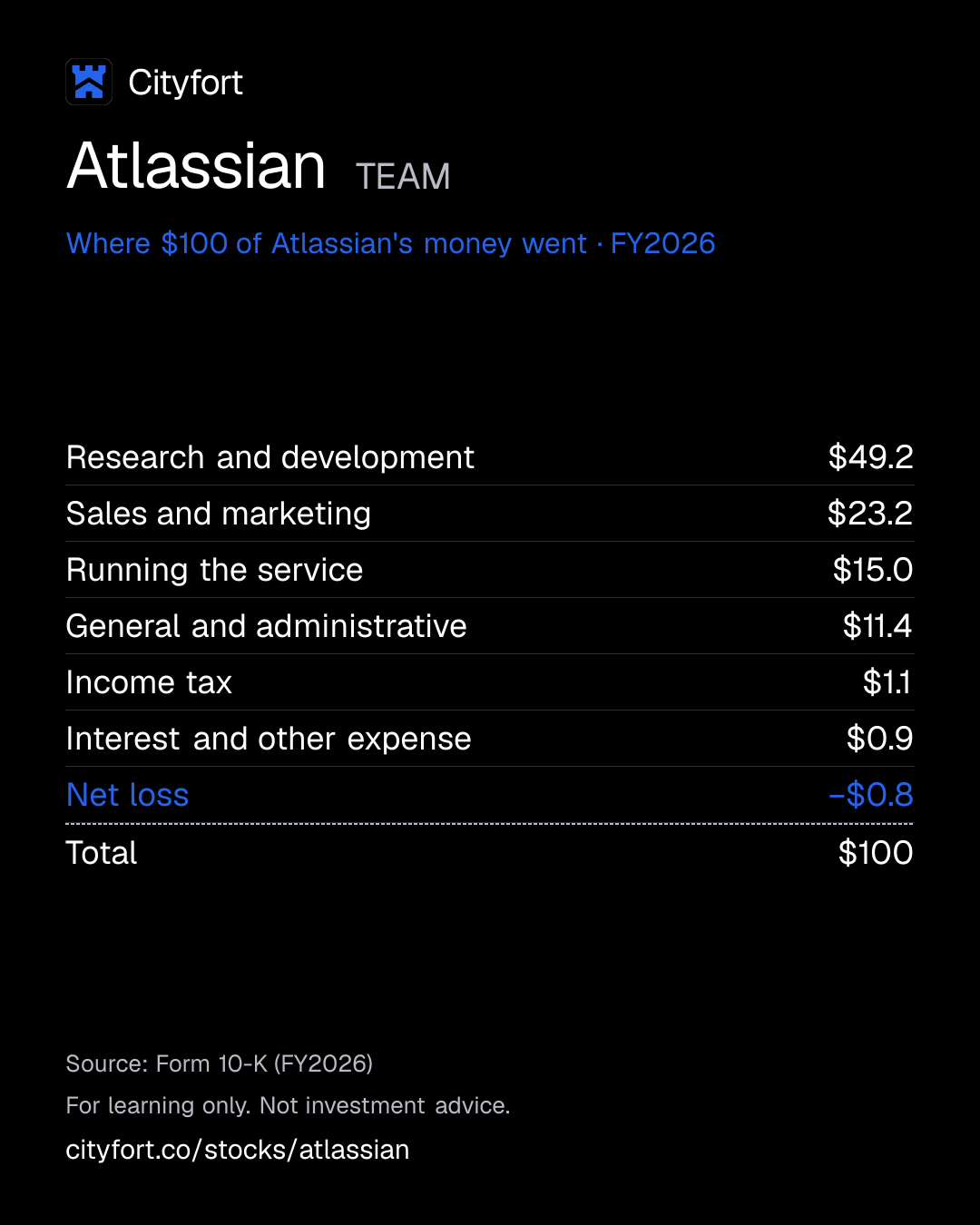
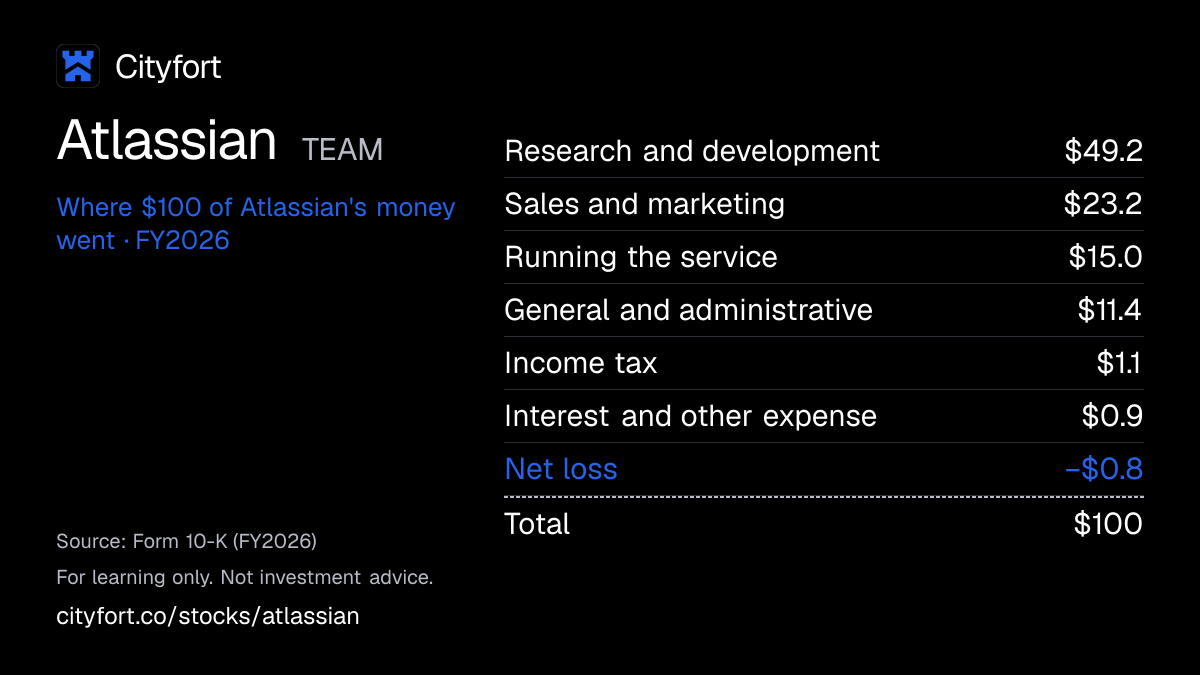
Where does $100 of Atlassian's money go?
Atlassian · FY2026
Receipt for every $100
| Research and development | $49.2 |
|---|---|
| Sales and marketing | $23.2 |
| Running the service | $15.0 |
| General and administrative | $11.4 |
| Income tax | $1.1 |
| Interest and other expense | $0.9 |
| Net loss | −$0.8 |
| Total | $100 |
Each line = amount ÷ total money in × 100. Lines may not add to exactly $100 because of rounding.
How this is worked out
Cityfort calculation from the FY2026 10-K. Each line is per $100 that came in during FY2026 (revenue $6,572.3 million + interest income $69.7 million = $6,642.0 million). Stock-based pay ($1,606.6 million) and restructuring charges ($285.4 million) sit inside the cost lines.
Save this receipt as an image
Embed this receipt or the key numbers
Paste this code into a blog or website to show the card you choose, with a link back to this page.
Each week: the next company due to report earnings, explained in 5 points.
No tips. Unsubscribe anytime.
We'll send a confirmation email. See our privacy policy.
02The business in one line
What does Atlassian do?
Companies pay Atlassian subscriptions for software their teams use to plan and track work; most of the money goes on building that software, and FY2026 ended with a small net loss.
- More than 350,000 customers pay, many buying online without a salesperson. Cloud subscriptions were 67.1% of FY2026 revenue.
- Research and development took $49.2 of every $100 that came in during FY2026. Stock-based pay of $1,606.6 million sits inside the costs.
03Who pays it
Who pays Atlassian?
Teams that buy online
Share of revenue not disclosed
Most new customers try the software and buy it on Atlassian's website without a salesperson, then add users over time.
Large enterprises
Share of revenue not disclosed
A direct sales force and partners sell more seats, Collections and higher editions to the biggest customers. 57,334 customers had more than $10,000 of Cloud annual recurring revenue at Jun 30, 2026.
Data Center customers
27.9%
of revenue
Existing customers that run Atlassian software on their own servers. Data Center was 27.9% of FY2026 revenue; the FY2026 10-K (Aug 14, 2026) says Atlassian plans to end support in Mar 2029.
Marketplace app buyers
5%
of revenue
Customers buying third-party apps through the Atlassian Marketplace; Atlassian keeps a fee. Marketplace and other revenue was 5.0% of FY2026 revenue.
- Data Center customers27.9%
- Marketplace app buyers5%
How spread out the customers are
No single customer was more than 5% of FY2026 revenue. Atlassian had more than 350,000 customers at Jun 30, 2026, including over 85% of the Fortune 500.
04How it makes money
How does Atlassian make money?
Software that costs little to deliver again, with most spending on people
Atlassian kept $84.8 of every $100 of FY2026 revenue after the cost of running its service. Research and development then took $49.7 and sales and marketing $23.4 per $100 of revenue. Much of the pay is in shares ($1,606.6 million in FY2026): a cost in the income statement, but not a cash payment. FY2026 ended with a $53.8 million net loss and $1,319.1 million of free cash flowCash from operations minus spending on buildings and equipment. Learn more.
Gross profit per $100 of revenue
$82.1$84.8
FY2023 to FY2026
- Teams try the software online and buy without a salesperson
- Usage spreads to more teams inside the same company
- The sales force sells larger plans and Collections to big customers
- Subscriptions renew, so most revenue comes from existing customers
- Revenue pays for more product and AI development
↺ Step 5 feeds back into step 1.
05Business segments · FY2026
Which businesses make up Atlassian?
Cloud
67.1%Subscriptions to software Atlassian runs for customers; up 28% in FY2026.
Revenue $4.4B ($4,411M)
Data Center
27.9%Licenses for software customers run on their own servers. The FY2026 10-K (Aug 14, 2026) says Atlassian plans to end support in Mar 2029.
Revenue $1.8B ($1,831M)
Marketplace and other
5%Fees on third-party app sales, plus advisory and training services.
Revenue $331M
How the mix changed
- Cloud
- Data Center
- Marketplace and other
Revenue by segment, FY2023 to FY2026.
US$
See the numbers
06The numbers · Consolidated · US$
How has Atlassian done?
Revenue
$6.6BFY2026
Revenue rose every year, from $2,802.9 million in FY2022 to $6,572.3 million in FY2026, up 26% in FY2026.
US$
See the numbers
Net income
−$53.8MFY2026
Atlassian reported a net loss every year from FY2022 to FY2026, narrowing to $53.8 million in FY2026.
US$
See the numbers
Net income for every $100 of revenue
−$0.8FY2026
Stock-based pay of $1,606.6 million in FY2026, 24.4% of revenue, sits inside the costs behind these margins.
Net margin: $ of net income per $100 of revenue
See the numbers
Free cash flow
$1.3BFY2026
Free cash flow was $1,319.1 million in FY2026, down from $1,415.5 million in FY2025.
US$ · cash from operations minus spending on plants and equipment
See the numbers
See all yearly numbers
EBITDA here = operating income plus depreciation and amortization (from the cash flow statement). Fiscal years are the company's own: Fiscal year runs Jul 1 to Jun 30 (FY2026 ended Jun 30, 2026). Net income is the share belonging to the company's owners.
Learn: Fiscal years that don't end in December: Nvidia's FY2027 explained · Stock-based compensation and dilution: pay that becomes shares
Sources (15)
- Form 10-K for FY2024
- Form 10-K for FY2023
- Form 10-K for FY2025
- Form 10-K for FY2026
- Form 10-Q for Q2 FY2024
- Form 10-Q for Q3 FY2024
- Q4 FY2025 earnings release (8-K Ex. 99.1)
- Form 10-Q for Q1 FY2025
- Form 10-Q for Q2 FY2025
- Form 10-Q for Q3 FY2025
- Form 10-Q for Q1 FY2026
- Form 10-Q for Q2 FY2026
- Form 10-Q for Q3 FY2026
- Q4 FY2026 earnings release (8-K Ex. 99.1)
- Form 10-Q for Q1 FY2027
07Who runs it
Who runs Atlassian, and did they deliver?
Mike Cannon-Brookes
Co-founder and CEO · since 2002
Sole CEO since Aug 31, 2024, when co-CEO Scott Farquhar stepped down. On Aug 6, 2026 Atlassian disclosed his plan to buy up to $250 million of Class A shares under a Rule 10b5-1 planAn insider's trading plan, set up in advance, that buys or sells shares on a schedule. Learn more; this page has not checked whether purchases were made.
Scott Farquhar
Co-founder and director · since 2002
Co-CEO until Aug 31, 2024.
James Chuong
Chief Financial Officer · since 2026
CFO since Mar 2026; from Jul 2021 to Mar 2026 he was CFO of LinkedIn.
Shona L. Brown
Chair of the board (independent)
The board has an independent chair, separate from the CEO role.
Gene Liu
Chief Accounting Officer
What they said, and what happened
3 delivered · 2 too early to tell
Said on Aug 7, 2025
Atlassian said it expected FY2026 revenue growth of about 18.0%.
DeliveredWhat happened
FY2026 revenue rose 26% to $6,572.3 million, as stated in the FY2026 10-K.
Said on Apr 30, 2026
Atlassian said it expected Q4 FY2026 revenue of $1,653–1,661 million.
DeliveredWhat happened
Q4 FY2026 revenue was $1,766.5 million, 6.4% above the top of the range (Cityfort calculation from the Q4 FY2026 earnings release).
Said on Aug 6, 2026
Atlassian said it expected Q1 FY2027 revenue of $1,705–1,715 million.
DeliveredWhat happened
Q1 FY2027 revenue was $1,772.2 million, 3.3% above the top of the range (Cityfort calculation from the Q1 FY2027 10-Q).
Said on Nov 5, 2026
Atlassian said it expects FY2027 revenue growth of about 13.75% and Subscription ARR growth of about 18.5%.
Too early to tellWhat happened
FY2027 ends Jun 30, 2027.
Said on Nov 5, 2026
Atlassian said Rovo will be submitted for FedRAMP Moderate authorization in Atlassian Government Cloud by June 2027.
Too early to tellWhat happened
Not yet reported.
Sources (9)
- Form 10-K for FY2026
- Form 10-K for FY2025
- 8-K filed Aug 6, 2026 (Item 8.01, CEO planned share purchases up to $250 million)
- 2026 proxy statement (DEF 14A)
- Q4 FY2025 earnings release (8-K Ex. 99.1)
- Q3 FY2026 earnings release (8-K Ex. 99.1)
- Q4 FY2026 earnings release (8-K Ex. 99.1)
- Form 10-Q for Q1 FY2027
- Q1 FY2027 earnings release (8-K Ex. 99.1)
08What could go wrong
What could go wrong for Atlassian?
- Execution
Data Center is being retired
Data Center brought in 27.9% of FY2026 revenue, and Atlassian stopped selling it to new customers in Mar 2026. The FY2026 10-K (Aug 14, 2026) says it will stop selling licenses and expansions to existing customers in Mar 2028 and plans to end support in Mar 2029.
Watch Data Center revenue each quarter. In its Q1 FY2027 earnings release (Nov 5, 2026), Atlassian said it expects Data Center revenue to fall about 16% in FY2027.
- Governance
Founders hold most of the votes
Class B shares carry 10 votes each, and entities tied to the two co-founders hold substantially all of them. Class B holders had about 86% of voting power at Jun 30, 2026. The 10-K says they will keep a majority of the votes while Class B is at least 10% of all Class A and Class B shares.
Watch The Class B share count against that 10% threshold (37.4% of all shares on Oct 30, 2026, a Cityfort calculation from the Q1 FY2027 10-Q).
- Competition
AI-native competitors
The 10-K names AI-native companies and startups using generative AI and large language models among its competitors, alongside large technology vendors.
Watch Cloud revenue growth and the customer count above $10,000 of Cloud ARR, which rose 10% in the year to Jun 30, 2026.
- Demand
Revenue depends on renewals
Over 90% of FY2026 revenue came from customer accounts that existed on or before Jun 30, 2025. Subscriptions mostly run for a month or a year, so customers can cut seats or leave at renewal.
Watch Subscription ARR growth: $6,812 million at Sep 30, 2026, up 23% from a year earlier.
- Execution
Integrating recent acquisitions
Atlassian paid $1,228.9 million in cash for acquisitions in FY2026, mainly The Browser Company of New York and DX. Goodwill (the price paid above the value of assets bought) rose to $2,302.7 million from $1,304.4 million.
Watch Any goodwill impairment charge in a 10-Q or 10-K.
- Execution
Staff cuts and leadership changes
On Mar 11, 2026 Atlassian announced cuts of about 10% of its workforce, and its CTO stepped down on Mar 31, 2026. A new CFO joined in Mar 2026; the 10-K names executive turnover and retention as a risk.
Watch Further 8-K filings on executive changes and restructuring charges.
- Other
Large stock-based pay
Stock-based payPay given as shares instead of cash, which spreads ownership more thinly. Learn more was $1,606.6 million in FY2026, 24.4% of revenue. New shares issued to staff add to the share count, while buybacks of $1,800.5 million in FY2026 reduced it.
Watch Stock-based pay as a share of revenue and the Class A share count in each 10-Q.
09Supporters vs. critics
What do supporters and critics point to?
What supporters point to
- Revenue rose every year, from $2,802.9 million in FY2022 to $6,572.3 million in FY2026.
- FY2026 free cash flow was $1,319.1 million, while the income statement showed a $53.8 million net loss.
- Customers with more than $10,000 of Cloud ARR rose to 57,334 at Jun 30, 2026, from 51,978 a year earlier.
- Contracted revenue not yet recognized (RPO) reached $4,817 million at Jun 30, 2026, up 44% in a year.
- Q4 FY2026 and Q1 FY2027 revenue came in above the top of the ranges Atlassian had given.
What critics point to
- Atlassian reported a net loss in every year from FY2022 to FY2026.
- Stock-based pay was $1,606.6 million in FY2026, 24.4% of revenue; the company's adjusted figures leave it out.
- Data Center, 27.9% of FY2026 revenue, is being retired. On Nov 5, 2026 Atlassian said it expects it to fall about 16% in FY2027.
- Class B holders, almost all tied to the two co-founders, had about 86% of the votes at Jun 30, 2026.
- Cash and marketable securities fell to $1,239.5 million at Jun 30, 2026 from $2,937.1 million (Cityfort calculation from the FY2026 10-K), after buybacks and acquisitions.
10What to watch next
What should you watch next at Atlassian?
Next event
Q2 FY2027 results
Date not announced yet.
Data Center revenue
Data Center brought in $1,830.9 million in FY2026. On Nov 5, 2026 Atlassian said it expects Data Center revenue to fall about 16% in FY2027.
Whether quarterly profits continue
Net income was $139.1 million in Q4 FY2026 and $90.7 million in Q1 FY2027, after a net loss in every quarter from Q4 FY2024 to Q3 FY2026.
Stock-based pay against buybacks
Stock-based pay was $1,606.6 million in FY2026 and buybacks $1,800.5 million. Each 10-Q shows the Class A share count.
Recent acquisitions
Goodwill rose to $2,302.7 million at Jun 30, 2026 after the purchases of The Browser Company of New York and DX. A 10-Q or 10-K would show any impairment charge.
11Key facts
Key facts about Atlassian
- What does Atlassian do?
- Atlassian Corporation sells software that teams use to plan, track and share work, including Jira, Confluence and Jira Service Management. Most of its FY2026 revenue (67.1%) came from Cloud, software Atlassian runs for customers over the internet.
- How does Atlassian make money?
- Atlassian earned 95.3% of its FY2026 revenue of $6,572.3 million from subscriptions. Cloud brought in 67.1% of FY2026 revenue, Data Center 27.9% and Marketplace and other 5.0%.
- Who are Atlassian's customers?
- Atlassian had more than 350,000 customers at Jun 30, 2026, including over 85% of the Fortune 500. No single customer was more than 5% of Atlassian's FY2026 revenue.
- How big is Atlassian?
- Atlassian's revenue was $6,572.3 million in FY2026 (the year to Jun 30, 2026), up 26%, with a net loss of $53.8 million. It had 13,301 full-time employees at Jun 30, 2026.
- How did Atlassian do in its latest quarter?
- In Q1 FY2027 (Jul to Sep 2026), Atlassian's revenue was $1,772.2 million, up 24% from $1,432.6 million a year earlier. Atlassian reported net income of $90.7 million for the quarter.
- Who controls Atlassian?
- Entities tied to Atlassian co-founders Mike Cannon-Brookes and Scott Farquhar hold substantially all of its Class B shares, which carry 10 votes each. Class B holders had about 86% of Atlassian's voting power at Jun 30, 2026.
- What is happening to Atlassian Data Center?
- Atlassian Data Center, software customers run on their own servers, was 27.9% of FY2026 revenue. Atlassian stopped selling it to new customers in Mar 2026, and its FY2026 10-K says it plans to end support in Mar 2029.
- Does Atlassian pay a dividend?
- Atlassian paid no dividends in FY2026. It repurchased $1,800.5 million of its Class A stock in FY2026.
- Where is Atlassian from?
- Atlassian was founded in Sydney, Australia, in 2002 by Mike Cannon-Brookes and Scott Farquhar. Since Sep 30, 2022 its listed parent has been Atlassian Corporation, a Delaware company traded on Nasdaq as TEAM.
Terms on this page
- Annual recurring revenue (ARR)
- Capital expenditures (capex)
- Debt-to-equity
- Earnings per share (EPS)
- EBITDA
- Free cash flow
- Net debt
- Net margin
- Remaining performance obligations (RPO)
- Revenue vs net income
Each explains the term in plain English, with the same number from other companies on Cityfort.
Go deeper
More detail from the same filings. Open any section.
12What it sells
12What it sells
What does Atlassian sell?
Jira
Project tracking: teams list tasks, assign them and follow progress. Built for software teams, it is also used by thousands of business teams.
Confluence
A shared online workspace where teams write, organize and share documents and know-how.
Jira Service Management
Help-desk software for IT, HR and other teams that handle requests. It is part of the Service Collection, which adds customer support.
Loom
Recorded video messages for teams; Atlassian bought Loom, Inc. on Nov 30, 2023.
Rovo
Atlassian's AI offering: search, chat and AI agents that do tasks, drawing on a customer's own work data (the "Teamwork Graph").
Bitbucket and DX
Tools for software engineers: Bitbucket stores code, and DX measures engineering teams' work. DX was bought on Nov 10, 2025.
Collections
Bundles of apps and agents sold together. The Teamwork Collection, for example, combines Jira, Confluence, Loom and Rovo.
Atlassian Marketplace
An online store with more than 6,000 third-party apps and integrations. Atlassian earns fees on the apps sold there.
Think of it like this
Like a shared to-do list and filing cabinet for a whole company, rented online and paid for by the number of users.
What it does
- Does: Sells subscriptions to software it runs in its own Cloud, used through a web browser
- Does: Sells Data Center licenses to existing customers who run the software on their own servers
- Does: Runs a marketplace where other developers sell add-on apps
What it does not do
- Does not: Does not sell Data Center products to new customers (since Mar 2026)
- Does not: No longer supports its older Server products (support generally ended in Feb 2024)
- Does not: Does not depend on one large customer: none was more than 5% of FY2026 revenue
13How the money flows
13How the money flows · FY2026
How does money flow through Atlassian?
Money in
- Revenue from customers$6.6B
- Interest income$69.7M
The company
Atlassian
$6.6B came in
Money out
- Research and development$3.3B
- Sales and marketing$1.5B
- Running the service (cost of revenue)$997M
- General and administrative$755M
- Interest and other expense$58M
- Income tax$75.9M
- Net loss−$53.8M
- In FY2026, customers paid Atlassian $6,572.3 million, 95.3% of it for subscriptions.
- Atlassian also earned $69.7 million of interest on its cash.
- Building and improving products (research and development) took $3,269.3 million, the largest cost.
- Sales and marketing took $1,541.2 million and running the service $996.8 million.
- After $754.7 million of administration costs, interest and $75.9 million of tax, the year ended with a $53.8 million net loss.
Sources (1)
14What it needs to run
14What it needs to run
What does Atlassian need to run?
Software engineers
Atlassian had 13,301 full-time employees at Jun 30, 2026, and over half worked in research and development.
AI models
Rovo and other AI features route work across several outside AI models through Atlassian's "AI Gateway".
Outside developers
Third-party developers build the more than 6,000 apps and integrations in the Atlassian Marketplace.
Customer work data
The Teamwork Graph links each customer's goals, documents, teams and tasks; the 10-K says AI agents need this context to work well.
Sources (1)
15Where it sells
15Where it sells · FY2026
Where does Atlassian sell?
- Americas48.2%
- Europe, Middle East and Africa41%
- Asia Pacific10.9%
Sources (1)
16Where growth could come from
16Where growth could come from
Where could Atlassian's growth come from?
On Nov 5, 2026, Atlassian said it expects FY2027 revenue growth of about 13.75% and Subscription ARR growth of about 18.5%. It expects Cloud revenue up about 26% and Data Center revenue down about 16%, with a GAAP operating margin of about 5.0%.
Customers moving to Cloud
WorkingCloud revenue +28%, FY2026
Cloud revenue reached $4,410.6 million in FY2026, 67.1% of revenue, up from 59.0% in FY2023.
Status: Working, on track against what the company said.
Bigger customers
Working57,334 customers above $10,000 Cloud ARR
The count at Jun 30, 2026 was up from 51,978 a year earlier. The 10-K says these customers make up the majority of Cloud revenue.
Status: Working, on track against what the company said.
Contracted revenue
WorkingRPO $4,817 million, Jun 30, 2026
Remaining performance obligationsSigned contracts with customers that have not been billed yet. (revenue already contracted but not yet recognized) were up 44% from a year earlier.
Status: Working, on track against what the company said.
Collections and AI
EarlyService Collection ARR over $1 billion
The Nov 5, 2026 release said the Service Collection passed $1 billion of ARR, growing over 30%, and Teamwork Collection customers rose 7x in a year.
Status: Early, too early to judge.
Acquisitions
New$1,208.7 million for two companies
Atlassian bought The Browser Company of New York ($488.3 million, Oct 20, 2025) and DX ($720.4 million, Nov 10, 2025). The total is a Cityfort calculation from the FY2026 10-K.
Status: New, recently announced.
Status compares progress with what the company itself said it would do: Working = on track against what the company said; Mixed = partly on track; Behind = behind the company's own plan; New = recently announced; Early = too early to judge.
17The company's own measures (non-GAAP)
17The company's own measures · FY2026 and Jun 30, 2026
What do Atlassian's own measures show?
Official (GAAP): Operating income, FY2026
$10.4M
Company's own measure: Non-GAAP operating income, FY2026
$2.0B
Atlassian leaves out stock-based pay ($1,605.1 million), amortization of acquired intangibles ($101.5 million) and restructuring charges ($279.5 million).
Official (GAAP): Net loss, FY2026
−$53.8M
Company's own measure: Non-GAAP net income, FY2026
$1.5B
Same exclusions as operating income, less $406.1 million of income tax adjustments.
Official (GAAP): Diluted EPS, FY2026 (US$)
−$0.2M
Company's own measure: Non-GAAP diluted EPS, FY2026 (US$)
$5.9M
Per share, stock-based pay added $6.16 back to GAAP EPS.
Official (GAAP): Remaining performance obligations, Jun 30, 2026
$4.8B
Company's own measure: Subscription ARR, Jun 30, 2026
$6.6B
ARR is the annualized value of active Cloud and Data Center subscriptions at a point in time, excluding one-time fees (company definition). RPO is contracted revenue not yet recognized. The two are measured differently and are not added together.
These are the company's own measures, defined by the company. They are not comparable across companies, and they are not added together. Each sits beside the nearest official (GAAP) figure.
Learn: Non-GAAP measures: what a company's "adjusted" numbers leave out · Stock-based compensation and dilution: pay that becomes shares
18Financial strength and debt
18Financial strength · Jun 30, 2026
How much debt does Atlassian have?
- Total debt$990M
- Cash and investments$1.2B
- Net cash (cash minus debt)$250M
- Net worth (shareholders' money)$1.1B
- Debt to equity
- 0.93×
- $ of debt for every $1 of shareholders' money
- Debt is two $500 million bond issues: 5.250% notes due May 15, 2029 and 5.500% notes due May 15, 2034.
- A $750 million revolving credit facility was undrawn; operating lease liabilities of $243.4 million are not counted as debt here.
- Cash and marketable securities fell from $2,937.1 million a year earlier, after $1,800.5 million of share repurchases and $1,228.9 million paid for acquisitions in FY2026 (Cityfort calculation from the FY2026 10-K).
Sources (1)
19Who owns it
19Who owns it · ownership as of Sep 30, 2026
Who owns Atlassian?
- Officers and directors (as a group), shares
- 37.6%
- Officers and directors (as a group), votes
- 85.7%
Shares vs votes by class
Atlassian has more than one class of shares, and the classes carry different votes. The share of votes a class holds can differ a lot from its share of the shares.
- Class A common stock: share of all votes14.4%
- Class B common stock: share of all votes85.6%
Each class's part of all votes = its shares outstanding × votes per share ÷ the total for all classes.
Share classes
Holders of 5% or more
From the company's proxy statement (DEF 14A), later Schedule 13G filings and the share counts on its latest annual or quarterly report. Each holder row shows the date of its own filing.
Learn: Dual-class shares: when votes and ownership don't match · How to read a proxy statement (DEF 14A): Nvidia's 2026 proxy · Form 4 insider filings: who files, the codes and the footnotes
20What it does with profit
20What it does with profit
What does Atlassian do with its profit?
Buyback · Jun 30, 2024
Repurchased $395.3 million of Class A stock in FY2024.
$395M
Buyback · Jun 30, 2025
Repurchased $779.4 million of Class A stock in FY2025.
$779M
Buyback · Jun 30, 2026
Repurchased about 19.1 million Class A shares for about $1.8 billion in FY2026, at an average of $94.31 a share.
$1.8B
Buyback · Sep 30, 2026
Repurchased about 3.3 million Class A shares for about $581.4 million in Q1 FY2027, at an average of $174.10; $1.3 billion of the $2.5 billion 2025 program remained.
$581M
21Governance signals
21Governance signals
What do Atlassian's governance filings show?
- Auditor
- Ernst & Young LLP, since 2012
- Auditor changes
- None in the period covered
- Audit qualifications
- None reported
- Related-party dealings
- In FY2026 Atlassian paid about $2.8 million for business travel on a private aircraft indirectly and wholly owned by CEO Mike Cannon-Brookes, under a charter arrangement with an independent operator. The audit committee authorized it. The proxy also lists indemnification agreements with directors and officers.
- Credit rating
- Not checked for this page
22How it got here
22How it got here
How did Atlassian get here?
2002
Milestone
Founded in Sydney
Mike Cannon-Brookes and Scott Farquhar founded Atlassian in Sydney, Australia.
2022
Business-model change
Became a US company
On Sep 30, 2022 a redomestication made Atlassian Corporation, a Delaware company, the listed parent in place of the UK-incorporated Atlassian Corporation Plc.
2023
Crisis
First job cuts
On Mar 6, 2023 Atlassian announced a rebalancing that removed about 500 roles, about 5% of its workforce.
2023
Milestone
Bought Loom
Atlassian completed its purchase of the video-messaging company Loom on Nov 30, 2023, for about $885.6 million.
2024
Business-model change
Server support ended
Atlassian generally ended maintenance and support for its Server products in Feb 2024; Server revenue was nil in FY2025.
2025
Business-model change
Data Center end of life announced
In Sep 2025 Atlassian announced plans to retire Data Center, its self-managed product, with support planned to end in Mar 2029.
2025
Milestone
Two AI-era acquisitions
It bought The Browser Company of New York (Oct 20, 2025, $488.3 million) and DX (Nov 10, 2025, $720.4 million).
2026
Crisis
About 10% of staff cut
On Mar 11, 2026 Atlassian announced a restructuring affecting about 10% of its workforce, to shift spending toward AI and enterprise sales.
23Sources and changes
Where every number on this page comes from
Sources (24 documents)
- S1Form 10-Q for Q1 FY2027 · SEC EDGAR · Tier 1: company or exchange filing · Nov 6, 2026
- S2Form 10-K for FY2026 · SEC EDGAR · Tier 1: company or exchange filing · Aug 14, 2026
- S3Form 10-Q for Q3 FY2026 · SEC EDGAR · Tier 1: company or exchange filing · May 1, 2026
- S4Form 10-Q for Q2 FY2026 · SEC EDGAR · Tier 1: company or exchange filing · Feb 6, 2026
- S5Form 10-Q for Q1 FY2026 · SEC EDGAR · Tier 1: company or exchange filing · Oct 31, 2025
- S6Form 10-K for FY2025 · SEC EDGAR · Tier 1: company or exchange filing · Aug 15, 2025
- S7Form 10-Q for Q3 FY2025 · SEC EDGAR · Tier 1: company or exchange filing · May 2, 2025
- S8Form 10-Q for Q2 FY2025 · SEC EDGAR · Tier 1: company or exchange filing · Jan 31, 2025
- S9Form 10-Q for Q1 FY2025 · SEC EDGAR · Tier 1: company or exchange filing · Nov 1, 2024
- S10Form 10-K for FY2024 · SEC EDGAR · Tier 1: company or exchange filing · Aug 16, 2024
- S11Form 10-Q for Q3 FY2024 · SEC EDGAR · Tier 1: company or exchange filing · Apr 26, 2024
- S12Form 10-Q for Q2 FY2024 · SEC EDGAR · Tier 1: company or exchange filing · Feb 2, 2024
- S13Form 10-K for FY2023 · SEC EDGAR · Tier 1: company or exchange filing · Aug 18, 2023
- S142026 proxy statement (DEF 14A) · SEC EDGAR · Tier 1: company or exchange filing · Oct 14, 2026
- S15Q1 FY2027 earnings release (8-K Ex. 99.1) · SEC EDGAR · Tier 1: company or exchange filing · Nov 5, 2026
- S16Q4 FY2026 earnings release (8-K Ex. 99.1) · SEC EDGAR · Tier 1: company or exchange filing · Aug 6, 2026
- S17Q3 FY2026 earnings release (8-K Ex. 99.1) · SEC EDGAR · Tier 1: company or exchange filing · Apr 30, 2026
- S20Q4 FY2025 earnings release (8-K Ex. 99.1) · SEC EDGAR · Tier 1: company or exchange filing · Aug 7, 2025
- S248-K filed Mar 11, 2026 (Item 2.05 restructuring, about 10% of workforce) · SEC EDGAR · Tier 1: company or exchange filing · Mar 11, 2026
- S258-K filed Aug 6, 2026 (Item 8.01, CEO planned share purchases up to $250 million) · SEC EDGAR · Tier 1: company or exchange filing · Aug 6, 2026
- S268-K filed Sep 8, 2025 (Item 7.01, Data Center end-of-life) · SEC EDGAR · Tier 1: company or exchange filing · Sep 8, 2025
- S278-K filed Sep 4, 2025 (Item 7.01, The Browser Company merger agreement) · SEC EDGAR · Tier 1: company or exchange filing · Sep 4, 2025
- S28Schedule 13G/A, Mike Cannon-Brookes · SEC EDGAR · Tier 1: company or exchange filing · May 15, 2026
- S29Schedule 13G/A, Scott Farquhar · SEC EDGAR · Tier 1: company or exchange filing · May 15, 2026
Changes to this page (v1 · Nov 20, 2026)
- v1 · Nov 20, 2026First version. (first version)
Numbers come only from tier 1 and tier 2 sources. Read how we research.
Disclaimer
For learning only. Cityfort is not a registered investment adviser or broker-dealer and does not recommend buying or selling any security. Prices shown are dated and may be out of date.
Investing in securities involves risk, including loss of capital. Before making any investment decision, do your own research and consider consulting a registered investment adviser or other qualified professional.
Cityfort, its owners and contributors may or may not hold securities of companies covered. Cityfort is not paid by any company it covers. Content is not an offer or solicitation to buy or sell any security, including in any initial public offering.
Read the positions policyRead the full disclaimerHide the full disclaimer
Cityfort publishes general educational content that explains how listed companies work. Cityfort is not registered with the US Securities and Exchange Commission or any state securities regulator as an investment adviser, and is not a broker-dealer or a member of FINRA. Cityfort does not provide investment, tax or legal advice, recommendations, ratings, price targets or any opinion on whether to buy, sell or hold any security. Nothing on the site is tailored to any person's circumstances.
All information is taken from publicly available sources, mainly company filings with the SEC, which are listed on each page with dates. We work to keep it accurate and correct errors publicly, but we do not guarantee that it is complete, accurate or up to date. Any market price or price-based ratio shown is dated, may be out of date by the time you read it, and is included only to explain concepts.
Statements by company management, including forward-looking statements and guidance, are reported as the company's statements, with their date and source; they are not our forecasts. Adjusted (non-GAAP) figures are the company's own measures and are shown next to the official (GAAP) figures.